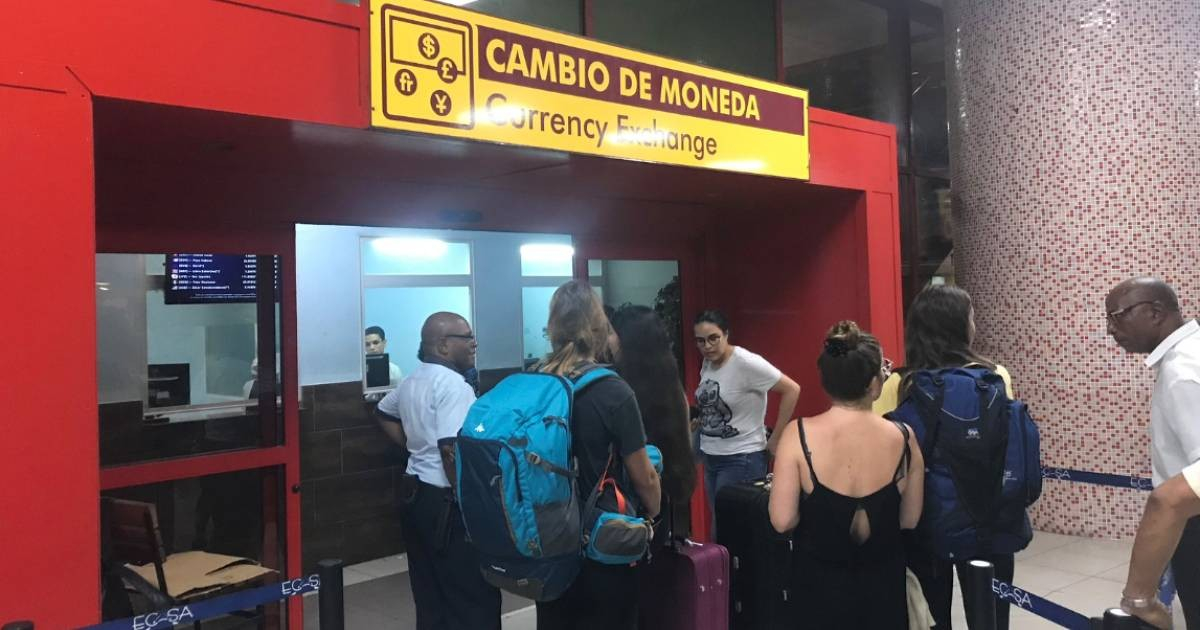
Prime Minister Manuel Marrero Cruz announced on Wednesday before the National Assembly of People's Power that the first private currency exchange in Cuba is ready to operate as a pilot project, following the approval of the regulatory framework that authorizes this type of entity under a license from the Central Bank of Cuba.
The immediate reaction on social media was not one of celebration, but rather of widespread skepticism: dozens of Cubans ironically questioned, through the social media of CiberCuba, who that entity really belonged to.
"Whose is it? The Machi's, the Crab's, or Marrero's sister's?" wrote a user on Facebook.
Another comment was straight to the point: "Private, is it from the Central Bank?".
A third person summed it up with a rhetorical question: “Who’s going to believe it’s private? No words. If it were an ice cream factory, a pizzeria, I would understand, but a currency exchange?”
Distrust has a clear precedent: since the regime authorized small and medium enterprises (mipymes) in 2021, there has been a persistent public suspicion that some operate as fronts for officials or their relatives. One comment put it bluntly: "Like the mipymes, whose will they be?"
Other users pointed directly at the nomenclature: "Guess, guesser, who will be the owner? How creative of the gentleman!" wrote one. Another stated: "Lower the curtain and raise the curtain."
The criticism also pointed out the lack of concrete information. Marrero did not specify the name of the entity, its owners, its location, the rates it will apply, or the exact start date of operations. "What a lot of talk without saying where or how much," summarized a user.
In his address to the deputies gathered at the Palace of Conventions in Havana, Marrero stated: "The regulatory framework for the authorization of private exchange houses, under a license from the Central Bank of Cuba, has been approved. The first private exchange house is ready to begin operations as a pilot project."
The announcement is part of the package of 176 economic transformations approved on June 18 during an extraordinary session of the National Assembly, which also includes the authorization of private banking, private remittance operators, and a real-time digital exchange market.
The context in which the announcement arrives intensifies public skepticism. The dollar was quoting around 673 Cuban pesos on the informal market this Wednesday, compared to an official rate of Segment III of 601 CUP, after having reached a peak of 695 CUP in June.
This gap has fueled a parallel market for converting bank transfers into cash with informal commissions of up to 40% in cities like Santiago de Cuba, where the National Revolutionary Police detained individuals in May who charged between 35% and 50% for that service.
Marrero acknowledged the seriousness of the cash problem and warned that "there must be more demands, more confrontation, and measures in line with the gravity of this issue," referring to those who charge commissions for accepting transfers or require high-denomination bills.
He also admitted that the process now enters its stage of "greatest importance and difficulty": ensuring the effective implementation of the measures, evaluating their real impacts, and correcting deviations that arise in a timely manner, a warning that, for many Cubans on social media, sounded more like an acknowledgment of past failures than a promise of real change.
Related videos:
Filed under: