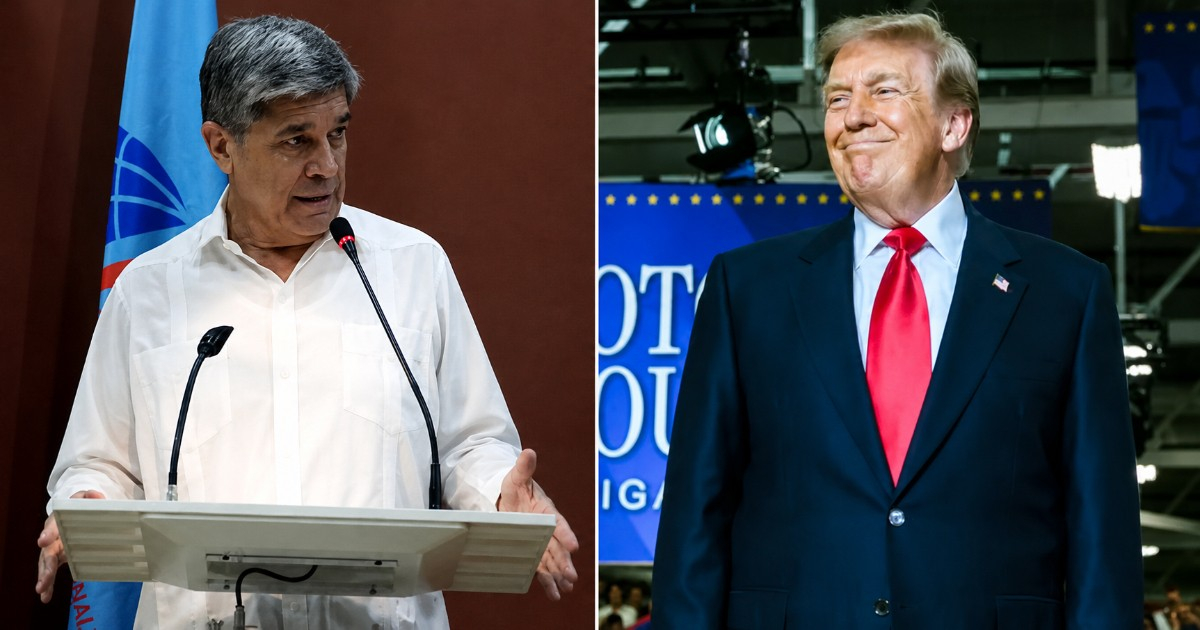
The Deputy Minister of Foreign Affairs of Cuba, Carlos Fernández de Cossío, stated to the New York Times that the regime does not exclude President Donald Trump or his organization from doing business on the island.
The interview, published on Thursday from Havana, illustrates starkly the contradiction between the ideological discourse of the Cuban government and its economic desperation.
"If he wants to do it peacefully, we see no specific reason to exclude him." Fernández de Cossío stated when directly asked about the possibility of Trump investing in Cuba.
The same official who in January 2025 compared Trump's foreign policy to Hitler's fascism and who in May 2026 described the US administration as "criminal", is now extending a hand as a potential investor through the pages of the New York newspaper.
The interview was conducted by Jack Nicas, head of the Times bureau in Mexico City, who traveled to Havana on a journalism visa described as "extremely unusual" granted to the newspaper.
Regarding the project known as "Trump Island" —a luxury resort that an Emirati developer is planning on Cayo Santa María and that could carry the Trump brand— Fernández de Cossío did not rule it out.
"If someone comes and says they have connections with important business people in the United States, we are ready to talk. If it's with the Trump administration, in principle, there is no reason for us to say no," stated the diplomat.
The Deputy Minister was explicit about where the real obstacle lies: "What prohibits Donald Trump from investing in Cuba are U.S. laws. We do not exclude him or his organization from doing business in Cuba, as long as they comply with Cuban laws".
This investor opening occurs at the worst economic moment for the regime in decades. As the NYT noted, the electrical grid collapsed three times in eight days during July 2026, tourism has plummeted, and, with the exception of a single Russian oil tanker that arrived in March, no ally has defied Trump's order not to send fuel to the island.
The coercive arm of the United States has proven to be very successful. Telling a European, Latin American, or Asian company that it cannot export its national resources to Cuba is a new world order," acknowledged Fernández de Cossío.
The regime's strategy to cope with the pressure, according to the vice chancellor himself, involves economic reforms: "We introduced some changes in our economy a few weeks ago. We believe they can allow us to confront this situation."
In June 2026, the regime approved a package of 176 measures to ease foreign investment, and in July it published decree 153/2026, which modifies the Foreign Investment Law of 2014.
But in the same interview where he opened the business file, Fernández de Cossío did not abandon the rhetoric of resistance: “If this leads to a military action against Cuba, we will suffer thousands of deaths. There will probably be a bloodbath in Cuba. There will also be deaths of young Americans.”
The White House and the State Department, for their part, classified Cuba as a threat to national security, accusing it of harboring terrorists and selling fuel to enrich elites instead of maintaining its power grid. Both sides acknowledge that their discussions have made little progress.
Fernández de Cossío himself acknowledged four days before the interview that the pressures from Washington are "extremely hostile" and that Cuba will not accept conditions that imply changes to its political system, which did not prevent him from offering Trump a spot on the island's investment map 72 hours later.
Related videos:
Filed under: