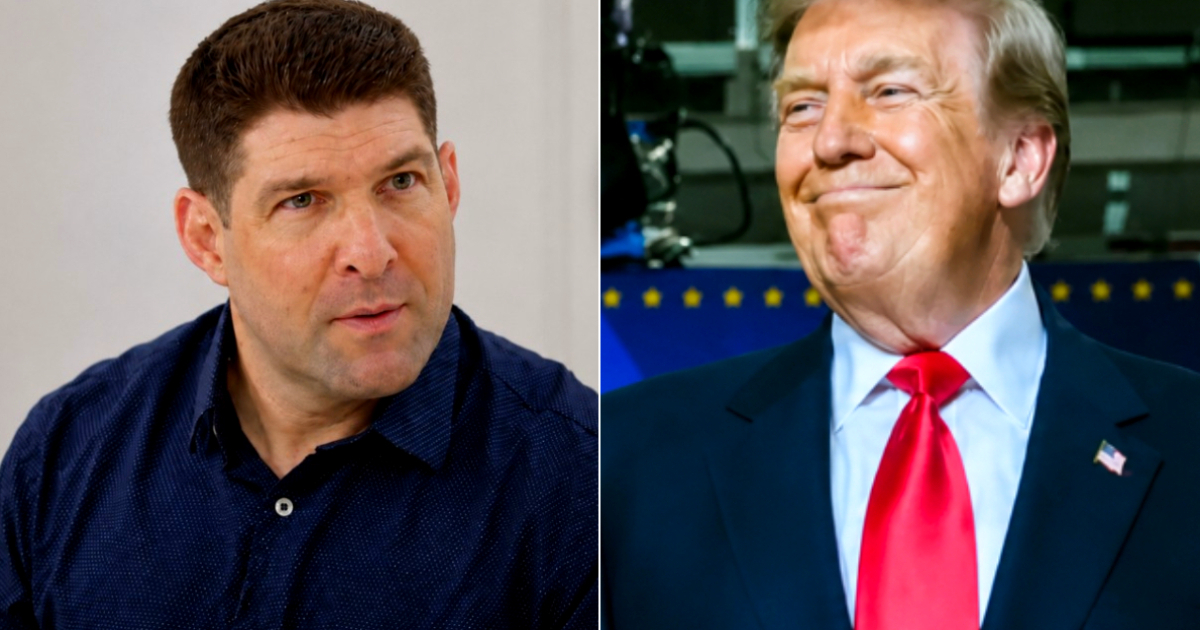
The proposal from a businessman in the United Arab Emirates to develop a luxury resort in Cayo Santa María, which could one day be named "Trump Island," has once again become the focus of discussion.
The catalyst was the statement made by Cuba's Deputy Minister of Foreign Affairs, Carlos Fernández de Cossío, who told the New York Times that the regime would not exclude Donald Trump or his organization from doing business on the island.
On its own, the initiative is nothing more than a private project without confirmed involvement from the Trump Organization. However, when placed alongside other events that have occurred in recent months, questions arise that, at least for now, remain unanswered.
A project that does not belong to Trump
The origin of the story lies in a report published in June by the Emirati newspaper The National.
The media revealed that businessman Ali Abdullah Bin Haidar, president of the Abdulla Ali Bin Haidar Group, signed a letter of intent with the Cuban government to develop a large tourist complex in Cayo Santa María.
According to the documentation consulted by the newspaper, the resort could be named "Trump Island" only if the Trump Organization agreed to participate in the project.
The report itself clarifies that this participation does not exist. There is no authorization to use the Trump brand, nor is there a commercial agreement with the U.S. president's company.
The name appears simply as an option considered in the proposal presented by the Emirati developer.
The regime's response
The story took a new turn when the New York Times directly asked Carlos Fernández de Cossío about those reports.
The Deputy Foreign Minister responded that the Cuban government was not considering a specific project of that nature. However, he immediately left the door open for a potential investment from Donald Trump himself.
If he wants to do it peacefully, we see no specific reason to exclude him, he stated.
He further added that the real obstacle was not Cuba, but rather U.S. legislation. "What prevents Donald Trump from investing in Cuba are U.S. laws. We do not exclude him or his organization from doing business in Cuba, as long as it is done in compliance with Cuban laws,” he stated.
The official's words represent one of the most explicit messages sent so far by the regime regarding the possibility of Trump or his company investing in the island.
Why the Emirates?
Beyond the project itself, there is another element that stands out.
The initiative did not come from a Spanish, Canadian, or European hotel group, which are typical investors in Cuban tourism. It originated from a businessman from the United Arab Emirates.
And it was precisely an Emirati medium, The National, that revealed the story.
That same outlet had interviewed shortly before in the Emirates Raúl Guillermo Rodríguez Castro, known as "El Cangrejo," the grandson of Raúl Castro and considered one of the most influential figures within the Cuban power structure.
Rodríguez Castro did not travel alone. He was accompanied by the Deputy Minister of Foreign Trade and Foreign Investment, Carlos Méndez, on a visit specifically focused on economic opportunities and attracting foreign capital.
There is no public evidence that the visit was related to the Cayo Santa María project. However, the temporal and thematic coincidence is striking.
The background of the contacts with Trump
Another episode, known months earlier, is added to that sequence.
Various news reports, including one published by The Wall Street Journal, indicated that Rodríguez Castro attempted to send a letter directly to President Donald Trump using an unofficial channel.
According to that information, the messenger was intercepted by U.S. authorities at Miami airport and sent back to Cuba.
The reports also indicated that the letter addressed, among other issues, possible economic agreements and investments.
These events were never officially confirmed by Havana, but they did fuel theories about an attempt by the Cuban power structure to establish direct communication with Trump outside of traditional diplomatic channels.
A context that invites one to ask questions
Individually, each of these events can be explained independently.
An Emirati businessman proposes a major tourism project. The Cuban regime is desperately seeking foreign investment amidst the worst economic crisis in decades, but above all, it seeks the appeasement of Trump, who has made a series of fiery statements about Cuba.
Fernández de Cossío states that Trump would not be banned as an investor.
And various reports indicate that El Cangrejo is attempting to open a channel of communication with the U.S. president.
"I can negotiate with anyone designated by the U.S. If given the opportunity, of course, with Trump," he said in his first interview with a U.S. media outlet, granted to .
However, when viewed together, the facts outline a sequence that deserves attention.
Why did the proposal arise precisely in the United Arab Emirates, a country whose major developers have maintained close business relationships with the Trump Organization for years?
Why did The National go from interviewing one of the most influential figures in Raúl Castro's circle to publishing an exclusive about a project designed to attract Donald Trump's company within just a few weeks?
Was "Trump Island" merely a business venture by a businessman from Dubai who saw a business opportunity in Cuba?
Or did it coincide with a moment when different actors within the regime were exploring ways to approach the U.S. president directly through economic incentives?
The available public information does not allow for a positive response to any of those questions. However, it does not prevent us from raising them.
For now, the only thing proven is that an Emirati businessman proposed a tourism project that aimed to attract the Trump Organization, that a high-ranking Cuban official publicly stated that Trump would be welcomed as an investor and that, in parallel, reports circulated regarding attempts by the real center of power in Cuba to establish direct communication with the President of the United States.
It may just be a series of coincidences.
Or perhaps, over time, new pieces will allow us to better understand an episode that, seen in perspective, appears much more complex than what a simple story about a resort provisionally named "Trump Island" would suggest.
Related videos:
Filed under: