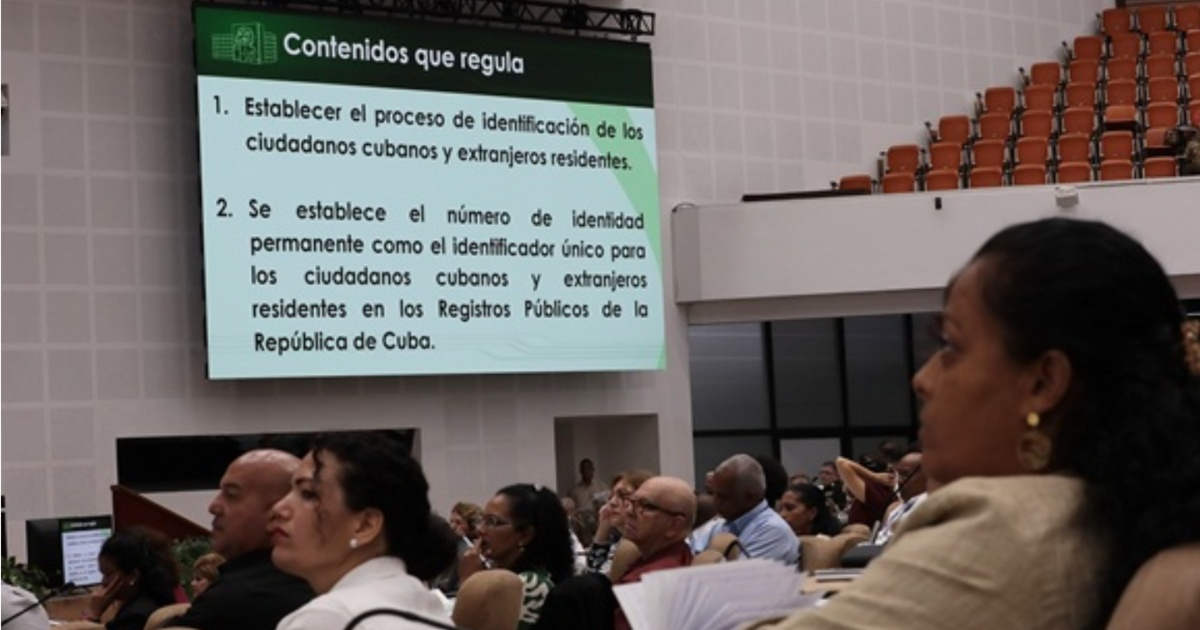
The National Assembly of People's Power approved this Thursday the Law of the Personal Identity and Residence System, which replaces the legislation in effect since 2007 and introduces significant changes in how the Cuban state records, identifies, and controls its citizens.
The new law replaces Decree-Law 248 of 2007 —a text consisting of only nine articles— with a legal framework of 60 articles, accompanied by regulations containing more than 60 additional articles.
According to the official media Cubadebate, the project was presented to the deputies by Colonel Mario Méndez Mayedo, head of the Identification, Immigration, and Foreign Affairs Directorate of the Ministry of the Interior (MININT), who stated that the regulation "addresses the need to develop the constitutional principles related to personal identity and residence."
Approximately a quarter of the included content consists of new elements or those that previously lacked specific legal support.
The main changes
One of the central aspects of the regulation is the creation of the Personal Identity and Address Authority, a function that until now operated under the MININT processing authority without formal legislative backing.
The law also establishes a unique, permanent, and unrepeatable identifier for every Cuban citizen and resident foreigner, linked not only to the identity document but also to the processes of the national public registry.
For the first time, digital identity is defined in legal terms as "the unique, verifiable, and electronic representation of a natural person, securely linked to their physical identity, which will allow for authentication and the completion of digital procedures."
The biometric catalog is expanding to include facial photographs, fingerprints, voice, iris, skin color, eye color, and height, under the leadership of the Directorate of Identification, Migration, Foreigners, and Citizenship (DIMEC) of MININT.
The home as a tool of control
The law legally defines domicile as "the principal residence of a natural person, the center of their legal relations, the place where they habitually reside or intend to settle," and imposes on citizens the obligation to keep that registration updated with the state authority.
To determine a person's domicile, the authority will take into account "the physical presence in the place and evidence of their intention to establish stable living conditions," a formulation that grants the state considerable discretion.
This regulation has generated doubts among Cuban emigrants, as the text does not specify what will happen to those who live permanently abroad but maintain a registered address in Cuba.
The scope of the regulation is extraordinarily broad: it applies to Cuban citizens both inside and outside the country, foreign residents, state bodies, businesses, self-employed workers, cooperatives, political and mass organizations, as well as Cuban diplomatic representations abroad.
Critiques: "surveillance disguised as a civil procedure"
The human rights organization Cubalex warned that the regulation constitutes “a surveillance infrastructure disguised as a civil procedure”, as it concentrates registered identity, biometrics, and address under a single state system without clear safeguards against the use of data for social control purposes.
The context in which this law is approved is significant: in August 2025, a 67-year-old man passed away in front of the MININT Processing Unit in Santiago de Cuba while waiting for his turn to renew his identity card, highlighting the precarious conditions of the system that the new law aims to modernize.
The approval occurred in the same parliamentary session in which the regime also greenlighted a new Housing Law and a new Labor Code, and ratified the reduction from 27 to 21 ministries.
According to the state media Cubadebate, the law is expected to come into effect within a period of three months after its approval.
Related videos:
Filed under: