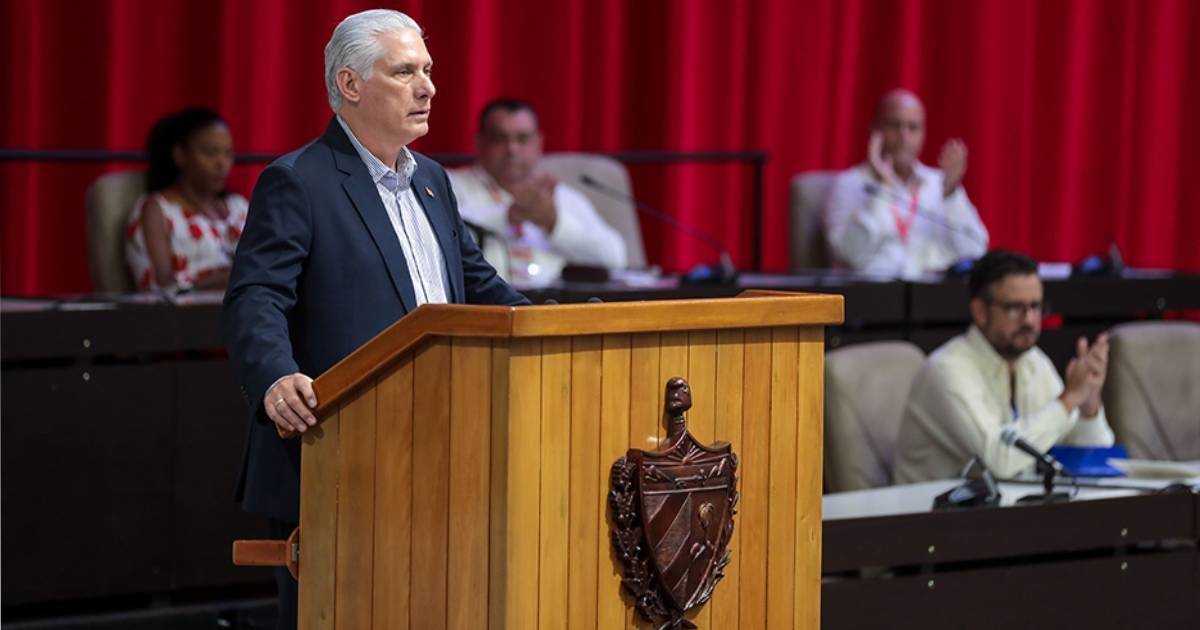
Miguel Díaz-Canel affirmed this Thursday that "for a revolutionary, there is no rest, neither in action nor in the dreams that inspire action," while concluding the VII Ordinary Period of Sessions of the X Legislature of the National Assembly of People's Power with a tribute to the late commander Ramiro Valdés Menéndez, whom he presented as an example of the commitment that, in his opinion, the leaders of the Revolution must uphold.
According to the official media Cubadebate, the leader used the figure of Valdés —who passed away on June 21 at the age of 94— as a thread to weave a speech in which he also defended the economic reforms promoted by the regime and again criticized the United States' policy towards Cuba.
Valdés, regarded as one of the historic commanders of the Revolution, was the only deputy to serve in all the legislatures of the National Assembly since its inception in 1976. Díaz-Canel placed him alongside Fidel Castro, Raúl Castro, Ernesto "Che" Guevara, and Juan Almeida Bosque as part of the so-called "centennial generation."
"It confirms to us that for a revolutionary, there is no rest, neither in action nor in the dreams that inspire action," he stated.
The leader stated that he preferred not to speak of Valdés in the past because his legacy, he said, remains present "in the face of the colossal challenges currently at hand."
From that tribute, Díaz-Canel defended the economic transformation process approved by the Government. He reiterated that the 176 measures announced in June do not seek “more capitalism,” but rather to strengthen socialism, although he acknowledged that there is concern among the population regarding the growth of the private sector, the concentration of wealth, a possible privatization of state-owned enterprises, and the increase in inequalities.
It also reported that 120 of those measures are already ready to begin implementation and highlighted the approval of new laws, including the Labor Code, the Housing Law, and the Agricultural and Forestry Land Law.
In the international arena, the leader once again accused the United States of tightening the economic blockade against the island and called the U.S. government a "neofascist regime," while denouncing the sanctions directed at countries, businesses, and individuals that maintain trade relations with Cuba.
Díaz-Canel concluded his remarks by recalling the upcoming centenary of Fidel Castro's birth, which will be commemorated on August 13, and stated that the historical leader of the Revolution "lives" on in the political project of the regime.
"Fidel is no longer just ours; he grows larger and multiplies. Fidel lives on and promises to continue fighting battles for a better world," he concluded.
Related videos:
Filed under: