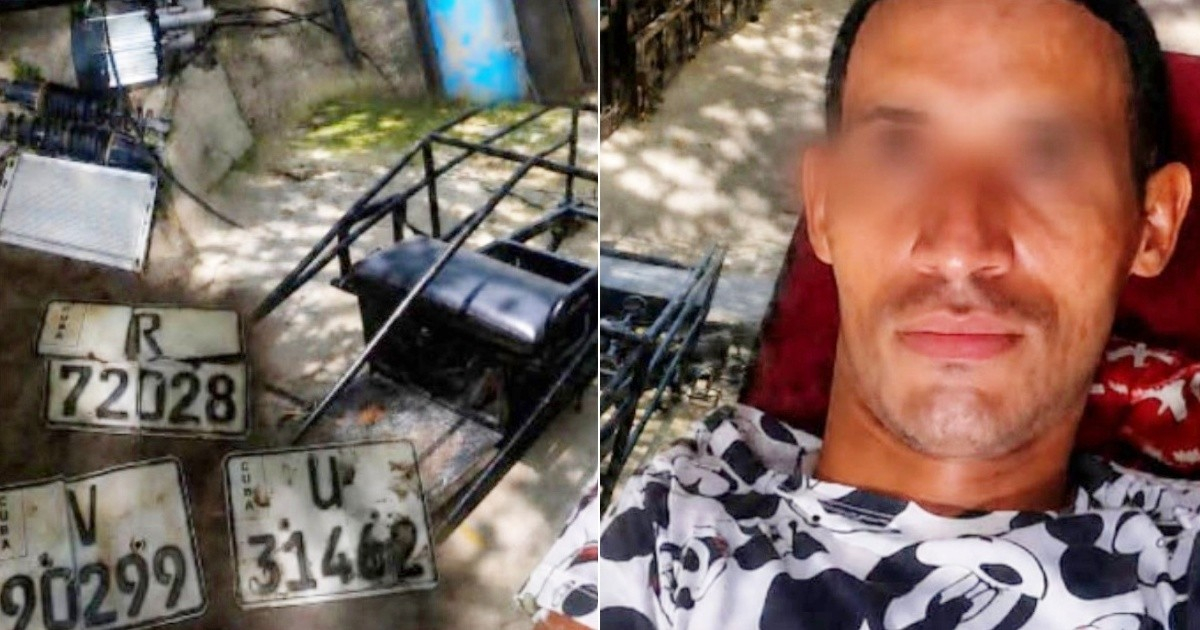
A man was arrested in the capital municipality of Guantánamo following the discovery of a stolen electric tricycle in his home, along with evidence linking him to the theft of at least five other vehicles, as reported by the official Facebook profile "Guantánamo y su Verdad."
According to the aforementioned source, everything began when the victim reported in several Facebook groups the theft of his tricycle, which occurred outside the processing unit of MININT, at the corner of 18 Norte and Beneficencia, in the Caribe neighborhood.
The dissemination on social media provided key information to the authorities, who -according to the publication- "were already investigating prior events in the area."
With that information, the agents raided a house in the Los Cocos neighborhood of Confluentes and found the stolen tricycle "disassembled into several pieces and apparently ready for sale."
A broader picture than a mere theft
The most revealing discovery was not the tricycle itself.
In the same residence, "numerous parts and at least five license plates belonging to other vehicles reported as stolen" were found, indicating a prior chain of offenses.
The source acknowledges that "investigations are ongoing to determine their possible involvement in other incidents," but does not specify how many vehicles may be involved or whether there are additional suspects under formal investigation.
The report omitted essential details: it did not inform about the date of the arrest nor did it reveal the identity, age, or background of the detainee, nor did it mention the value of the recovered tricycle or the condition of the parts.
This opacity is characteristic of official publications that report on operations with a propaganda tone but systematically omit the data that would allow for independent verification.
The text concluded with a call to inform the authorities about similar cases: "If you see something suspicious, report it - your involvement helps protect our community and ensure justice."
Outrage, doubts, and suspicion of accomplices
The post generated a wave of comments filled with indignation and distrust.
Many called for exemplary sanctions: "30 years without parole, damn it!" wrote one user. Another pointed out that "many repeat offenders reoffend because the penalties are too lenient."
A second محور of the debate revolved around the decision to cover the face of the detainee in the images.
“If they cover his face, we can't recognize him,” protested one commentator. Another was more direct: “It's not clear why they are protecting his identity if he has already been detained.”
The most significant indication pointed towards possible accomplices.
“He wasn't alone; he must have had several accomplices”, wrote a user, a sentiment echoed in various forms. “It's necessary to investigate if he was acting with others,” insisted another. The presence of license plates from at least five different vehicles at a single residence fuels that suspicion.
A rising pattern of insecurity
The case is not isolated. In the months leading up to this, Guantánamo experienced several high-profile operations: in June, three nighttime robbery gangs were dismantled with 11 individuals arrested, and a fuel theft network was dismantled with seven arrests.
Electric tricycles have become one of the most sought-after goods in Cuba, with prices ranging from 2,350 to 4,500 dollars.
The pattern of dismantling for selling parts is recurring: in April 2026, a driver was killed in Santiago de Cuba during a robbery to steal the battery and charger.
Nationally, the Cuban Observatory against Corruption documented 2,833 verified crimes in 2025, representing a 115% increase compared to 2024, with theft being the most common crime.
Related videos:
Filed under: