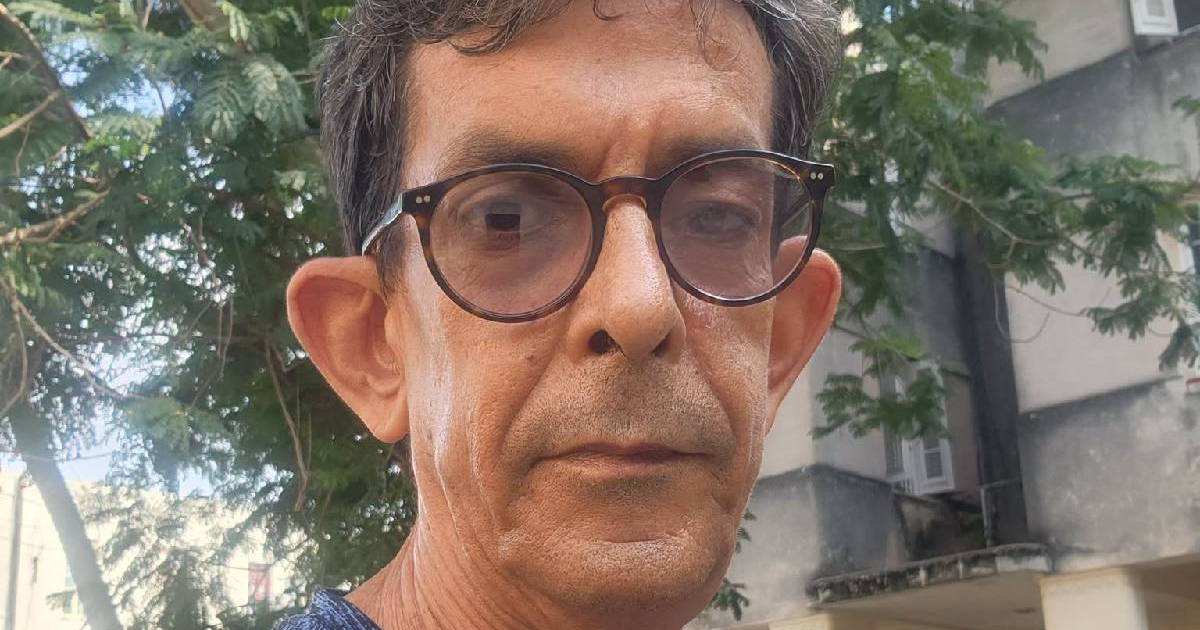
The actor and comedian Ulises Toirac published a new reflection on Cuban reality this Friday on Facebook, this time marked by the physical and emotional exhaustion of his daily trips to the Manuel Fajardo Hospital in Vedado, Havana, where he receives medical care.
"My daily trips to Fajardo will continue for a while longer. It’s exhausting, draining. And when I return home, there’s no electricity, which amplifies the fatigue," wrote Toirac, describing a routine that combines the toll of commuting with returning to a home without power.
Despite the fatigue, the comedian highlighted the work of the medical staff at the hospital. "What stands out the most is the work of the doctors, to whom I cannot thank enough," he stated.
But the journey also reflects a raw image of Cuban society. "Day after day, I encounter the sadness and hopelessness of the people. With serious children sitting on the steps in front of their homes. With bitter women struggling, with guys hanging around and sharing bits of their daily lives, with young people staggering from the chemicals on a corner," he wrote, using the popular term to refer to the synthetic drugs that have spread through the neighborhoods of Havana.
The publication concludes with a phrase that summarizes the accumulated weight: "I am going back, and each day the burden grows heavier."
Toirac's reflection comes at the worst energy moment of the year for Cuba. On July 29, the National Electric System recorded a deficit of 2,380 MW, the highest in 2026, leaving 74% of the country without power simultaneously. Some localities have accumulated more than 26 consecutive days without electricity.
This is not the first testimony from Toirac about his visits to Fajardo. On July 21, he had already publicly thanked the surgeons at the hospital for operating during blackouts and shortages, and on July 16, he narrated the exhaustion of crossing Havana from Playa to Vedado combining segments on foot and in a riquimbili.
Throughout July, Toirac has maintained a consistent line of social criticism. On July 29, he described the accumulated garbage in each neighborhood of Havana as an "infection"; on July 25, he wrote that there is no "light at the end of the tunnel" because "there is no tunnel"; on July 18, he challenged Cuban leaders to live without cars or privileges; and on July 12, he described life during blackouts as a "nightmare."
Toirac, who has amassed over 190,000 followers on social media, has become one of the most prominent civil voices on the island. In June, he had already stated that Cuba is in "a labyrinth without a solution" and that he sees no way out "for what remains of his life."
Related videos:
Filed under: