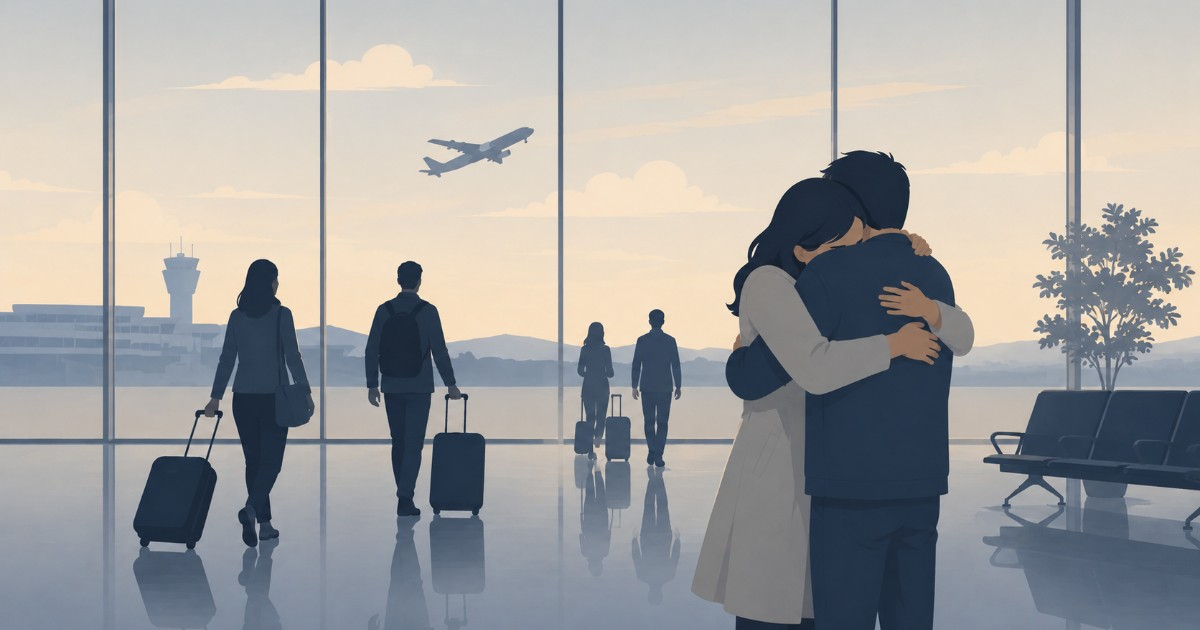
A Cuban doctor residing in Dubai published a reflection on Facebook this week that challenges the triumphant narrative surrounding emigration in Cuba: Alejandro Terry, who has been away from the island for four years, offers an ambivalent and unfiltered response to the question that thousands of Cubans ask themselves before getting on a plane.
"Emigrating was the worst mistake of my life," Terry begins. He then adds, "Because it was also the best decision I ever made. And those two things are true at the same time. And no one tells you that."
The testimony, structured in three parts, first describes the shock of everyday capitalism: the credit system, app-based transportation, and the overwhelming variety of products in a supermarket.
"Capitalism has its own language and teaches it to you without a translator and by laughing at you," he writes. For Terry, the first month of an immigrant can be summed up as "surviving the mundane": tasks that are automatic for any local resident but are "expeditions to the beyond" for the newcomer.
The second part abandons the ironic tone. Terry describes the silent mourning that no one photographs: "Your mom is aging on a six-inch screen."
Introduce the psychological concept of ambiguous loss —the grief for someone who is not dead but is also not present— to explain what it feels like to see your father ill through a video call with poor signal, unable to touch his hand.
"The worst part isn't the physical distance. The worst part is the disconnect. You change here, they change there, and when you see each other—if you see each other—sometimes you feel like almost strangers who care a lot for each other."
Terry notes that studies from universities such as Harvard and the London School of Economics document that the first year of an immigrant shows levels of stress comparable to major traumatic events. "It's not weakness. It's biology," he writes.
Terry, a graduate in Medicine from the University of Medical Sciences of Havana in 2018 and son of the former director of the official newspaper Granma, left Cuba in February 2022 with a work contract in Dubai.
The third part of his message addresses the difficulty of starting from scratch without a support network. "You arrive at a place where you are nobody. Not in a deep existential sense. In the most basic and brutal sense possible. You have no references. You have no history. You don't have the friend who knows the friend who can do you a favor."
Everything built in Cuba—reputation, contacts, street smarts—falls behind.
Despite the weight of that balance, Terry's response to the headline question is affirmative: emigrating is worthwhile if one seeks real freedom, the opportunity to build something of their own, and a horizon of options.
But it also advocates for those who stay and for those who emigrate for political or economic reasons without the need to justify themselves. "The Cuban emigrant does not abandon their family. They support them from afar with an effort that nobody photographs either."
Your case illustrates that even those who had certain privileges within the system chose to leave during this period.
His conclusion is straightforward: "Emigrate knowing what you are leaving behind, not fleeing from what you do not want to see. Because if you emigrate with your eyes open, fully aware of what it entails—the family, the nothingness, the chaos of the first year—you are much more likely to land on your feet."
Terry's testimony is part of an unprecedented exodus. According to data from the National Office of Statistics and Information of Cuba, in 2024, 251,221 Cubans emigrated, and the island's population decreased to 9,748,007 inhabitants, nearly 308,000 less than the previous year.
The UN has warned that if the trend continues, Cuba could shrink to 5.6 million inhabitants in the coming decades.
Related videos:
Filed under: