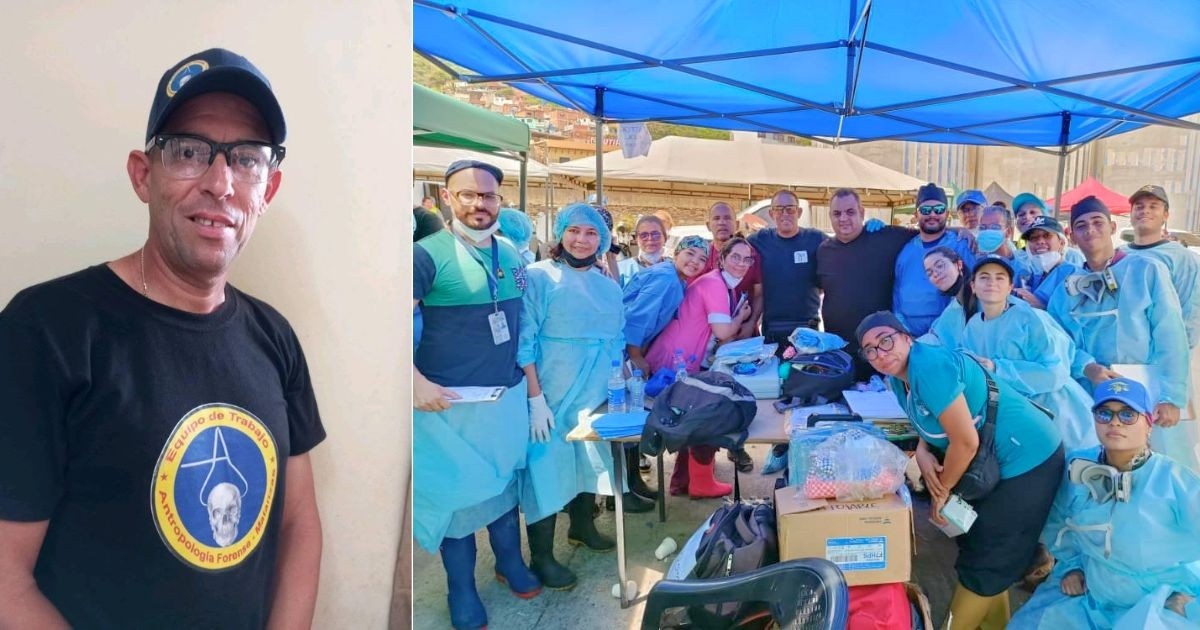
A young woman who repeatedly arrived at the makeshift morgue in La Guaira with the remains of her relatives was the case that had the most impact on Cuban forensic anthropologist Yoel Monzón González during his mission in Venezuela following the double seismic event on June 24, 2026. The specialist recounted this in an interview published this Sunday by the official newspaper Juventud Rebelde.
The case began in the early days of the mission. The woman first arrived with the body of her mother, whose identity was confirmed. Two days later, she returned with the remains of a four-year-old girl; six days after that, with those of another six-year-old girl. With each visit, the physical and emotional deterioration of that mother became more evident.
"Just before we left, she arrived with a 15-year-old boy, and that hit me hard because it reminded me of my 16-year-old son. Then the mother approached me and said, 'All I need now is to find my eight-year-old girl...' She seemed resigned to her situation, but she was worried that we were about to leave. Eventually, she showed up with her other daughter, and at that point, I really had to step away for a few minutes to process such a sad reality... I collected myself after a while, but her case touched me deeply as a human being," recounted the specialist to interviewer Hugo García.
In total, that woman lost five relatives in the disaster. "In this way, we met several families that lost almost all their members," she added.
The impact of working with minors was a constant throughout the mission. "In Cuba, it is uncommon to work with child victims. On this occasion, more than 60 percent of the cases we examined involved individuals younger than 17 years old at the time of death, some were just a few months or two, three years old," emphasized the forensic expert, who has accumulated 23 years of experience in criminalistics and physical anthropology.
Monzón González worked 30 days without rest in that emergency facility as part of the Brigade 91 of the Henry Reeve International Contingent, which arrived in Venezuela on June 29. The Cuban forensic team—eight specialists including forensic doctors, two forensic anthropologists, and a forensic technician—was, according to reports from July 5, the only international group specialized in corpse identification operating alongside the National Service of Forensic Medicine and Science of Venezuela, with a capacity for between 50 and 60 identifications daily.
The conditions were extreme from the very beginning. "It was very tense… Some victims arrived in pieces, their bodies could be decomposed or charred because there were fires. Others came in with amputations because they died in the hospitals where they received emergency care," he described.
The seismic doublet on June 24 —two earthquakes with magnitudes of 7.2 and 7.5 separated by just 39 seconds— resulted in 5,208 fatalities according to the official report of July 20, along with 16,740 injured and 17,907 people without housing.
The team also identified Cuban victims. The embassy alerted the group upon their arrival about missing compatriots —at least 32 were reported as such and by July 3rd the death of at least eight Cuban citizens was confirmed—. At one point, two deceased individuals arrived: a mother and her son, whose identities were confirmed with information from the Venezuelan husband.
Despite the hardships experienced, Monzón González rejected the image of coldness often associated with forensic professionals: "Although sometimes we are seen as cold individuals, that is not true: we have feelings and it hurts us what is happening, but we must fulfill our role as scientists." The specialist leads the forensic anthropology team at the provincial service of Legal Medicine in Matanzas.
At the end of the mission, the Cuban medical brigade awarded him the April 16 Medal, and the Venezuelan government recognized him with the Second Class Hero of Venezuela Medal. However, the greatest recognition came from another gesture: "Those families who placed their hands on our shoulders as a sign of gratitude and sought us out for reassurance... that was the greatest recognition."
Related videos:
Filed under: