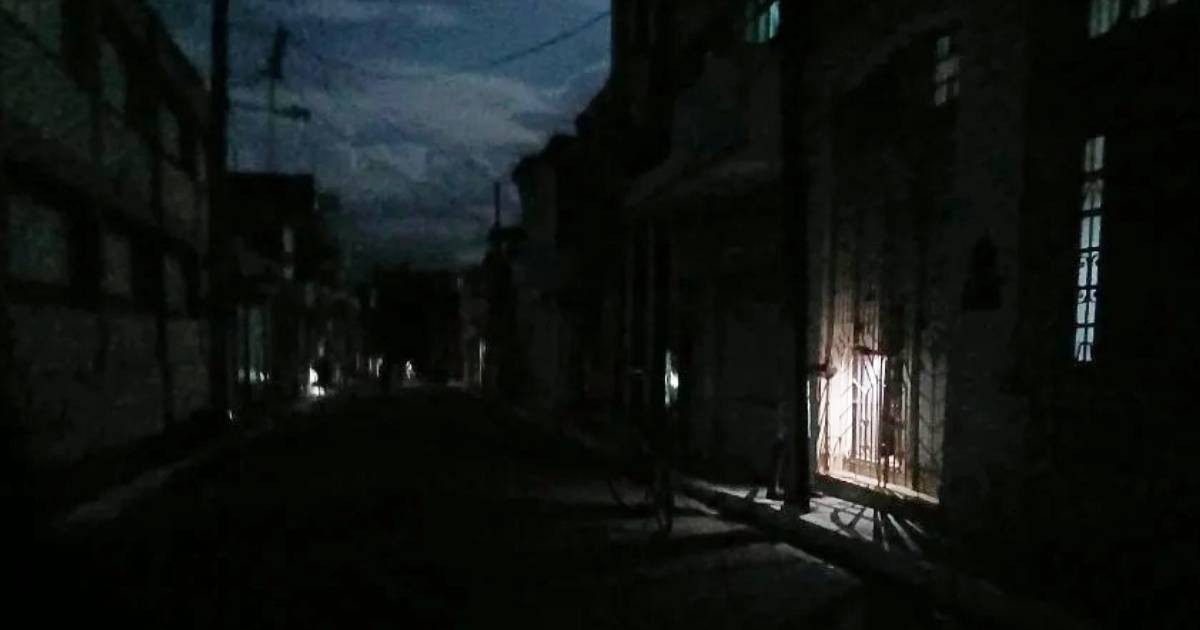
The province of Santiago de Cuba was reconnected to the National Electric System (SEN) this Tuesday, as announced by the state company Unión Eléctrica (UNE) on its Facebook account, becoming the last province in the country to regain service after almost two days without electricity.
The collapse that led to this new massive blackout occurred on Sunday, August 2, at 10:43 PM, when Cuba experienced a total disconnection of the national electric system, classified as the sixth of 2026.
The restoration became even more complicated when, on the night of Monday, August 3, a frequency oscillation caused another total failure of the electrical system, erasing in one fell swoop the progress made up to that point.
The setback was dramatic: Havana, which by dawn on Monday had recovered just 14% of the power supply —87,480 customers and 78.51 MW with 19 prioritized hospitals—, fell after the new fluctuation to a coverage of just 3.8%, with 33,182 customers, 11 active circuits, and six substations.
The reconnection process included the startup of units in the thermal power plants Ernesto Guevara, Máximo Gómez, and Carlos Manuel de Céspedes, but the eastern part of the country, and Santiago de Cuba in particular, was the last to be addressed.
The magnitude of the structural deficit explains why each collapse takes so long to resolve: for the Sunday night peak, the UNE projected an impact of 2,195 MW with only 1,035 MW available against a maximum demand of 3,200 MW, a deficit of nearly 68%.
Santiago de Cuba has been enduring months of energy suffering that go far beyond this episode.
In March, the local electric company admitted to 24-hour blackouts and promised only two hours of service "when possible." In June, it reorganized the outages, giving each neighborhood one or two daily time slots of electricity lasting between one and two hours.
On July 30, a fire at the Santiago Este Substation further exacerbated the situation by forcing an emergency shutdown of power supply in four circuits of the city.
The accumulated desperation has triggered a wave of protests. Santiago de Cuba recorded cacerolazos on July 3, July 26, and July 30, with slogans such as "electricity, food, and freedom."
The regime responded with the militarization of Santa Úrsula Park and the deployment of armed forces to intimidate the protesters.
This new collapse adds to a relentless chain: on July 14, Cuba had already experienced its fifth total blackout in just eight days, and in June, 107 protests were recorded across the country.
With the reconnection of Santiago de Cuba this Tuesday, the SEN is technically restored; however, the structural crisis that causes it to collapse repeatedly remains unchanged.
Related videos:
Filed under: