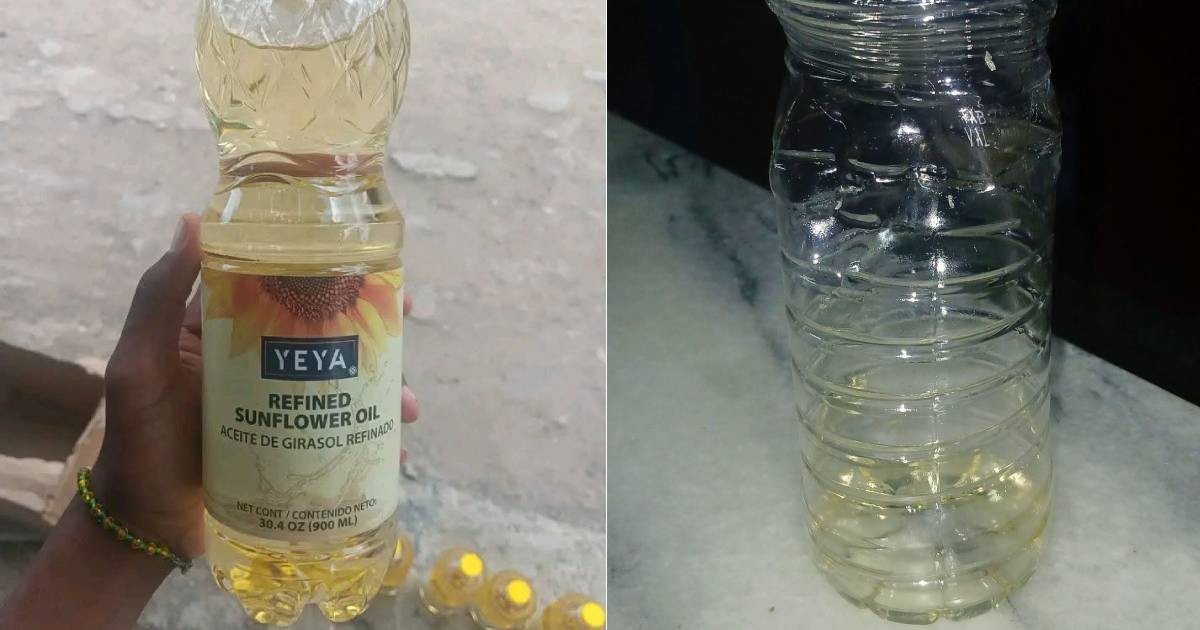
A Cuban resident in the Isle of Youth sparked a wide debate on social media after expressing her outrage upon discovering that a bottle of oil went from costing 2,600 to 4,500 pesos in just a week. She attributed this price increase to both the new government measures and the abuses of certain merchants.
Yaneisa Peña Turró shared on Facebook a scene that, as she said, reflects the daily life of thousands of Cuban families. While shopping, she heard a woman ask the sales clerk how it was possible for prices to increase so quickly.
The response, he assures, was as brief as it was decisive.
"That's the fault of your president, who removed the price caps, and now the business owner can sell however they want. Supply and demand," the employee replied.
Peña Turró shared that she was also unable to buy the oil. The money she had was barely enough to purchase a can of condensed milk for her children, which already cost 900 pesos. She also found one-kilogram packages of powdered milk for 5,500 pesos, but they could only be paid for in cash as the establishment did not accept transfers, citing connection issues.
The increase in prices began after the entry into force of the from the Ministry of Finance and Prices, published on June 20, which eliminated price caps on several high-demand imported food items, including cooking oil, cut chicken, powdered milk, pasta, and sausages.
Since then, the price of oil has continued to rise in various parts of the country. While in some provinces the liter has already exceeded 2,500 pesos, several users in the comments of the post claimed to have seen prices ranging from 6,000 to even 7,000 pesos, depending on the region.
While he held the government responsible for the elimination of price caps, Peña Turró also directed his criticisms at certain owners of small and medium-sized enterprises.
"Yes, it is the president's fault and that of his House of Representatives, but just as unfortunate as he is all the heads of the micro, small, and medium enterprises who also do not help the population, neither with transfers nor with their abusive prices. They are all cut from the same cloth," he wrote.
The post generated dozens of reactions. Some users pointed out that the rise of the dollar no longer solely explains the increase in food prices, while others highlighted the scarcity of goods and the challenges resulting from banking measures as factors that have exacerbated the situation.
In July, the Central Bank of Cuba itself eased some restrictions on the use of cash, after acknowledging the difficulties faced by merchants and consumers in making transactions through electronic payments.
All of this occurs in a context where the average state salary remains well below the cost of basic food items, while inflation continues to erode the purchasing power of Cubans.
The publication concludes with a reflection that summarizes the feelings of many citizens within the island.
"Why can't we hold a march against the abuse and the needs that we, ordinary Cubans, have been facing for years, which is normal in any part of the world, without resorting to violence?" he asked.
And she answered herself:
“We cannot... that is indeed a utopia I have had for years: to be able to express myself freely, demanding my rights without resorting to violence and ending up imprisoned.”
Related videos:
Filed under: