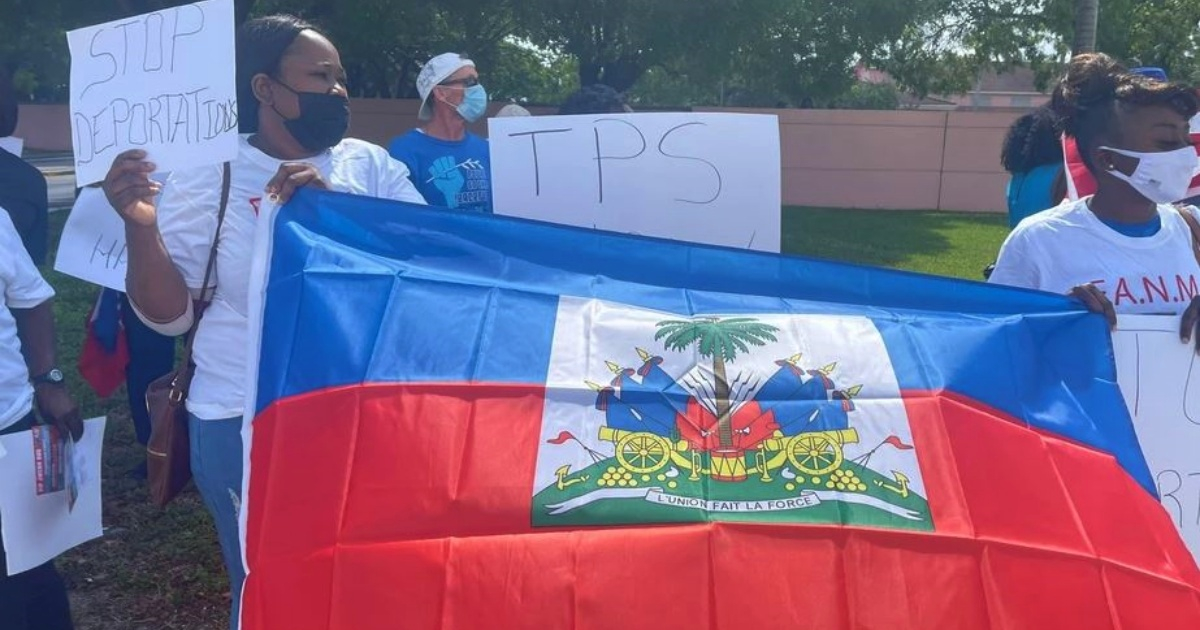
A federal judge cleared the last legal doubt this Wednesday regarding the fate of about 350,000 Haitians in the United States: District Judge Ana C. Reyes issued a formal order confirming that the judicial block she had imposed in February is no longer in effect.
The announcement paves the way for the Trump administration to proceed with deportations, according to reports from the U.S. press.
The Temporary Protected Status (TPS) for Haiti officially expired at midnight on July 27, but the district judge's order was the formal step needed to lift the protections that she had imposed months earlier.
In her ruling, the judge was succinct:
"The court's order, which had suspended the effective date of the termination of Haiti's designation for Temporary Protected Status by the Secretary of the Department of Homeland Security, Kristi Noem (...) while the judicial review was underway, is no longer in effect."
The program was established in 2010 following the earthquake that killed more than 200,000 people in Haiti and has been renewed by successive administrations for over a decade.
The Supreme Court authorized its cancellation on June 25, with six votes in favor and three against, determining that district courts do not have the authority to review the Department of Homeland Security's decisions regarding TPS.
ICE is already taking action: Shackles and pressure to "self-deport."
The Secretary of the Department of Homeland Security, Markwayne Mullin, was straightforward with NewsNation in describing the government's stance:
"We are chasing them right now. These people can choose to deport themselves voluntarily, or we will arrest them and send them back. It's that simple."
In Springfield, Ohio, at least 50 people with TPS were summoned by Immigration and Customs Enforcement (ICE) in the past week and left their interviews with electronic ankle monitors; those who did not show up were detained.
The activist Guerline Jozef, president of Haitian Bridge Alliance, described a shift in strategy:
"Instead of deploying massively in the communities, they are using strategies to summon people to their offices or to detain them or place an ankle monitor on them, telling them that if they do not 'self-deport', they will be called to appear again in a month."
Jozef described the cancellation as "the largest legal status revocation in recent U.S. history."
Economic and human impact
Approximately 190,000 Haitians with TPS were employed in the country and contributed about $5.9 billion annually to the economy, in addition to paying $1.6 billion in taxes.
The elderly care sector is one of the hardest hit: Westminster Communities of Florida has already laid off 12 Haitian workers—nursing assistants, dining staff, and cleaning personnel—and will replace them with temporary employees.
A long-term care service provider from the East Coast, who requested anonymity from CNN, summarized the paradox:
"She is a person doing an important job that no one else wants to do. We are going to send her back to an unknown place, devastated by war and dangerous. A woman who has paid taxes, raised her children here, and put down roots in this country. For what purpose? What do they aim to achieve?"
The organization Global Refuge highlighted the central contradiction: the State Department itself classifies Haiti as a "Level 4: Do Not Travel" destination and advises those who go to draft a will and provide DNA samples to identify their remains.
The legal battle continues, but the Senate is blocking the way out
The judicial case overseen by Judge Ana C. Reyes has not concluded: the lawyers representing the Haitians will continue to seek evidence that the cancellation was motivated by racial discrimination, an argument that the judge had partially accepted but which the Supreme Court rejected due to insufficient evidence.
The Haitians in Miami live in fear of a situation they deem unjust after decades of contributing to the country; about 158,000 of those affected reside in Florida.
The only visible legislative solution is the H.R. 1689 bill, which would extend Haitian TPS until January 2029 and was approved in the House of Representatives in April with 224 votes in favor and 204 against.
The project has the support of Republican congress members from Miami, María Elvira Salazar, Carlos Giménez, and Mario Díaz-Balart, but it remains blocked in the Senate, where the Republican leadership has not brought it to a vote.
Related videos:
Filed under: