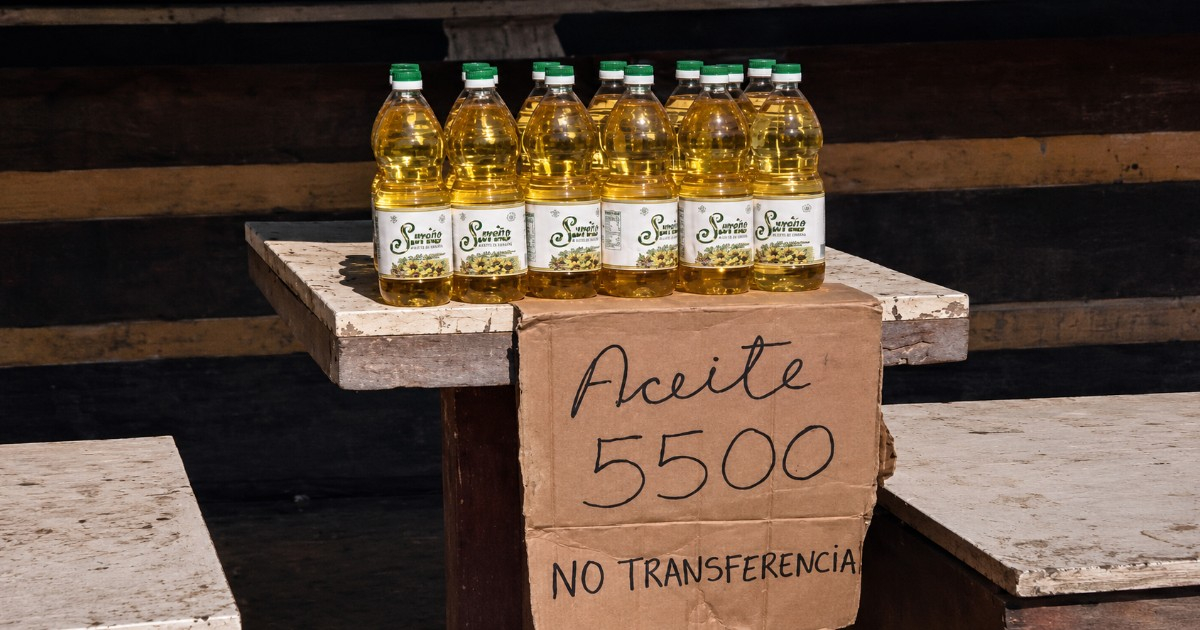
The Provincial Government of Granma called on Wednesday for representatives from the private sector who import oil, other food items, and personal hygiene products to a meeting scheduled for next Friday, with the official and explicit goal of seeking "joint solutions to the cruel Yankee blockade".
The announcement was shared on Facebook by the profile Coordinadora Economía, associated with the local government, and it announces a meeting with small and medium-sized enterprises (mipymes) and self-employed workers involved in the import of food and personal hygiene products.
Although the brief message does not mention sanctions, new prices, or specific measures, the call to seek solutions “for the good of our people,” amid the rapid increase in the cost of basic goods, gives the meeting a tone of urgency and pressure on private importers.
The call has a direct precedent in the decision made earlier this Wednesday by the authorities in Guantánamo, who, in response to complaints about the increase in oil prices, set a reference price of 2,200 pesos per unit, but without specifying the brand, volume, or packaging. However, they did strongly warn that they would impose fines, seizures, forced sales, and temporary closures on those who violate the regulations.
However, the pressure on the private sector is not new in that province. Governor Yanetsy Terry Gutiérrez had already convened small and medium-sized enterprises and self-employed workers in July to demand greater responsibility regarding issues that fall under the State's purview, including the circulation of cash and timely payments to pensioners and workers.
However, the situation has spiraled out of control to such an extent that the regime is forced to resort to new mechanisms of pressure on private actors.
The announcement in Granma comes just a few weeks after the Ministry of Finance and Prices removed the maximum retail prices for cut chicken, cooking oils —except for olive oil—, powdered milk, pasta, and sausages.
The decision was established through Resolution 150/2026, which repealed the limits approved in 2024 and maintained the exemption from customs duties for the importation of those five food items.
On the other hand, Miguel Díaz-Canel acknowledged that the controls did not manage to stop inflation and assured that the regime would not continue to implement general price caps.
The ruler also acknowledged that “there are obstacles that do not come from outside or from blockades”, a statement that contrasts with the motto now chosen by the authorities of Granma.
The removal of controls was followed by significant price increases for oil in various regions. A consumer from the Isle of Youth, for instance, recently reported that a bottle went from 2,600 to 4,500 pesos in just one week, a situation that sparked numerous criticisms against the government and private merchants.
The increasing weight of these businesses has not managed to reverse the overall decline. A data analysis published by the National Office of Statistics and Information indicated that Cuba had 20,349 economic entities at the close of 2025, including 9,941 private small and medium-sized enterprises, while the economy contracted at an average annual rate of 2% during the period analyzed from 2022 to 2025.
The liberalization of prices, presented as a correction to the failure of price ceilings, has thus become a boomerang for the regime.
The sharp increase in the price of oil and other foods has multiplied citizens' complaints and now forces local administrations to seek quick solutions to contain a crisis that is directly impacting the purchasing power of the population.
Related videos:
Filed under: