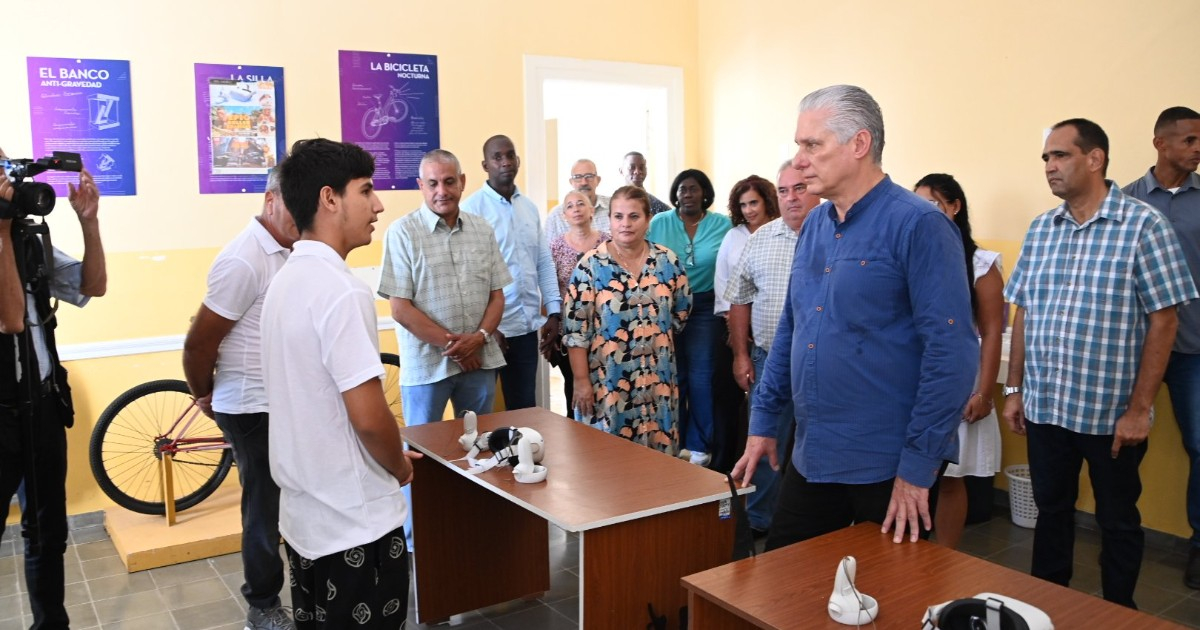
While millions of Cubans are enduring a summer marked by blackouts lasting up to 25 consecutive hours and collapsed services, Miguel Díaz-Canel toured parks, sports facilities, and a soap factory in Havana on Wednesday during a trip presented by the official site of the Cuban presidency as a working visit focused on "recreation and the economy."
The tour included the Great Metropolitan Park of Havana, the Sports Complex of 23 and B in the Plaza municipality, the Technological Palace "Finca de los Monos," the recreational center "Río Cristal" on Rancho Boyeros Avenue, and the Base Business Unit "Suchel Cetro," a soap factory located in the eastern part of the capital.
At each stop, the official discourse revolved around concepts such as business autonomy, connections with economic actors, and artificial intelligence.
In the soap factory, Díaz-Canel spoke with the director Alexander Puig Varona about expansion strategies, renewable energy sources, and electric mobility. "We must pay attention to how we can take advantage of this context of transformations to enhance an industry whose impact on the lives of Cubans is direct," said the leader, according to the official portal.
He was accompanied by Liván Izquierdo Alonso, the first secretary of the Provincial Committee of the Communist Party of Cuba in Havana, and Yanet Hernández Pérez, the governor of the capital.
The tour is part of a broader journey that Díaz-Canel began on June 30 across the 15 municipalities of the capital, framed within the so-called "Year of Preparation for Defense 2026," and shortly after the approval in June of a package of 176 economic transformations. By the end of July, he had visited 11 of the 15 municipalities. During his visit to Centro Habana and Plaza de la Revolución, the president called on local authorities to "better organize the blackouts", while in San Miguel del Padrón and Diez de Octubre, he emphasized the need to place "the most capable individuals" at the helm of the structures.
The contrast between the official outing and the reality faced by Cubans could not be more striking. Cuba experienced two total collapses of the electrical system in less than 48 hours between August 2 and 4, marking the sixth and seventh national blackout of the year, respectively, just the day before the tour.
The visit occurs amidst the greatest collapse of the Cuban electrical system in decades. During July, the Electric Union (UNE) recorded historic generation deficits exceeding 2,300 MW, several national collapses of the National Electroenergetic System (SEN), and prolonged blackouts throughout the country, a crisis that leaves millions of Cubans subjected to daily electricity outages.
The tourism sector, which the regime presents as the engine of economic recovery, is also experiencing its worst moment in years.
Between January and April 2026, Cuba received only 328,608 international tourists, a drop of 55.8% compared to the same period in 2025. By the end of July, 73% of hotel facilities were closed and about 25,000 workers in the sector were "on standby."
Users on social media, for their part, have rated the concrete results of Díaz-Canel's municipal tours as scarce or merely declarative, while the regime continues to organize visits to parks and factories as a sign of management amid a crisis that has been deepening for decades.
Related videos:
Filed under: