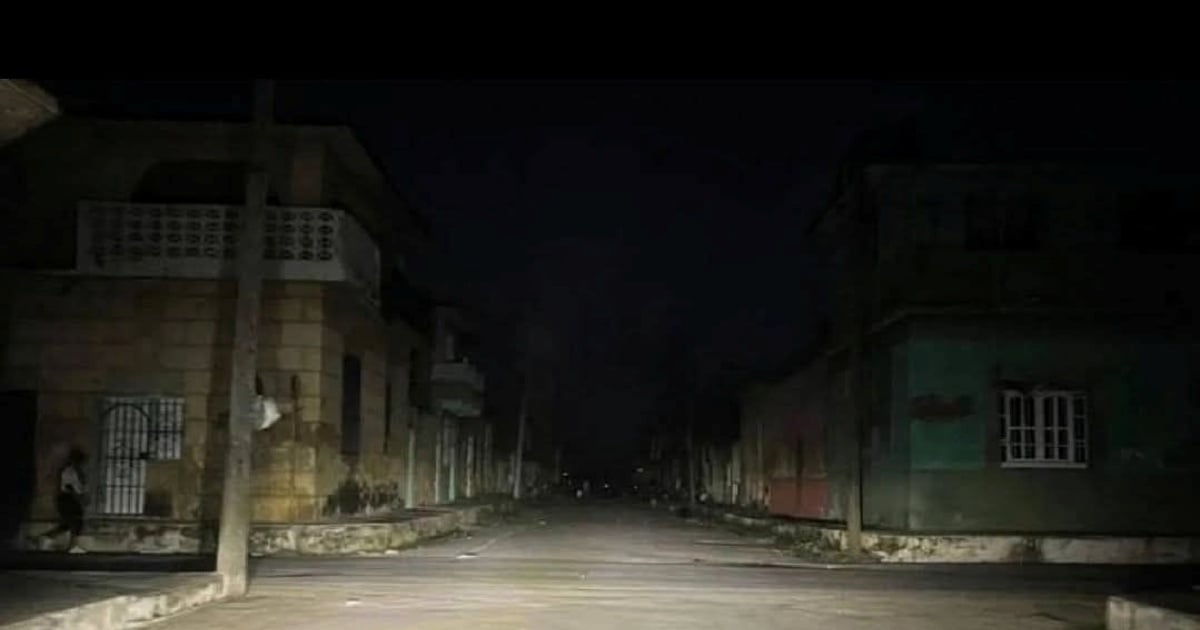
Cuba was plunged into darkness again this Sunday when the Electric Union (UNE) confirmed, at 10:43 PM, a new total disconnection of the National Electric System. The official statement was as brief as usual: "A total disconnection of the National Electric System is taking place. We will continue to provide updates."
This is the sixth total blackout of the SEN so far in 2026. The outage occurred just one day after a partial disconnection in the western part of the country—from Pinar del Río to Matanzas—left approximately 4.5 million Cubans in seven provinces without electricity, caused by a simultaneous trigger in the 220 kV Matanzas-Cienfuegos and Matanzas-Santa Clara lines.
After the partial reconnection of the west, the UNE was already expecting an impact of 2,195 MW this Sunday, with only 1,035 MW available against a demand of 3,200 MW, making another collapse virtually inevitable.
The reaction of Cubans in the comments on UNE's Facebook post was immediate and filled with sarcasm. "He came in, said hello, and went back to sleep," wrote Nuri Benítez. Sofía Del Toro Domgz was more direct: "The question is, when is he online?"
Becky Pereira Infante made a medical comparison: "The SEN is worse than a person with Alzheimer's; it doesn't know if it's coming or going from the kitchen." Yoa Pzm added: "The SEN sits down, stands up, and acts like a little donkey. It's about to break its own record."
Barber Pineda blended political irony with a reference to the Antonio Guiteras thermal power plant, the largest in the country and a key component of the system: "Utopia collided with Guiteras and unraveled on the horizon."
Gladys V. Fernández's comment touched on an open criticism of the regime: "What needs to fall doesn't fall. Well, of course, we as a people have to bring it down."
Meanwhile, several users reported situations that illustrate the extent of the accumulated collapse. Maydelin Redondo wrote: "This is nothing new; they had just restored my electricity after almost 24 hours. What a lack of consideration." Evelyn Cabrera summed up the absurdity in one sentence: "I haven't had power since yesterday, when it was on for three hours, so I’m not even aware." Rauli Velázquez condensed it all into one word: "Apagolandia."
The deterioration had been building up throughout the week. On July 29, the UNE projected a historic record deficit of 2,380 MW, with only 850 MW available against a demand of 3,200 MW. By July 31, the impact had reached 2,042 MW.
The history of total blackouts in 2026 includes the blackout on March 16 —the longest, lasting 29 hours and 29 minutes—, on March 22, the July 6 when nearly 9.6 million people were left without electricity, on July 10, and the July 14, attributed to the unexpected shutdown of Unit 1 of Felton in Holguín.
Behind every collapse, there are structural causes that the regime has not addressed for decades: thermoelectric plants that have been operational for over 30 years—many of them using Soviet technology—insufficient maintenance, chronic fuel shortages, and a complete dependency on imports of fuel oil and diesel that the system itself cannot guarantee.
Related videos:
Filed under: