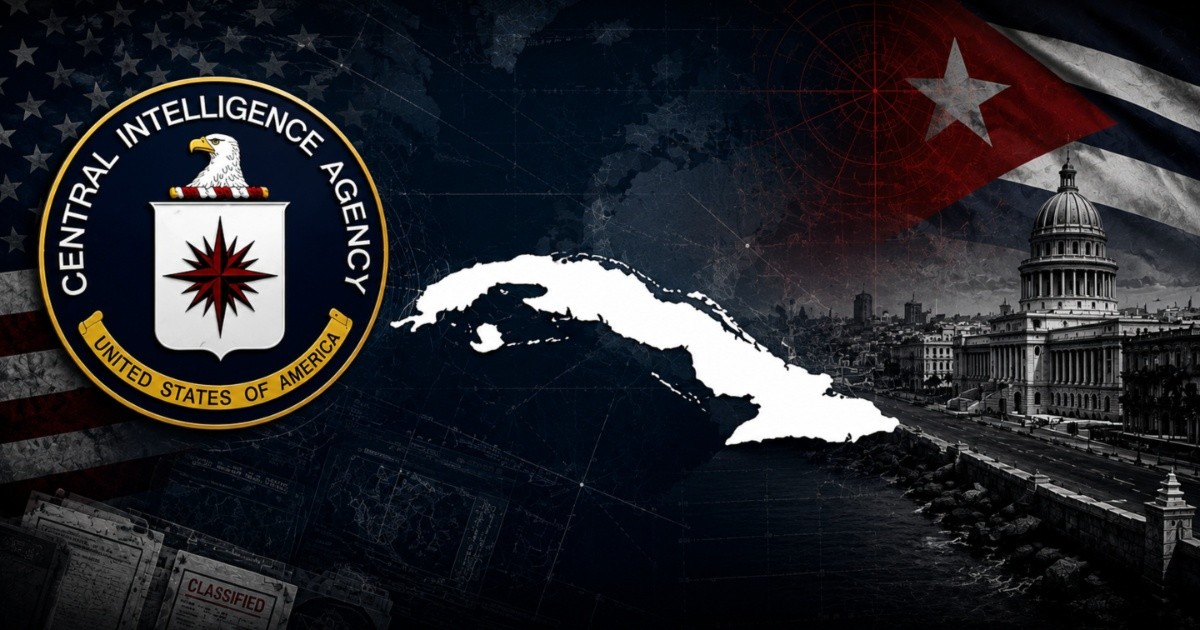
The Central Intelligence Agency (CIA) of the United States is reportedly trying to explore divisions within the upper echelons of the Cuban regime through a task force created specifically to focus on the island, according to a report by The New York Times citing sources close to the operation.
The mandate of the group, according to those sources, is to "create rifts among the Cuban political elite, with the hope of pressuring Cubans to replace those considered intransigent anti-American with leaders who are more pragmatic and more responsive to the demands" of President Donald Trump.
The team has already begun to incorporate officers specialized in recruiting spies, intelligence analysts, cybersecurity experts, and specialists in covert influence operations, the newspaper emphasizes.
The CIA, when consulted by the New York newspaper, declined to comment.
Unlike the working group that the agency established in 1960—whose members oversaw the failed invasion of the Bay of Pigs the following year—the new unit does not have organized Cuban partners nor is it authorized to facilitate lethal operations. However, due to its flexible nature, the president can modify those authorities at any time.
The creation of the group fits into a broader escalation. The Trump administration recently revised its National Intelligence Priorities Framework (NIPF) to place Cuba in the “Priority 1” category, at the same level as China, Iran, and Russia.
As a result, agencies like the National Security Agency (NSA) and the National Geospatial-Intelligence Agency have begun to redirect satellites and other collection resources to the island. This new intelligence will also assist the U.S. military in updating its options in the event of potential military action.
One of the most notable moves in this offensive was the visit of the CIA director, John Ratcliffe, to Havana on May 14, where he met with the Minister of the Interior Lázaro Álvarez Casas and Raúl Guillermo Rodríguez Castro, known as "El Cangrejo," grandson of Raúl Castro and colonel of MININT.
Ratcliffe conveyed a dual message: he acknowledged the Cuban intelligence services as "worthy adversaries and potential future partners," but warned that their time was running out to implement the changes demanded by Trump, hinting that Cuba could become "the next Venezuela."
The reference to Venezuela was not incidental. The speed with which Trump managed to capture Nicolás Maduro in January of this year led the more hawkish advisors of the administration to estimate that the Cuban regime could disappear before the midterm elections in November.
However, those same hawks privately acknowledge that decisive action against Havana "will probably only occur once the war in Iran has definitively concluded," according to the newspaper.
Among the tools that the CIA could activate is the public disclosure of information about money flows and business dealings of Cuban leaders both on and off the island, aimed at undermining their image in the eyes of the public, a tactic that the agency has already used against Russia.
The day before the Times published its article, Politico reported that Washington had sent more intelligence assets to Cuba. Since February, reconnaissance aircraft such as the P-8A Poseidon, the RC-135V Rivet Joint, and the MQ-4C Triton have accumulated over 150 hours of missions around the island.
The anti-Cuban hawks surrounding Trump "still believe that the administration will eventually dedicate the necessary resources and attention to overthrow the Cuban government," concludes the Times, although the timetable largely depends on what happens on the Iranian front.
Related videos:
Filed under: