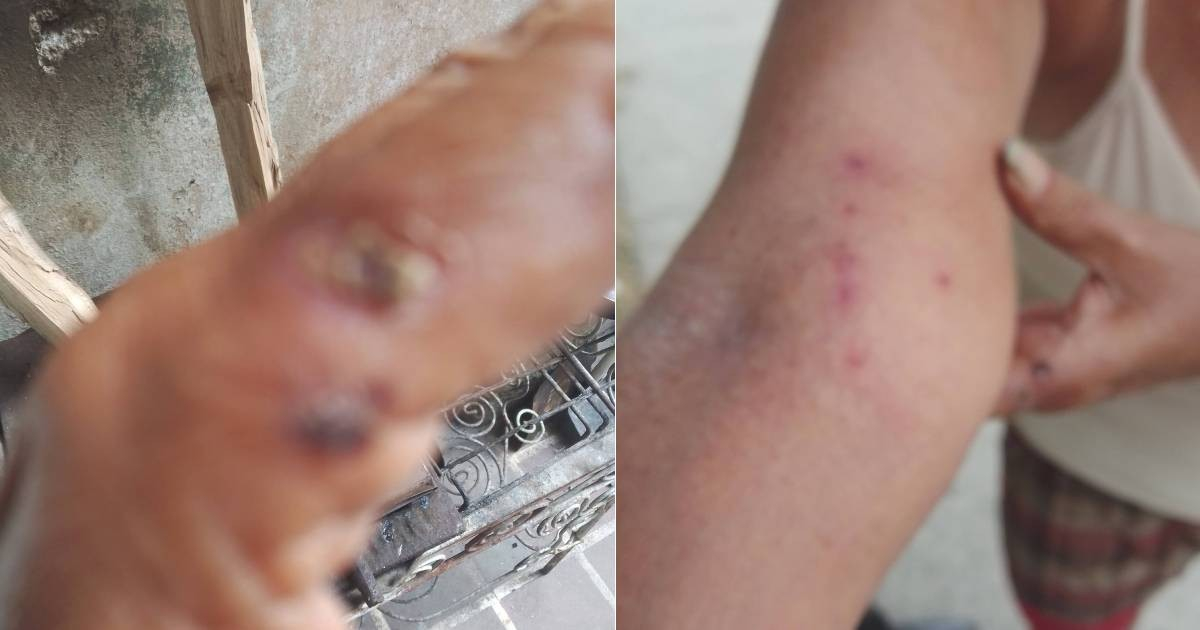
A Cuban teacher identified as Yasmina Ornella shared a harrowing testimony on Facebook about the conditions in which she survives in Cuba: without gas, without water, facing constant blackouts, and forced to cook with firewood, despite suffering from a neurological illness that severely limits her mobility.
"I'm cooking like this, with firewood, because even charcoal is no longer an option... Here it's sold as if it were gold; even that is for millionaires. Look at the burns on my hands from trying to light the firewood so we can eat, after carrying water because there's none available, unable to do so because I'm a patient with transverse myelitis, and no social worker attends to me," she wrote.
The woman accompanied her post with images of an improvised cast iron stove, surrounded by ashes and firewood, as well as photographs showing visible burns and injuries on her arms, which she explains are the result of her efforts to prepare food amid the scarcity.
Yasmina suffers from transverse myelitis, an inflammatory condition that affects the spinal cord and can lead to partial paralysis, chronic pain, loss of sensation, and respiratory difficulties. Despite her condition, she claims that she faces each day alone and does not receive support from social services.
His account also reveals the constant fear he lives with. Just a few days ago, he experienced a severe crisis during the night.
"I felt my leg go numb and could barely breathe. I couldn't get up to ask for help. Thanks to a good friend on WhatsApp who kept me engaged in conversation and encouraged me... I started to drift off to sleep," she said.
But the most painful episode of his publication is the memory of his mother's death, which he attributes to the deterioration of her health due to the constant hardships they faced.
"My mom had a stroke because of this whole situation. That fateful day she told me, 'I can't stand this heat with the power outages,'" she recalled.
According to Yasmina, her mother had been struggling to obtain the medication to control her blood pressure. When she suffered the stroke, it happened during a blackout and there was no ambulance available. It was the neighbors, around midnight, who managed to find a tricycle to take her to the hospital.
Once there, he assures that the staff told them they had all the necessary resources. However, a former student of his who worked as a doctor confessed a different reality to him.
"Teacher, that's a lie; there's nothing there. What happens is that when they take a person of that age, the first thing they say is: 'That old man has lived enough already,'" he recounted.
The professor assures that those words will never leave her memory.
"My mom died talking about water, electricity, and shortages, with tears in her eyes from the worry that she was leaving me all alone in the world and sick," she wrote.
Yasmina's testimony reflects a reality that impacts millions of Cubans. The water shortage continues to worsen across the island. According to official data released this year, nearly 2.7 million people suffer from a severe lack of access to drinking water and around 10 million receive the service intermittently.
The crisis worsens because 87% of the pumping system relies on electric supply, meaning that every prolonged blackout leaves entire communities without water for days.
This is compounded by the lack of fuel for cooking. The scarcity of charcoal has driven its price up to the point of making it unaffordable for many families, while the Food Monitor Program estimates that over a third of the Cuban population has had to resort to firewood or charcoal to prepare their meals.
The collapse also affects the healthcare system. By March 2026, around 80% of domestically produced medicines faced supply shortages, while millions of patients with chronic illnesses experienced interruptions in their treatments due to a lack of medications and the impact of the energy crisis on healthcare services.
In the midst of that scenario, Yasmina summarizes her reality with a phrase that has moved hundreds of users on social media:
"This is no life, not even for animals. No one, absolutely no one, deserves this. It's a crime; it's inhumane."
Related videos:
Filed under: