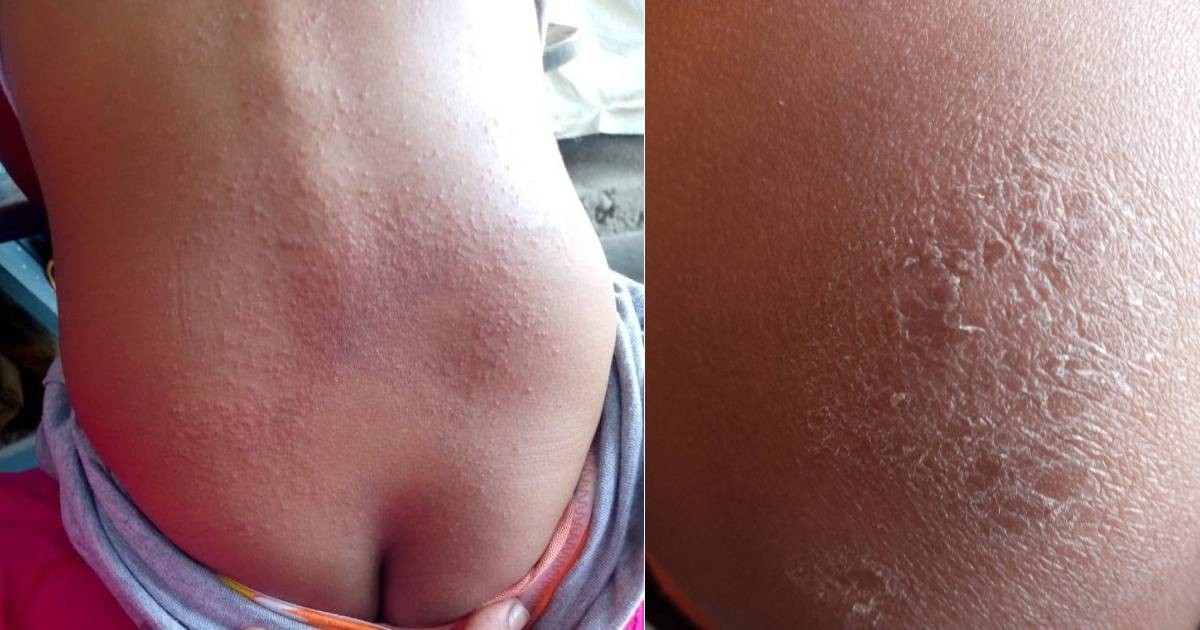
A Cuban mother raising her two younger children alone in the El Salao neighborhood of Imías, Guantánamo, publicly reported the dramatic situation her family is facing after going more than five weeks without receiving water, a crisis that is endangering the health of her youngest daughter, who suffers from a chronic skin condition.
Sainet Yan Yun made her complaint public on Facebook on August 1, where she explained that since June 24 her home has not received any water supply and that the solutions implemented by the authorities are insufficient for dozens of families.
According to the report, the only measure taken has been the dispatch of a water truck once a week to a community park, intended to supply about 40 families, and only after the residents protested about the lack of service.
"My house is far away, and living alone with my two younger children, I am forced to carry water myself, a task that has become unsustainable. The physical exhaustion is immense, but the emotional pain is greater," she wrote.
But the mother's greatest concern is her young daughter's health, who has been diagnosed with atopic dermatitis, a chronic inflammatory condition that requires constant hygiene and frequent baths to prevent lesions and infections.
"She suffers from atopic dermatitis, a skin condition that is extremely painful and complex. This disease requires constant hygiene and specific care, but without water, her skin is deteriorating rapidly," she reported.
The photographs accompanying the publication show extensive areas of redness and peeling on the girl’s back, images that reflect the physical deterioration caused by the inability to provide the care required by the illness.
"Seeing her suffer and knowing I can't even guarantee her the baths her skin needs due to a lack of basic water is heartbreaking," he confessed.
The woman claims that she has approached the municipal authorities several times to explain her situation, but she states that she has not received any response so far.
"I have approached the municipal authorities several times, explaining my situation regarding the water, but so far I have not received any response or attention," he lamented.
His case is not an isolated incident. The water crisis in Guantánamo has worsened this year and particularly affects municipalities such as Imías, Baracoa, and Manuel Tames, which have been identified by the authorities themselves as the areas with the greatest difficulties in ensuring supply.
Due to the shortage of fuel, the provincial government even considered the use of animal-drawn carts to distribute water to the population. Later, officials acknowledged that in some communities, the distribution cycles lasted up to 25 days, while independent reports raised that figure to 28 days in areas of the southern part of the province, where, in addition, the available water does not meet drinking standards.
The situation is worsening because a significant portion of the country's pumping system relies on electricity supply. In Cuba, about 87% of the water supply operates through stations powered by the National Electroenergetic System, making the prolonged power outages further exacerbate the scarcity.
The report by Sainet Yan Yun adds to others that have emerged in recent days from various parts of the island. Earlier this week, another Cuban stated that she has gone nine months without receiving water in her community, while a mother living in Lawton, Havana, reported having been without water or electricity for 15 days while caring for her six-year-old daughter who had a fever.
At the end of her post, the mother made it clear that she is not seeking preferential treatment, but rather respect for an essential right.
"I'm not asking for a favor; I'm demanding that our basic rights be respected. My daughter's health is my responsibility, but access to water is a right that the authorities are obligated to ensure," she concluded.
Related videos:
Filed under: