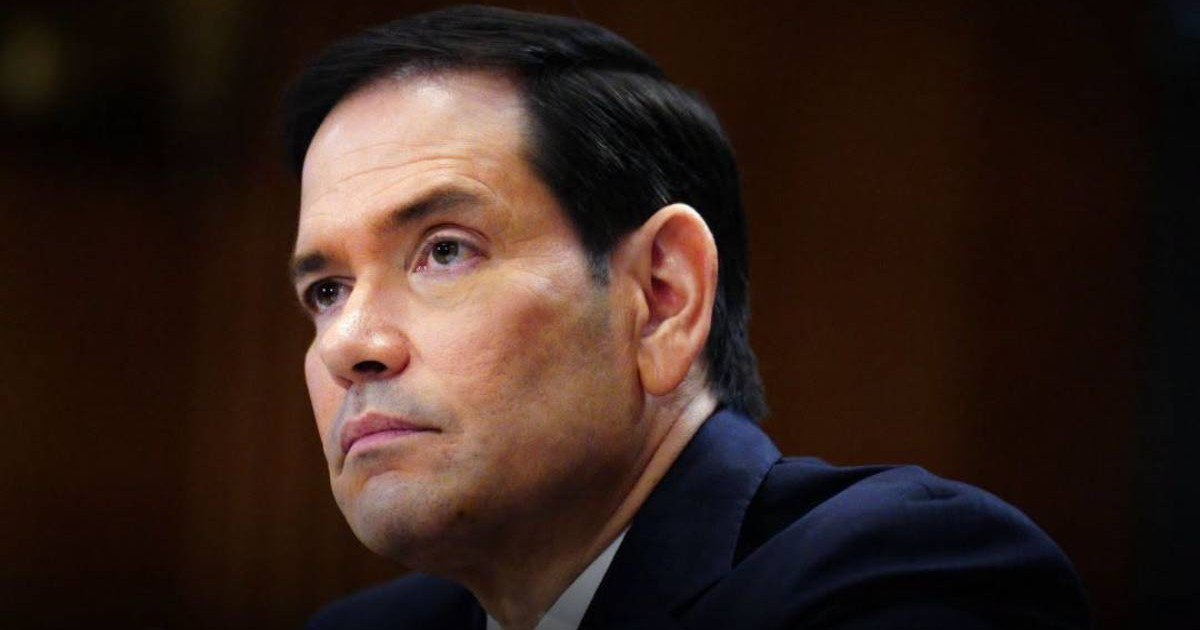
The Secretary of State Marco Rubio described this Friday, in an exclusive interview with Axios about the pressure campaign against Cuba, a strategy of sustained attrition that does not aim for an immediate outcome, but rather seeks to strip the Cuban regime of every mechanism of survival until internal contradictions take their toll.
The phrase that summarizes Rubio's logic is this: "What we are trying to teach them is that there are no escape valves." It is not a shock operation, but a gradual encirclement designed for Havana — not the United States — to race against time. "There is no escape", he stated.
The Secretary of State made it clear that he is in no hurry and asserted his shift in approach regarding U.S. foreign policy.
"One of the things we have lost in U.S. foreign policy and geopolitics is the concept of patience and persistence," he expressed.
Rubio was clear about the timeline and perseverance. “They cannot expect us to give up. This is not going to disappear in the next two and a half years.” He added: “Every time they create a new mechanism to try to escape the noose, we just tighten it.”
The strategy of patience is based on concrete foundations. The regime is in an unprecedented situation. "For the first time in the history of Cuba, the island lacks two things it has always relied on: an external sponsor and the lack of attention from the U.S. as a maximum priority."
The hardest blow to the regime has not been caused by economic measures, but by the capture of Nicolás Maduro. This cut off external support, the Venezuelan supply of up to 100,000 barrels per day of oil, and the revenues they obtained by reselling around 60% of that crude on the global market.
As pressure mounts, Washington continues to seek out possible interlocutors within the Cuban government for the moment of political transition.
Axios highlighted that Rubio has held discussions with Raúl Guillermo Rodríguez Castro ("Raulito"), a colonel in the Ministry of the Interior and grandson of Raúl Castro.
However, U.S. officials told Axios that the viability of that channel is uncertain, as "Raulito" or "el Cangrejo," as he is popularly known, could lose political support on the island upon the death of his grandfather.
In June, Rubio stated before Congress that there are "certain technocrats" within the Cuban political apparatus with whom collaboration could be possible, without identifying any specific individuals.
Rubio's statements to Axios could serve as a signal for those who expect Washington to immediately bring about the end of the regime from outside.
Rubio has referred to this topic subtly on several occasions. Last month, in Manila, he rejected any public timeline. "I have never set a schedule for when a change will occur or what that change will look like. I wish it were tomorrow, because the Cuban people deserve a better future."
Washington's bet is that the economic pressure, the absence of sponsors, and the inability to find new outlets will ultimately force the Cuban government to confront decisions it has managed to postpone for decades.
The horizon that Rubio marks is the end of Trump's term. It does not promise the fall of the regime, but rather something more specific.
"My level of confidence is that by the time this administration ends, at a minimum, Cuba will be on an irreversible path towards a different future." There are still two and a half years ahead.
Related videos:
Filed under: