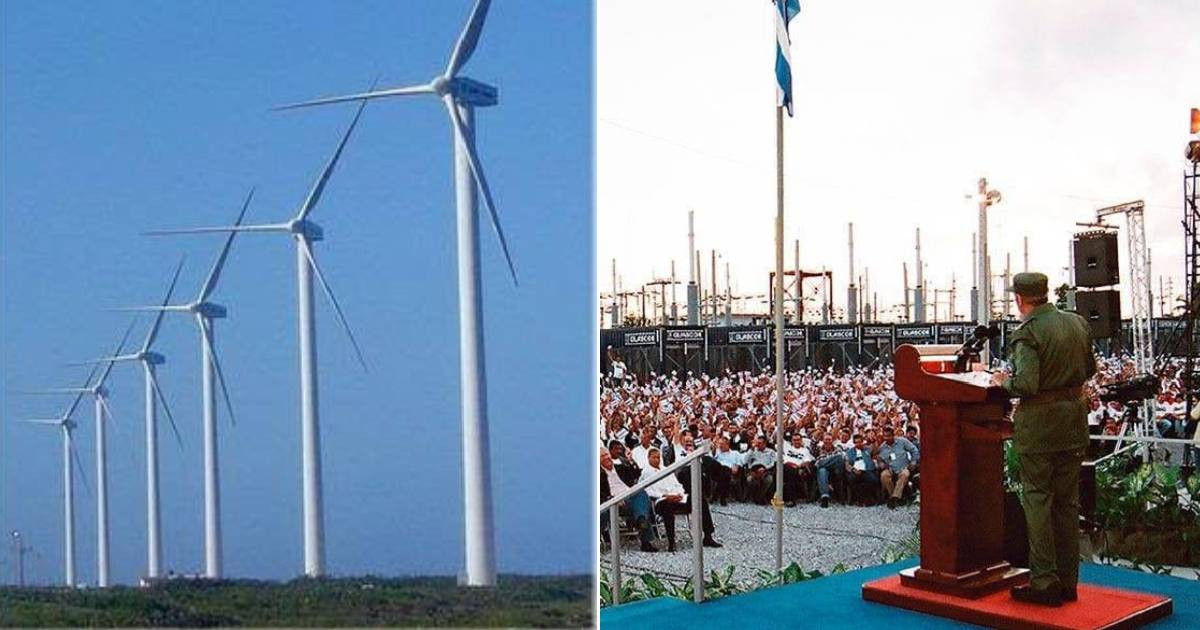
The Electric Company of Holguín sparked a wave of criticism on social media after posting a tribute this Thursday to the supposed "energy legacy" of dictator Fidel Castro (1926-2016), amid the prolonged electricity crisis affecting Cuba.
The post, shared on the entity's Facebook page to commemorate the centenary of the deceased ruler, stated that Castro was "the great visionary who knew how to point the way towards renewable energy sources."
He also stated that the leader understood the need to promote the energy transition, sustainable development, and the gradual reduction of dependence on fossil fuels.
The message also attributed to Castro the promotion of experimental wind farms, the installation of wind measurement stations, the expansion of photovoltaic systems in rural communities, and the utilization of hydroelectric energy.
The company concluded that this "legacy" today calls for the construction of a "more sustainable and sovereign" electrical system.
Instead of receiving support, the publication sparked a flood of critical comments from users who linked that discourse to the reality of the prolonged blackouts the country is facing.
"They should be ashamed and not talk about that," wrote one user. Another citizen commented, "It seems that you didn't pay much attention because we are worse off than ever."
Several internet users recalled promises made during the so-called Energy Revolution. One of them quoted a speech given by Castro in Pinar del Río on January 17, 2006, when he stated that the province "would not experience blackouts again." "Look at how things turned out for the visionary in Pinar del Río," he remarked sarcastically.
Skepticism also extended to the renewable facilities mentioned by the company. "I wonder if those wind turbines are actually working," Dany asked, while another person pointed out that the wind farms in Gibara "had their good moments," but lamented that wind energy never received the necessary support.
Other comments directly questioned the balance of the energy policies promoted by the regime. "Which Fidel, the one who promoted the use of electric pots because there would be no more blackouts? The one who promised us prosperity? A true prophet," wrote Julito RL.
A netizen summarized his opinion with a brief "Another failure among so many," while another labeled the former ruler as "The king of misery."
There were also those who felt that the official message was offensive to a population subjected to daily power outages. "News like that should not be published because it's a mockery," stated a user.
The reaction occurs as the National Electro-Energetic System continues to face a generation deficit that is causing widespread blackouts in much of the country.
In that context, the appeal to Fidel Castro's alleged energy legacy became a space where many Cubans expressed their frustration over a crisis that, two decades after the Energy Revolution, continues to impact the daily lives of millions of people.
The message appeared just days after Cuba experienced its seventh total blackout of the National Electro-Energetic System in 2026, and amid the most severe electrical crisis that Holguín has recorded in its recent history.
The province has only 70 MW available compared to a peak demand of 240 MW—less than 30% of what is needed—and its residential circuits receive approximately three hours of electricity, with outages that can exceed 50 continuous hours.
Of the 70 MW available, 26 are allocated to essential services and about 20 to the nickel industry, leaving only 14 MW to meet a residential demand of 190 MW.
The situation with the transformers worsens the situation. In Holguín, an average of 2.5 units are damaged each day, while the government only receives 10 replacement units every 20 days.
From January to June 2026, the damaged transformers totaled 252, an increase of nearly 35% compared to the same period the previous year.
The publication by the electrical company from Holguín is part of a pattern of official initiatives from the centennial that have met with the same level of rejection.
Related videos:
Filed under: