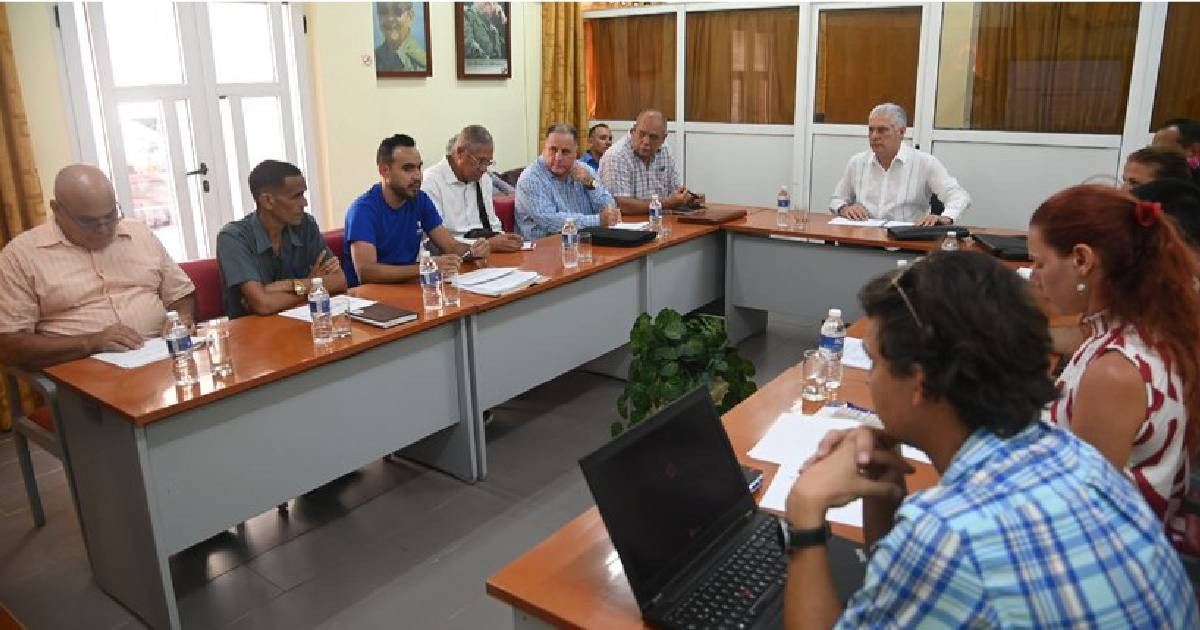
The ruler Miguel Díaz-Canel visited the Electric Company of Havana on Thursday, where it was announced that authorities are working with artificial intelligence experts from the University of Havana to achieve a more equitable distribution of power outages among the different municipalities of the capital.
In the meeting were the Minister of Energy and Mines, Vicente de la O Levy, the first provincial secretary of the Communist Party, Liván Izquierdo Alonso, and the governor of Havana, Yanet Hernández Pérez, among other officials, reported the official site of the Cuban Presidency.
The meeting addressed the high electrical demand in the capital, the deterioration of network infrastructure, the fuel deficit for distributed generation, the instability of thermal power plants, and the significant number of damaged transformers.
Regarding the technological promise, the source stated that "in the not-too-distant future, when the designed programs become available, there will be greater equity in the distribution of electricity, as well as improved analysis and control of this vital service."
The announcement does not include specific timelines or technical details about when those programs will be operational.
The context in which this promise arrives could not be more serious. On August 5, Cuba set a new historical record for electrical deficit by exceeding 2,411 MW of impact, surpassing the previous record of 2,380 MW set on July 29.
Demand is around 3,100 MW while available generation barely reaches 1,000 MW, a gap that reflects, in addition to the worsening fuel deficit, decades of disinvestment by the government and deterioration of the energy system.
A few days ago, the National Electric System collapsed twice in less than 48 hours, on Sunday, August 2, and Monday, August 3, marking the sixth and seventh national blackout of the year.
The inequality in the distribution of resources, which is precisely what AI is supposed to correct, is already causing increasing outrage among the population.
Recently, the content creator Yai Savón, mother of three from the municipality of La Lisa, posted a viral video on Facebook in which she directly addressed the president: "In Marianao, there's electricity all day long, and in La Lisa, not even for an hour. We've been without electricity for four days and without water for about fifteen days."
Savón described a desperate situation: "I have three small children. I have no food to give them because the food spoiled. I don’t have a rechargeable fan to cool them down because there is no electricity. There is also no water."
This visit by Díaz-Canel to the Electric Company is part of a tour of the 15 municipalities of the capital that began on June 30. During this tour, in July, he had already asked the authorities to “better organize” the blackouts without announcing measures to increase generation.
In July, the Cuban Observatory of Conflicts recorded 1,415 protests and critical expressions throughout the island, the highest monthly figure in its history, in a country where it is estimated that between $8 billion and $10 billion is needed to recover the national power grid.
Related videos:
Filed under: