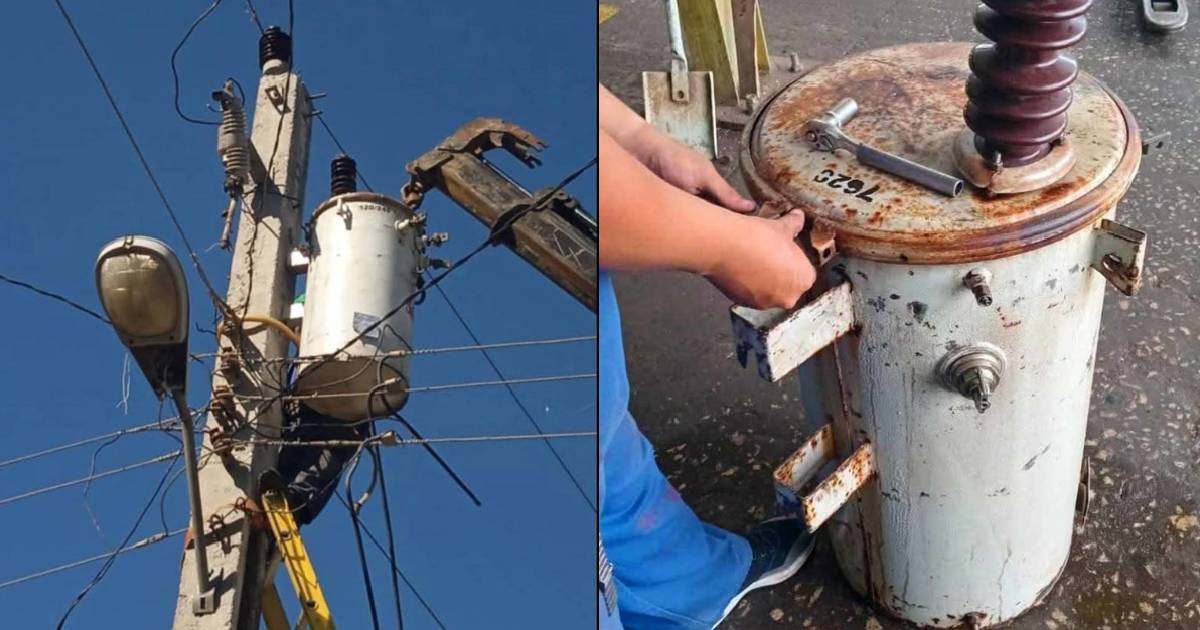
The prolonged blackouts in Holguín are destroying the transformers of the electrical grid at a rate that the Cuban regime is unable to contain, with an average of 2.5 units damaged each day, while it barely receives 10 replacement units every 20 days.
The mechanism of the collapse is brutally logical. After outages lasting 39, 40, or even 51 consecutive hours, when the electricity returns, residents simultaneously plug in refrigerators, air conditioners, rice cookers, water pumps, inverters, and battery chargers.
The result is that the transformers are operating at 150%, 200%, and sometimes even up to 300% of their nominal capacity, acknowledged an extensive report published this Saturday in the official newspaper ¡Ahora!
"When the service arrives, everyone wants to do everything in the three hours they will have electricity, and they expose the transformer to 150, 200, and sometimes even 300 percent of its load," explained Aroldo Pupo Hechavarría, senior specialist in Networks and Systems at the Provincial Electric Company.
In the city of Holguín, between 15 and 20 transformers can trip each time a circuit is restored, with instances where up to 25 units have been recorded tripped in a single restoration.
The statistics confirm the ongoing deterioration. From January to June 2025, 187 damaged transformers were recorded in the province; in the same period of 2026, the number rose to 252, an increase of nearly 35%.
"Last month, 74 transformers were burned out. In a normal month, we usually have around 40 or 50 burned in the province," stated Fabián Vega Genicio, technical director of the Provincial Electric Company, who places the current average at approximately 2.5 damaged units per day.
That rate of deterioration far exceeds the replacement capacity. In the 20 days leading up to the publication of the report, Holguín received around 10 transformers from the national centers.
"When one contrasts that with the 2.5 that are damaged daily, we cannot meet the demand," Vega acknowledged.
At the time the journalistic work was conducted, 43 damaged transformers were affecting 1,906 customers in Holguín. The oldest unresolved case is that of the Mícara community in the municipality of Frank País, which has been without electricity since May 28.
The government attempted to alleviate the shortage by removing transformers from state entities to relocate them to residential communities, but that reserve also ran out.
The debt to various sectors of the provincial economy has risen from 357 units a year ago to 530 currently, including those damaged and withdrawn. "That state reserve has already been exhausted; we have no resources left," admitted Vega.
Another temporary solution has been to "bridge" communities by supplying them from the transformer of a neighboring area. The number of teams operating under this condition has increased from 181 a year ago to 221 currently, posing a risk of also deteriorating the transformers that serve two communities at the same time.
"Sometimes the quality of the service is terrible, but at least you have electricity," Pupo summarized.
As a partial response, the Electric Company of Holguín is preparing its own provincial workshop that could reduce reliance on national recovery centers, although this measure comes at a time when the accumulated debt of equipment has already exceeded 530 transformers.
Holguín has only 70 MW available against a peak demand of 240 MW, less than 30% of what is needed, forcing most residential circuits to receive approximately three hours of electricity for every 39 to 51 hours of blackout.
Cuba only has three specialized transformer repair workshops across the country, located in Havana, Villa Clara, and Manzanillo, all of which are overwhelmed. The Electric Union acknowledged in June that there is no physical availability of spare parts in any province.
The crisis is further exacerbated by the collapse of the national electrical system: Cuba experienced its fifth total blackout of the year on July 14.
Related videos:
Filed under: