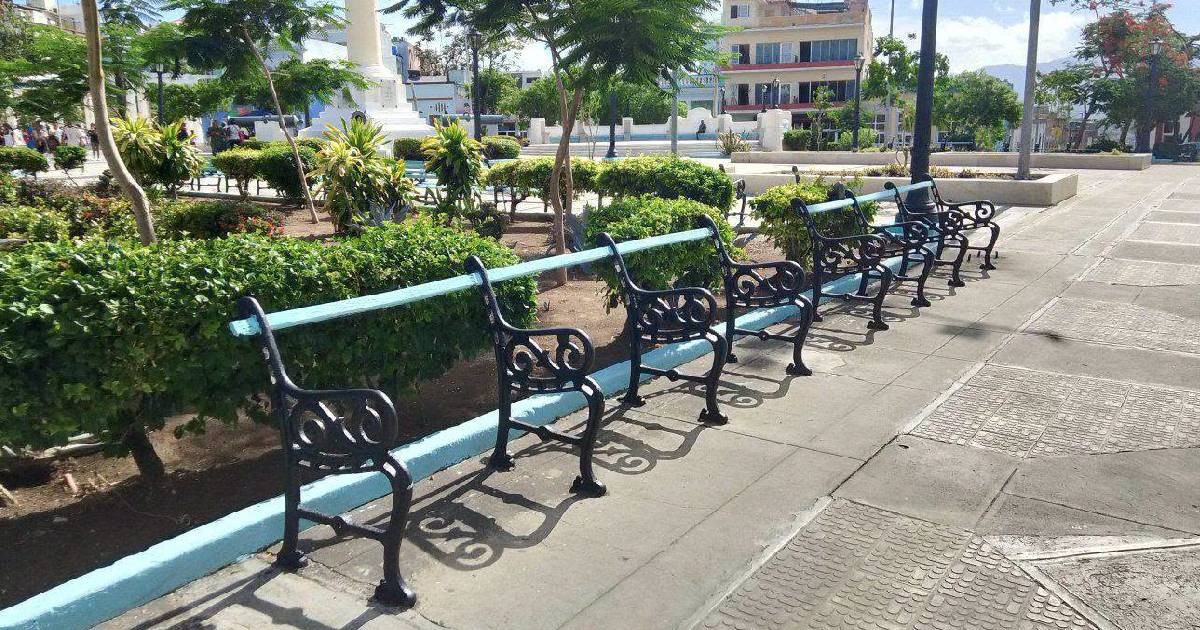
The wooden planks from the benches in Plaza de Marte, the most iconic public space in Santiago de Cuba, were reportedly torn out to be used as firewood for cooking, according to images published by the official newspaper Sierra Maestra on their Facebook page.
What makes this fact particularly revealing is who is denouncing it: the official organ of the Communist Party in the province, which titled its publication "The Woodpile" and asked its followers whether it was a matter of "social indiscipline or negligence."
The photographs show the benches with their black wrought iron structure and intact ornamental designs, but the seat and backrest planks—painted in turquoise blue—are completely gone or destroyed.
The square was restored in 2018 with the rehabilitation of urban furniture, and in December 2023, the official Granma reported new conservation works that included the replacement of materials, repairs to the electrical system, street lamps, and lighting fixtures.
Only in December 2025, the same outlet reported on a "revival" of the environment as part of a beautification plan for Santiago's historic center.
The deterioration occurs in the context of an energy crisis that has driven many Cubans to seek firewood as an alternative due to power outages, which in some provinces exceed 20 hours a day.
Santiago de Cuba has been one of the most affected areas: in March and July 2026, it recorded protests and pot-banging linked to power outages, and the provincial headquarters of the Communist Party—located precisely in Plaza de Marte—was militarized out of fear that the demonstrations would spread.
The pattern of destruction of urban furniture is not exclusive to Santiago. In July 2026, destroyed benches and ruined pools in public spaces of Havana evidenced the same phenomenon with no official response.
This Saturday, in Matanzas, the disappearance of a section of metal railings from a historic bridge was reported. In 2022, also in Matanzas, more than 40 benches and trash cans from a park were stolen.
In the past two years, thefts of telecommunications radio bases, solar panels, and steel bars from public infrastructure have also been documented across the island, in what experts and activists describe as a survival dynamic in the face of the state's collapse.
The Plaza de Marte is home to a tower-monument approximately 20 meters high dedicated to the Liberation Army, as well as busts of José Martí, Montes de Oca, and Camilo Cienfuegos, and is regarded as one of the most respected sites in the city.
That the state media itself documents its deterioration—without offering answers or announcing measures—summarizes the contradiction of a regime that restores facades while the crisis it generated destroys them.
Related videos:
Filed under: