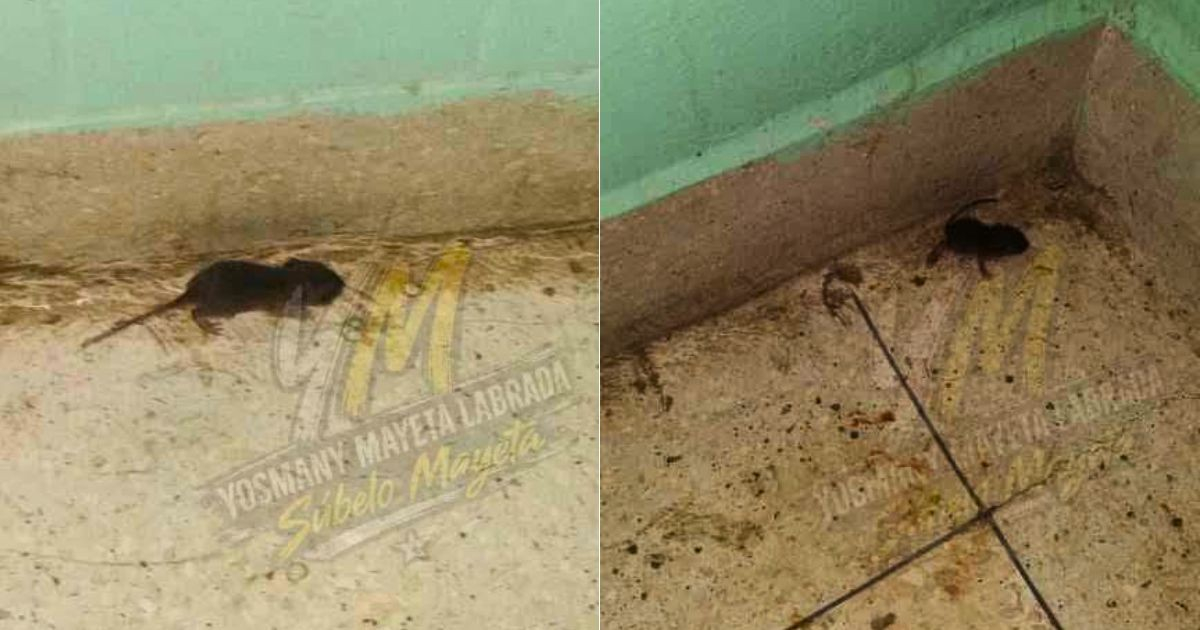
A baby rat was spotted this Friday moving across the floor of room 3I in the Perinatology department of the Juan Bruno Zayas Clinical Surgical Hospital, in Santiago de Cuba, in images shared by journalist Yosmany Mayeta Labrada on his Facebook page as part of a citizen's complaint.
According to the complaint received by Mayeta Labrada, the rodent was seen early in the morning inside the area designated for the care of pregnant women and patients requiring specialized monitoring.
The photographs show the animal—dark brown in color—stuck to the wall of mint green painted blocks, a characteristic of Cuban hospital facilities, while the terrazzo floor is stained with dirt and shows visible wear in several areas.
"The presence of rodents would be concerning in any healthcare institution, but it is even more serious in an area designated for the care of pregnant women and patients who require specialized monitoring," wrote Mayeta Labrada when posting the images.
The journalist directly pointed out the seriousness of the finding: "We are not talking about a garbage dump or an abandoned building. We are talking about Perinatology, within one of the main hospitals in Santiago de Cuba."
And he added a question that encapsulates the essence of the problem: "Where are the hygiene, rat control, and vector control protocols for a provincial hospital?"
The reaction on social media was immediate. While some users expressed outrage with phrases like "speechless" or "how disgusting," others pointed out that the situation goes beyond just the rodents. "And what about the cockroaches and bedbugs, because there are plenty of those," wrote one user. Another comment, with a tone of resignation, summed up the feelings of many: "Nothing surprises me about this country anymore."
What happened this Friday is not an isolated incident at that hospital. Since late 2025, the Juan Bruno Zayas has accumulated a series of complaints regarding unsanitary conditions: broken bathrooms and flooded hallways in room 5D in November of that year; cockroach infestation in the maternity ward in December; sewage water running under the beds of patients in room 5B in January 2026; and, just last month, new images of bathrooms with rusted toilets, severe humidity, and newspaper used as a substitute for toilet paper.
Institutional responses have been limited: occasional donations of mattresses and transfers of services, without addressing the underlying structural deterioration.
The issue of rodents in Cuban hospitals is a widespread phenomenon. In May 2026, rats were reported in the halls of the National Hospital Enrique Cabrera in Havana. Earlier, in February 2025, it was reported that the rodents "are roaming freely" in the León Cuervo Rubio Hospital in Pinar del Río. Infestations have also been documented in hospitals in Holguín and Contramaestre.
This situation takes on an additional dimension of risk: in May 2026, the Ministry of Public Health activated epidemiological surveillance for hantavirus —a disease transmitted specifically by rodents— although it clarified that "there is no documented presence" of the virus in Cuba.
The hospital health crisis is part of a broader collapse of the Cuban health system. The UN reported in May 2026 that Cuban hospitals were suspending surgeries due to power outages and a shortage of fuel and supplies. According to reports from that same year, the system had accumulated surgical waiting lists of 96,387 patients, including 11,193 children.
LUNCH AFTER 5:00 PM
In addition to the presence of rats in the Perinatology room, another complaint emerged this Friday regarding the delays and the feeding conditions of pregnant women hospitalized in the Santiago health center.
"A patient reported to this page that today, Friday, there was no lunch, and the food was not delivered until approximately 5:26 in the afternoon. The source also shared a photograph of one of the served portions, mainly composed of rice and picadillo," reported journalist Mayeta Labrada.
"How can a meal delivered when it's practically the late afternoon-evening be called 'lunch'? We are talking about pregnant women admitted to a hospital, some of whom have special nutritional needs..." the reporter pointed out. He concluded, "Each new image coming from the Juan Bruno Zayas Clinical Surgical Hospital raises a more uncomfortable question: what are the actual conditions under which pregnant women in Santiago de Cuba are being cared for?"
Related videos:
Filed under: