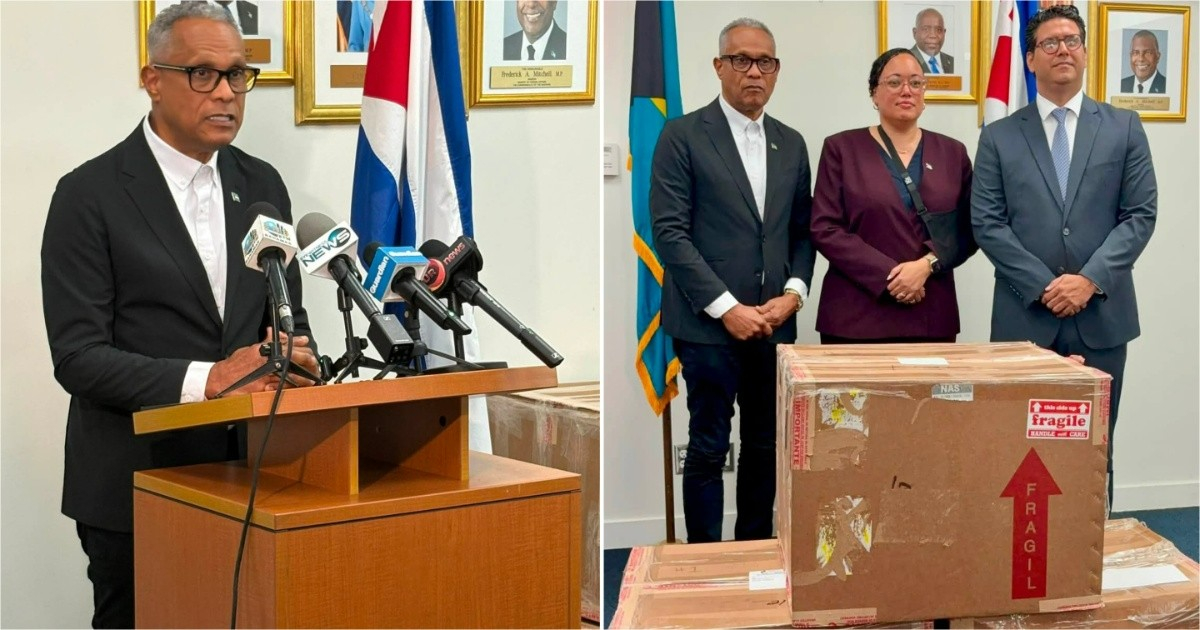
The Government of Bahamas announced on Friday the dispatch of the first of three shipments of medications intended for the treatment of cancer in Cuban children, in a humanitarian gesture that arrives at a time when the health system of the island is experiencing an unprecedented crisis acknowledged by the regime itself.
The announcement was made at the Lynden Pindling International Airport in Nassau by the Bahamian Minister of Health, Michael Darville, along with the Cuban ambassador Juan Carlos Marcof Sánchez and the Director General of the Bahamas Ministry of Foreign Affairs, Jerusa Alí, according to the Cuban embassy in that country.
Darville emphasized his government's commitment to humanitarian cooperation and recalled the solidarity that Cuba provided to the Bahamas during the COVID-19 pandemic as a precursor to this initiative.
The Cuban ambassador, for his part, took advantage of the event to criticize Washington and attribute the island's health deterioration to the U.S. embargo, noting that the donation arrives "at a particularly complex moment for Cuba, marked by the intensification of the economic, commercial, and financial blockade imposed by the United States."
Marcof Sánchez cited figures that the regime itself has acknowledged: the survival rate of children with cancer has dropped from 85% to 65%, infant mortality has doubled, and 100,000 patients are waiting for surgery in Cuba, including 12,000 children.
However, the Cuban healthcare collapse is not solely due to external factors. The deterioration of the Cuban healthcare system has deep structural roots: decades of underinvestment, reliance on imports for medication production, an energy blackout that disrupts chemotherapy and hospital logistics, and an economic model that has led the country to bankruptcy.
In April of this year, 461 of the 651 essential medications in the basic supply were out of stock in Cuban state pharmacies, more than 70% of the list. The Minister of Public Health himself, José Ángel Portal Miranda, had described the situation in July 2025 as an "unprecedented structural crisis."
The Bahamian donation adds to a chain of international aid that Cuba increasingly relies on to maintain its healthcare system. So far in 2026, the island has received medications from Russia, from Brazil, and from Venezuela, in addition to over seven tons sent by Belgium and the organization Open Arms in July. The UN activated a humanitarian plan worth 94.1 million dollars for health and nutrition in the island in April.
The episode also has a paradoxical dimension: the same Minister Darville who led the delivery of medications this Friday was the one who announced in June 2025 the cancellation of contracts with Cuban medical brigades in the Bahamas, partly due to pressure from Washington. By July 2026, only three Cuban doctors remained in the archipelago.
The regime takes advantage of every donation to build a narrative of international solidarity, while silencing the internal causes of the health disaster that forces Cubans—especially children with cancer—to rely on the generosity of others to access treatments that the State can no longer guarantee.
Related videos:
Filed under: