
Related videos:
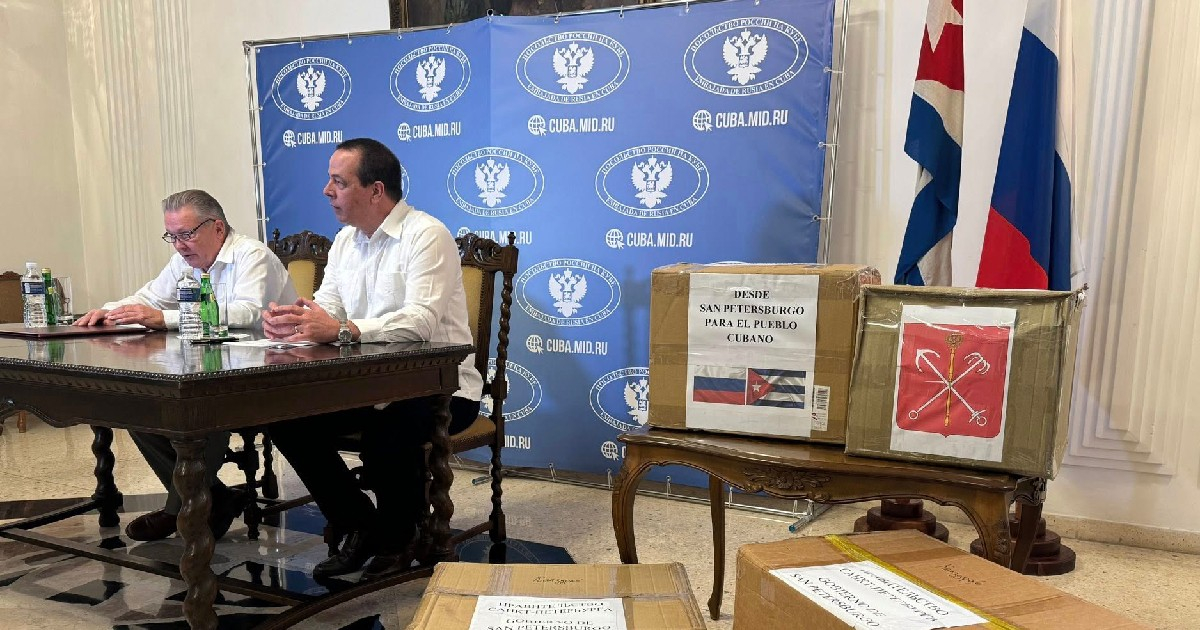
The Government of Saint Petersburg delivered a humanitarian shipment of medications to the Cuban regime this Friday in a ceremony held at the Russian Embassy in Havana, in a gesture that authorities from both countries presented as a symbol of bilateral friendship, but which barely scratches the surface of an alarmingly large health crisis.
According to reports from official media such as ACN and Cubadebate, Russian ambassador Víctor Koronelli personally delivered the shipment to Cuba's Minister of Public Health, José Ángel Portal Miranda. The batch, prepared under the leadership of Governor Aleksandr Beglov, includes 35 types of medications: paracetamol, omeprazole, sodium heparin, calcium chloride, clotrimazole, infant formula, carbamazepine, and ibuprofen, intended for hospitals and clinics on the Island.
Simultaneously, Sputnik reported, two more shipments arrived directly in the provinces of Matanzas and Santiago de Cuba, which have been sister cities with St. Petersburg since 2025, thereby extending the geographic scope of the donation.
During the event, Koronelli framed the delivery within the usual political discourse of the Kremlin. "The donation of this batch of medication is not merely an act of humanitarian aid, but a clear demonstration of the deep and historical bonds of friendship that unite our peoples," he stated. The diplomat also attributed the Cuban crisis to the U.S. embargo and reiterated Russia's opposition "to any form of pressure," defending the right of countries to choose "freely their own path of development."
The minister Portal Miranda expressed gratitude for the donation and acknowledged that the aid comes at a time of "great need." His own words reveal the magnitude of the crisis that no one-time donation can remedy: in February 2026, the official himself admitted that the Cuban health system is "on the verge of collapse" and that the underlying issues "will not be resolved" without external funding.
The reality in the nation's pharmacies and hospitals contrasts sharply with the images from the diplomatic ceremony. Only 30% of the basic medication stock is available in state pharmacies, with 461 out of 651 essential drugs out of stock. The Cuban Observatory of Social Rights reported that only 3% of citizens found the medications they needed in state pharmacies in September 2025. The agony of finding medications in Cuba has become a constant struggle affecting all pharmaceutical families.
Surgical waiting lists have reached 96,387 patients, including 11,193 children, while around 16,000 cancer patients lack proper care. The infant mortality rate closed 2025 at 9.9 per thousand live births, nearly triple the 3.9 recorded in 2018, and in Havana, it reached 14 per thousand. The World Health Organization described the situation as "deeply concerning" in March 2026. Additionally, the Cuban regime has reduced medical services and surgeries due to a lack of resources and basic supplies.
The Russian-Cuban healthcare cooperation is not new. St. Petersburg had already sent medications and food for neonatal care to the Matanzas Maternal Hospital in December 2025, and Russia donated 26 tons of medications and medical supplies to Cuba in August 2023. In January 2022, a shipment provided nearly twenty tons of supplies valued at two million dollars. Despite these accumulated shipments, the crisis in Cuban hospitals persists and the shortage remains structural.
The deep-rooted cause of the collapse, beyond the embargo, as the Kremlin's narrative and the regime insist, is more than six decades of poor state management, corruption, obsolescence of the national pharmaceutical industry, and massive brain drain of medical talent.
In light of the magnitude of the disaster, the UN activated a humanitarian plan of $94.1 million in April 2026 to address health and food needs on the island, a figure that underscores the vast gap between symbolic donations and the actual scale of the emergency.
Filed under: