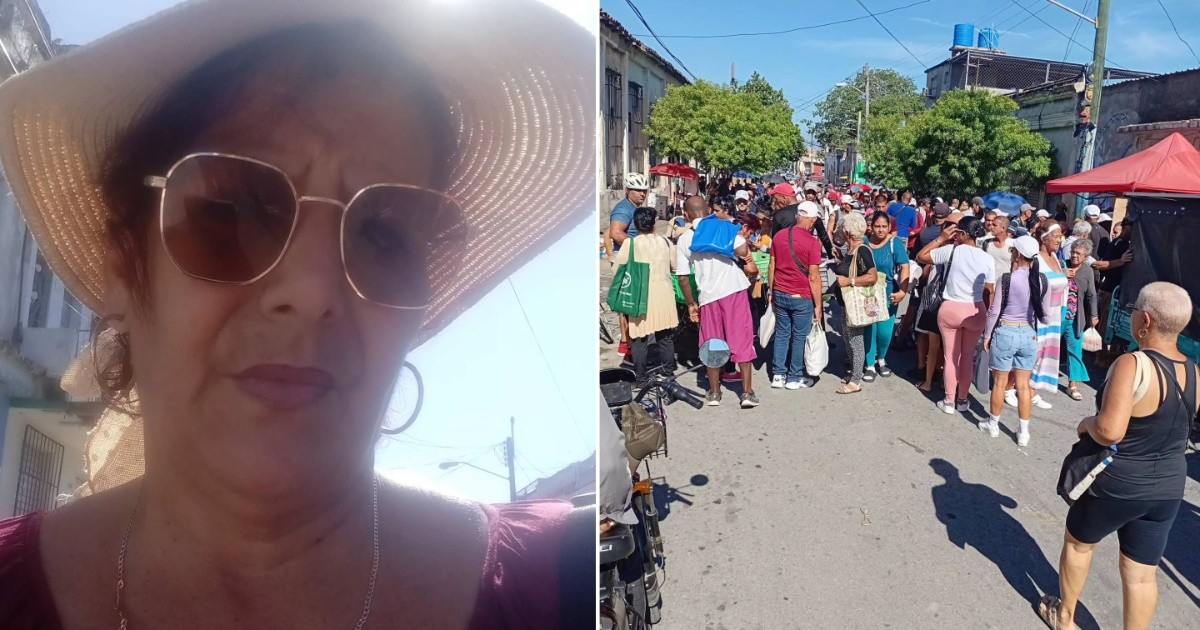
Yanet Rojas Rodríguez had not left her home for two years due to health issues when this Saturday she decided to make the effort to go to the fair at Calzada de Cienfuegos to purchase essential goods.
The outcome was a total disappointment: no seller accepted payment by transfer, and they returned empty-handed and with physical discomfort, as reported on their Facebook profile.
The woman, a resident of the Junco Sur neighborhood, explained that transfers are also not accepted in her area, which forced her to travel to the Calzada without any results. The excuses she heard from the vendors were the usual ones: “I don’t have a card, I don’t accept transfers, you can only buy one product via transfer, I reached my limit.”
"DISAPPOINTMENT is the key word, many offers... but NOBODY accepted transfers," she wrote in her Facebook post, where she also denounced speculative pricing and the presence of resellers who continue to profit while those earning a salary cannot afford even the basics to feed themselves.
Yanet directly questioned the provincial authorities: "Where is the administration of this Province, to ensure that the laws published in the Official Gazette are enforced?"
The situation you describe is not an isolated case. According to data from the press in July 2026, only 3.77% of transactions in Cuba were digital, and in provinces like Sancti Spíritus, less than 10% of private businesses regularly accepted transfers. The official press itself had acknowledged the failure of the banking process, labeling it as "a social problem."
The regime responded with coercive operations: by the end of this week, there were more than 15,240 fines and 269 closures nationwide due to non-compliance related to electronic payment. On Wednesday, five businesses in Bayamo were closed for not accepting transfers, and on Friday, authorities in Guantánamo threatened with fines and closures for those who refuse to accept digital payments.
However, the causes of the problem are structural. A commentator identified as Mary Aleman explained it clearly: “The blame is not on the sellers; it lies with the BPA, which tells self-employed workers that there is no money available when they go to withdraw from their cards.” Without cash available to restock, vendors cannot operate with transfers. The Metropolitan Bank has even reduced the withdrawal limit to 3,000 CUP per transaction, and intermediaries charge commissions ranging from 30% to 45% to obtain physical currency.
The Central Bank itself implicitly acknowledged the failure by issuing the Resolution 74/2026, effective from July 20, which removed the rigid cap of 5,000 CUP for cash payments among economic actors, thereby dismantling the scheme that had been imposed three years earlier.
Osmani Becerra Peña, one of the commentators who responded to Yanet's post, summed up the prevailing sentiment: "Unfortunately, anywhere you go, you will experience the same; those of us who work with the State are somewhat cursed."
"Speechless. How long will this last, for God's sake. The situation we are in is quite complex," wrote another follower, Idelma Frometa Ibañez, before adding what many Cubans think but few dare to say out loud: "From what I see, there is no hope for change at least in the short term."
Related videos:
Filed under: