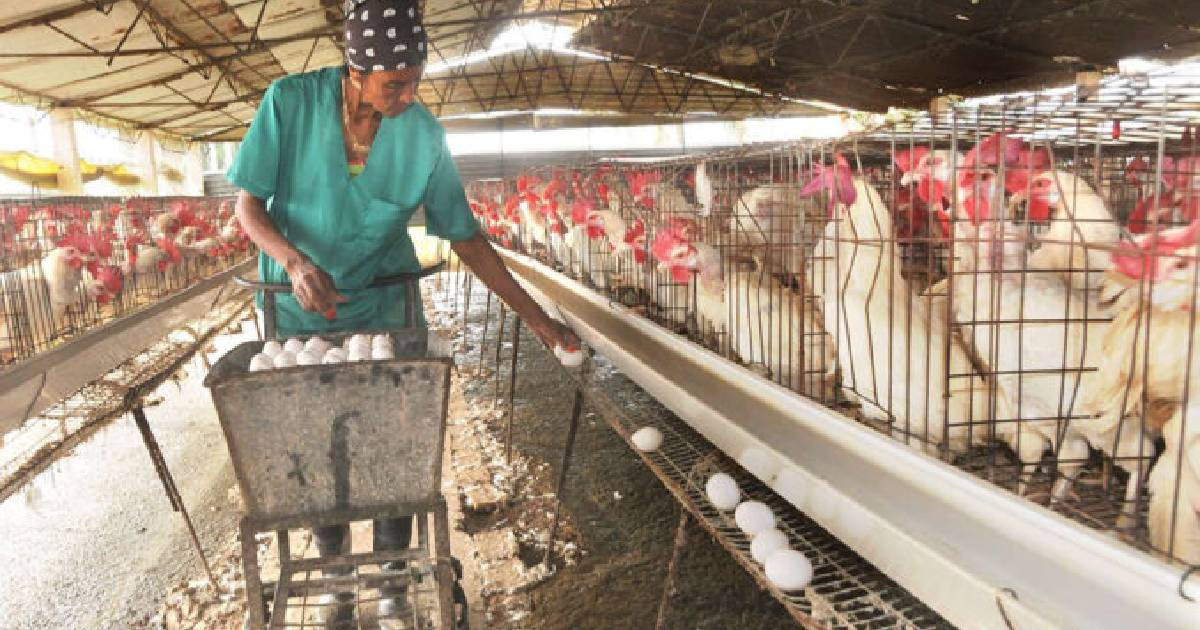
The province of Granma raises over 460,000 hens and has supplied more than 64 million eggs so far this year, but a portion of that production does not reach the tables of Cubans in pesos; instead, it is sold in freely convertible currency.
"Eggs are allocated for both social consumption and sales in freely convertible currency, with priority given to ensuring the basic diet of the population and health programs," acknowledged a report on the digital page of the station Radio Bayamo this Friday.
According to the media, poultry farming in Granma "shows signs of recovery with the incorporation of cooperative schemes among state companies, mipymes, and private producers."
In July 2025, the official newspaper Granma reported that five agricultural producers, three private SMEs, and one state-owned entity remained linked to cooperative production, with a total production of 64,852,900 eggs up to that point.
As of the end of May 2025, "29,244,000 eggs have been sold in freely convertible currency, generating $4,919,385, which have allowed for the payment of 7,453.6 tons of feed through this scheme," the official organ of the Communist Party of Cuba emphasized.
The paradox is hard to ignore; while Granma produces tens of millions of eggs, prices in the informal market of the province have skyrocketed to levels that most of the population cannot afford.
In Guisa, a municipality in Granma, the reported price this week is 110 pesos per unit.
Consumers from several provinces reported prices close to 200 pesos per unit, while others reported prices of up to 300 and 320 pesos.
In Bayamo, the provincial capital, the carton of 30 eggs reached almost 4,000 pesos in June, while pensions range between 2,000 and 3,000 pesos per month.
The minimum wage in the budgeted sector was set at 3,210 pesos in July, which means that buying a dozen eggs can cost nearly two full minimum wages.
This collapse in access to eggs is a direct consequence of the poultry crisis that has plagued state management for years. Cuba went from producing between four and five million eggs daily to barely 1,200,000, admitted in October 2024 by then Minister of Agriculture Ydael Pérez Brito.
Total production fell from 2,358.4 million units in 2022 to 415.3 million in 2024.
To offset the deficit, the government imports eggs from the Dominican Republic, Colombia, and the United States. The Dominican Republic resumed its exports to Cuba on July 24 with an initial shipment of 12 containers and nearly four million units, subsidized by the Dominican government at a rate of $4,500 per container.
Related videos:
Filed under: