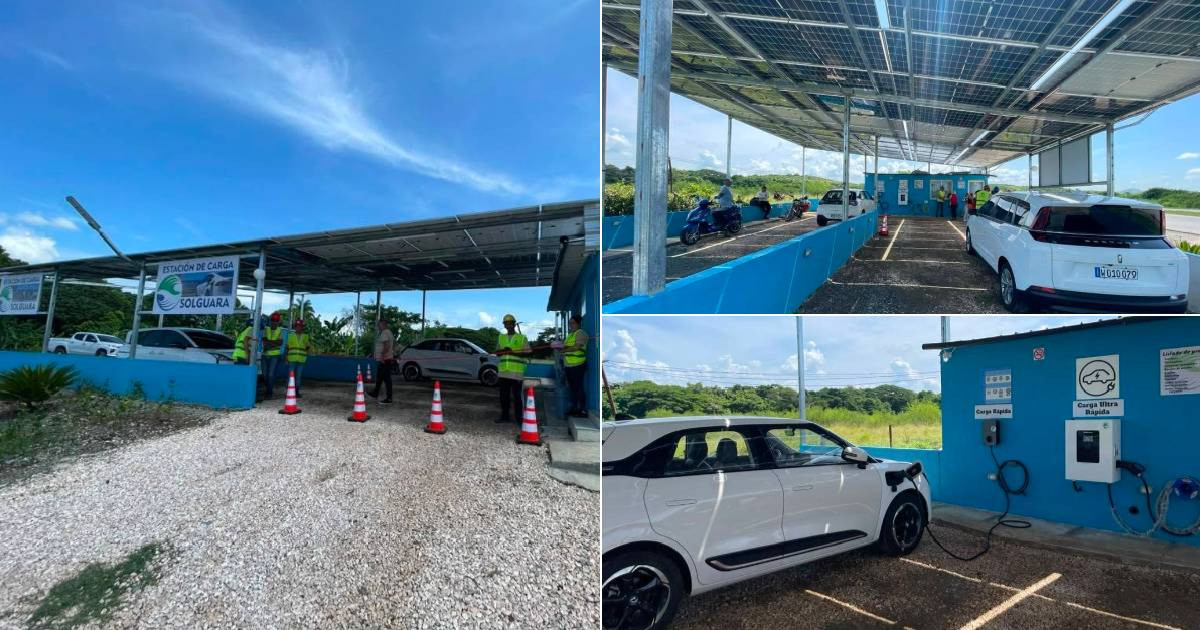
In the context of the festivities for July 26th, the authorities of Villa Clara inaugurated at least four new solar charging stations in that central province, including the first fast and ultra-fast charging station for electric vehicles in the country, operated by the private micro, small, and medium-sized enterprise Solguara.
The Solguara installation, located at kilometer five of the Santa Clara exit highway, is the most notable in the group, as it operates completely independently from the National Electric Power System, being fully powered by photovoltaic solar panels.
It offers two service levels —Fast Charging and Ultra Fast Charging— and connectors compatible with various international standards, according to a report published on July 29 by the Facebook page La Energía al Día.
The price list at the station reflects the reality faced by Cubans: charging cell phones, fans, and rechargeable lamps is free, while charging cars with their own charger costs 1,000 Cuban pesos, and using the station's charger is charged at 0.80 CUP per kilowatt.
The other three inaugurations complete a map of new energy infrastructures distributed throughout different neighborhoods of the city.
The micro, small, and medium-sized enterprise Leos opened in the lower levels of the 12-story buildings in the Sandino neighborhood of Santa Clara a "solinera," as this type of establishment is commonly known, featuring an installed capacity of 10 kilowatts, 18 solar panels, and 20 kilowatts of backup battery power; it offers free charging for cell phones, fans, and cooking food.
In the José Martí neighborhood, the small and medium-sized enterprise Alemanes Express launched another station with a capacity of 10 kilowatts, offering charging services for electric vehicles, mobile devices, and food preparation, from 10:00 a.m. to 6:00 p.m.
The Electromechanical Company of Villa Clara installed a container with a capacity of six kilowatts in the Ciro Redondo neighborhood, available at the same hours for cooking food and charging mobile devices.
The Sandino neighborhood, where Leos' gas station is located, is one of the areas most affected by the electrical crisis in the province: its residents have experienced over 112 consecutive hours without electricity starting from July 7, 2026, more than five days without power.
The proliferation of "solineras," a Cuban neologism that combines "solar" and "gas station," occurs as a decentralized response to the worst energy crisis the country has faced in decades.
Santa Clara inaugurated the first solar station in Cuba on April 5 in the Virginia popular council, built in just nine days with 56 solar panels, 30 kilowatts of power, and 60 kilowatt-hours of storage.
The National Electric System has experienced eight total blackouts in 18 months and records daily significant generation deficits, resulting in continuous outages that exceed 24 hours in several locations.
The situation worsened since January with the suspension of Venezuelan crude oil shipments and the halt of Mexican oil exports due to pressure from sanctions imposed by the Trump administration.
The model has been implemented across the entire island. Matanzas plans nine collective charging points, Havana announced the opening of a station in Vedado, Holguín has already inaugurated its station, and more than 15 of these locations are being built in Guantánamo.
Meanwhile, Cuba approved at the beginning of August that imported electric vehicles, along with a renewable charging station, are exempt from taxes and tariffs. This measure strengthens the electric mobility ecosystem that these facilities aim to support.
Related videos:
Filed under: