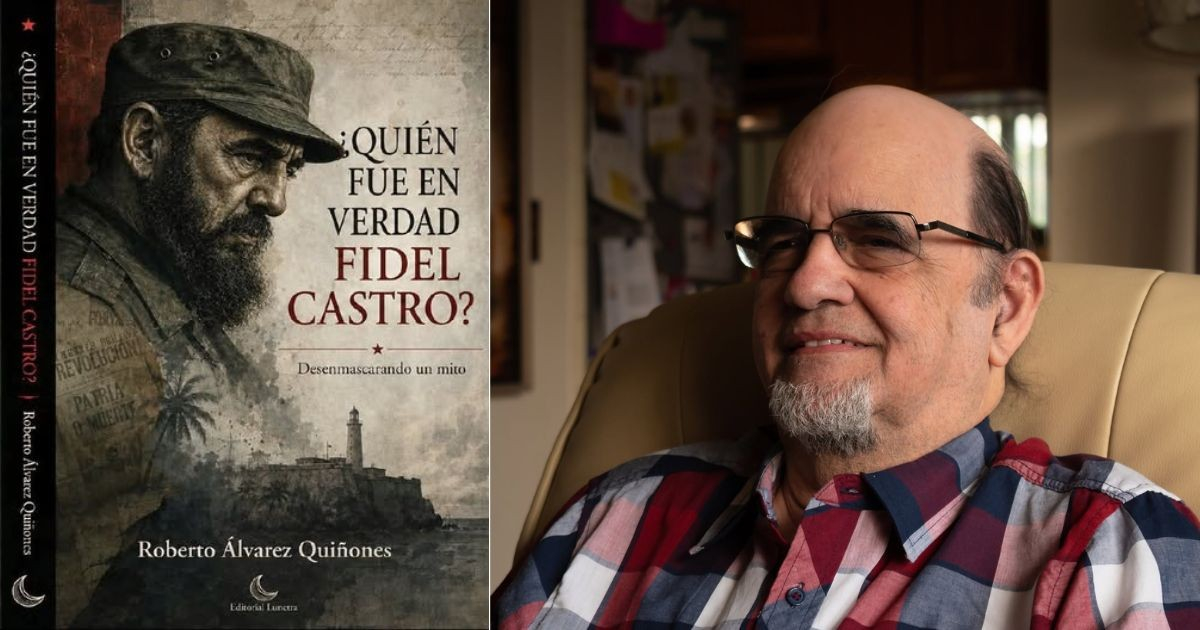
The book “Who Was Fidel Castro Really?: Unmasking a Myth”, by journalist and historian Roberto Álvarez Quiñones, will be presented on Saturday, August 29, at the gathering “Lunetreando en Miami”, organized by Lunetra Publishing under the direction of writer and editor Pablo Socorro.
The meeting will take place at the cultural space Sentir Cubano, located at 3100 SW 8th St (Calle Ocho), Miami, starting at 2:00 p.m. It will be dedicated to what the organizers call an "anti-homage to the Monster of Birán," referring to Fidel Castro, who was born in Birán, Cuba, on August 13, 1926.
The presentation takes place at a time of intense editorial battle surrounding the figure of the Cuban dictator: 2026 marks the centenary of his birth, and from the Island the regime has promoted works of exaltation such as "Voices with Fidel. Memory and Revolutionary Legacy", while from exile and dissent, critical titles have proliferated that seek to counter this official narrative.
According to the review of the book published by Pablo Socorro on his Facebook account, it raises a question that permeates the entire work from the outset: "Who was Fidel Castro really? The liberator who promised a new nation, or the architect of a system that stifled fundamental freedoms? The brilliant strategist, or the leader who for decades confused his personal destiny with that of an entire people?"
The text warns that "when a regime controls education, the press, culture, and the historical narrative for decades, the line between the real person and the manufactured character becomes blurred. Then history ceases to be a quest for truth and turns into an exercise of veneration."
What sets this work apart from other critical approaches to Castroism is the background of its author. Álvarez Quiñones—born in Ciego de Ávila in 1941 and holding a degree in History from the University of Havana—does not write from outside the system: he worked as an international commentator on Cuban television and as a journalist for the newspaper Granma before breaking with the regime and settling in the United States in 1995.
Since then, he developed an extensive career in exile media: he was the editor and economics columnist for the Los Angeles newspaper La Opinión for twelve years, an economic analyst for Telemundo California, and a columnist for publications such as ABC in Madrid, Independent in London, and El Nuevo Herald. He is the author of eight books and a member of the Academy of History of Cuba in Exile.
The text by Socorro emphasizes that this internal experience "does not replace documentary evidence, but it does provide a perspective that few authors can offer." The work, according to the same text, "does not aim to destroy one myth to create another," but rather "invites readers to review facts, compare accounts, and consider how much of what has been presented as historical truth for decades would withstand a dispassionate examination."
The reader will find, as the prologue announces, "well-known episodes alongside others that are much less publicized; documents, testimonies, anecdotes, and historical comparisons that aim to create a different portrait of the Cuban leader. Some conclusions may be uncomfortable; others will even surprise those who believe they are well acquainted with Cuba's recent history."
As a commercial singularity, the book will not be available through Amazon. Pablo Socorro explained that "due to editorial disagreements —and not principled ones— with Amazon […] the book could not be published on that platform, so it had to be uploaded to Lulu.com," where it is now available for purchase. The editor promised to detail the reasons for the disagreement with the platform in an upcoming article.
This title adds to other editorial efforts by the Cuban exile community to demystify the figure of Castro in the year of his centenary, including "El lector Fidel" by Cuban writer Michael H. Miranda, which challenges the image of the dictator as a great intellectual.
Socorro concludes his review of the volume with a statement that captures the spirit of the work: "No revolution, no ideology, and no leader should ever be placed above the truth. Only when myths are subjected to the scrutiny of facts does history truly begin."
At the very presentation gathering of Álvarez Quiñones' book, the volume "I'm Going to Write a Letter to the Commander - Chronicles of an Exile" by Lilo Vilaplana will be launched. It is, as reported in another post by Pablo Socorro, a "compilation of articles and reflections published on social media by the renowned filmmaker and writer."
Related videos:
Filed under: