The Cuban regime is once again resorting to controls, fines, and citizen reports against merchants amidst the rising food prices, just weeks after publicly acknowledging the failure of price ceilings and removing national limits on several basic products.
The Municipal Administration Council of Plaza de la Revolución has set up a WhatsApp number for the public to report private or state businesses for “abusive and speculative prices”, among other alleged irregularities that the organization has reported on its social media.
The authorities request to provide the name and address of the business, date and time of the incident, an explanation of what happened, and the complainant's information. “Write clearly to facilitate the response action,” states the publication, accompanied by the slogan “Zero Tolerance.”
The initiative revives a long-standing practice under the Cuban regime: engaging citizens in mechanisms of surveillance and reporting on other citizens.
Although channels for reporting commercial irregularities exist in numerous countries, in Cuba the initiative takes on a different dimension due to its combination with the language of "confrontation," inspections, fines, forced sales, and business shutdowns.
From the failure of the barriers to regaining control
The offensive is particularly contradictory because Miguel Díaz-Canel himself acknowledged on June 18 that the caps had failed.
Price ceilings in practice did not succeed in containing inflation, he admitted at the time, and acknowledged that they had caused “the disappearance of products, shifts towards illegal markets, higher prices” and a race between real prices and administrative decisions.
That's why we are not going to continue adjusting prices in a general way, he assured.
Three days later, the formally eliminated the national price ceilings for chicken pieces, oil, powdered milk, pasta, and sausages. The decision coincided with the 176 economic measures announced by the regime, which included a more decentralized pricing formation based on market references.
But prices skyrocketed while the structural causes of the crisis remained: shortages, a decline in production, depreciation of the peso, high costs, and difficulties in accessing foreign currency.
Now the regime is backtracking.
Fines for oil at 4,500 CUP
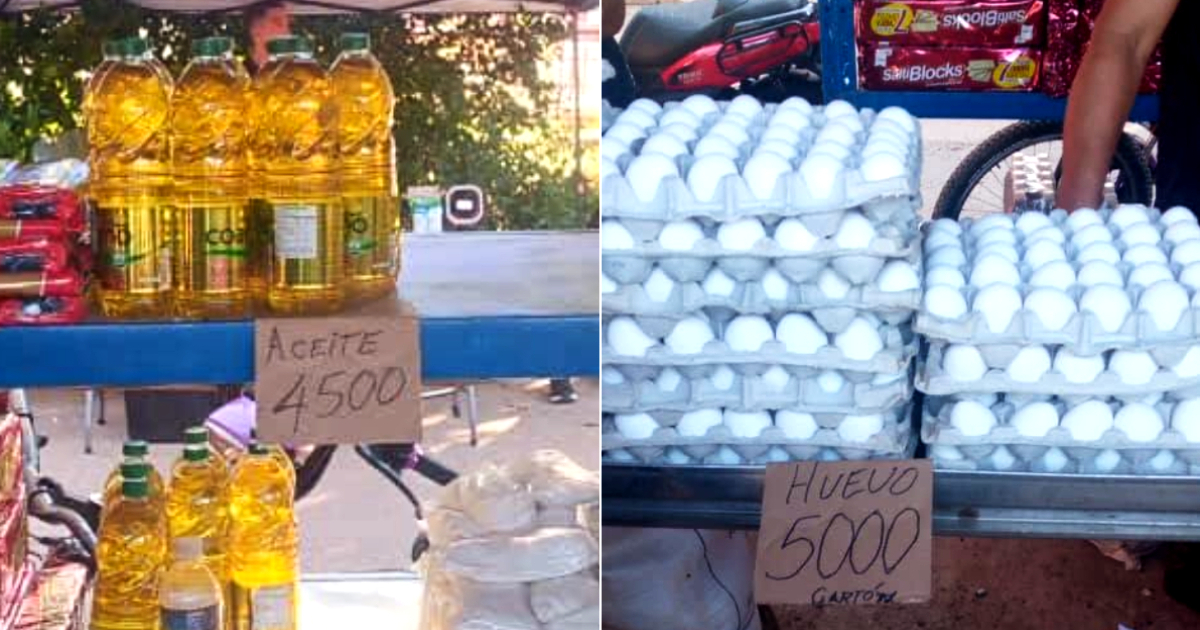
During an inspection conducted at the Municipal Fair in John Lennon Park, the authorities of Plaza de la Revolución reported eggs at 5,000 CUP, oil at 4,500, ground meat at 750, and sausages at 1,200 CUP, prices they deemed “speculative.”
The responsible parties received fines of 10,000 CUP. There were also sanctions for other irregularities, forced sales, and temporary shutdowns of establishments.
Fines related to prices are based on article 7, section l), of Decree 30 of 2021, which imposes penalties ranging from 8,000 to 10,000 CUP for the application of “abusive or speculative” prices.
The regulation defines as "abusive" a price increase above a "reasonable range" aimed at achieving an "excessive" profit, concepts that leave a considerable margin for administrative interpretation.
The contradiction is particularly evident with oil and sausages: these are precisely two of the products whose national price caps were lifted in June.
If the State has removed the maximum price for oil, what transparent reference now determines that selling it at 4,500 CUP deserves a sanction?
Stop, release, pursue, and report
The journey summarizes the ebb and flow of Cuban economic policy: the regime imposed price controls, acknowledged shortages, publicly recognized its failures, lifted the controls, and when prices rose again, intervened through local governments, inspections, and sanctions.
None of this addresses the reasons that allow a liter of oil to reach 4,500 CUP. An inspector does not increase national production, a fine does not strengthen the peso, and a forced sale does not lower import costs.
On social media, Cubans are labeling the new measures as a return to "failed methods" and criticizing the call for citizen reporting of merchants as a solution to rampant inflation.
The paradox is that Díaz-Canel himself explained less than two months ago where this policy leads: the disappearance of products, illegal markets, and rising prices.
However, in the face of inflation that cannot be controlled by addressing its causes, the regime returns to the familiar remedy: intervening in prices, punishing the seller, and now also asking neighbors to report them.
Related videos:
Filed under: