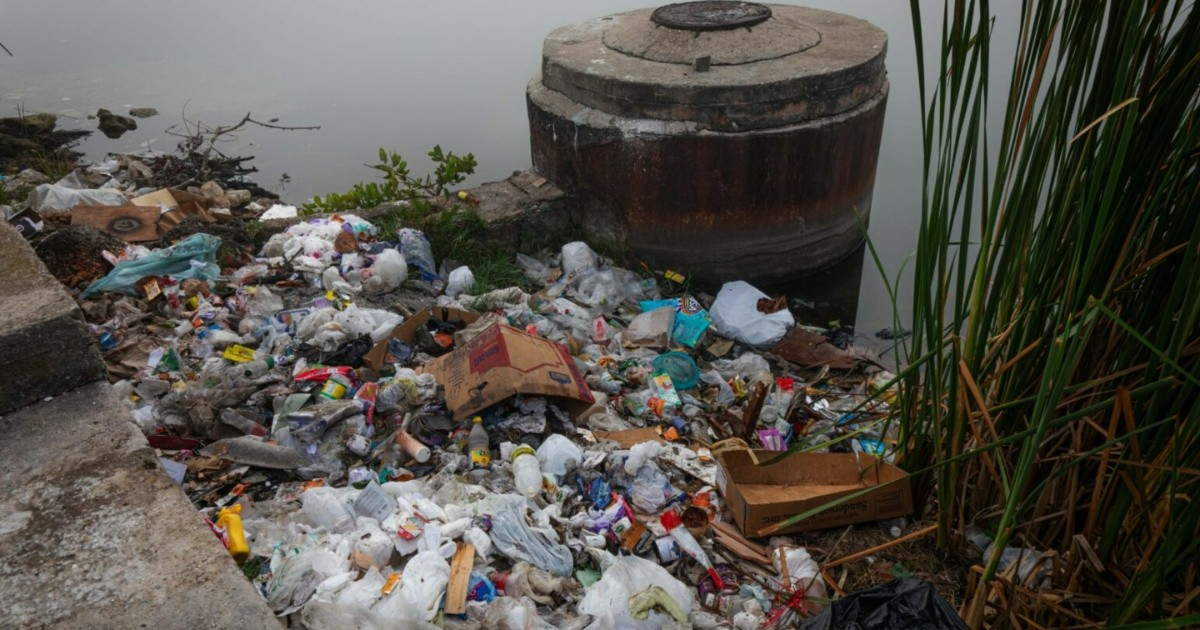
A photo report from the newspaper Girón published this Sunday starkly depicts what happens in Matanzas each time there is a torrential downpour: water floods streets, ditches, and avenues, carrying away bags, bottles, containers, and waste accumulated over the days, eventually dumping it into the rivers and bay of the city.
The images, captured by photojournalist Raúl Navarro González, document the mechanism of pollution that repeats itself with every downpour: some of the waste disappears through the sewers, but the rest follows the current until it reaches bodies of water. "The rain does not create the trash. It only reveals where it ultimately ends up," the report states.
From the bay, the perspective is even more eloquent. A fisherman who considers it the most beautiful in Cuba observed during the downpour how the current arrived laden with debris. "For some, the rain seems to clean the streets; for those who live off the river and the bay, it can signify the beginning of a new buildup of waste," the text from Girón notes.
What the photographs show is not an isolated phenomenon, but the visible consequence of a sanitation crisis that has been worsening for months. The Municipal Communal Enterprise operates with barely 11 of its 24 collection trucks, immobilized by the shortage of diesel fuel: the daily allocation ranges from 300 to 550 liters, when over 2,700 are needed to cover all routes. Of an estimated 1,400 workers, only 930 are active.
This deficit has filled the city with micro-dumps. Neighborhoods like Versalles, Embarcadero, and La Marina accumulate garbage and wastewater without any solutions offered by the authorities. With the onset of the rainy season, this waste finds its way directly into the San Juan and Yumurí rivers, and from there into the bay.
The health consequences are already being documented. At the beginning of June, authorities confirmed an outbreak of hepatitis A with seven new positive cases and 49 suspected cases in just one week, primarily concentrated in the Versalles neighborhood, from the area of Plácido pharmacy to the Yumurí River. More than 300,000 residents of the province lack a stable supply of drinking water.
The problem has deep roots. Academic studies identified 45 contaminating sources in the bay of Matanzas —34 indirect and 11 direct— and the rivers flowing into it contributed 61 tons of organic load daily. As early as 2018, the Yumurí was described as a landfill for solid waste, with agricultural, domestic, and industrial residues being discharged into its lower stretch.
In May, Girón himself warned that "what is at stake is no longer just the image of Matanzas, but the health and future of those who live there." The photo report this Sunday confirms that nothing has changed.
"The bay remains beautiful, but it continues to bear the consequences of what is happening inland, rainstorm after rainstorm," concludes the report from the official Matanzas media, an admission that reflects the regime's failure to ensure minimum sanitation conditions for its citizens.
Related videos:
Filed under: