The ruler Miguel Díaz-Canel concluded the XXIV International Meeting of Communist and Workers' Parties on Saturday, held at the Palace of Conventions in Havana, with a speech in which he defended the ongoing economic transformations and stated that both state and non-state enterprises must focus on a "single purpose": "to build the prosperous and sustainable socialism that the heroic Cuban people deserve".
The intervention took place five days before the centenary of Fidel Castro's birth, which is celebrated on August 13, and around which the Cuban regime has organized numerous activities.
When addressing economic transformations, Díaz-Canel sought to clarify to representatives of communist and workers' parties that the measures do not imply a abandonment of the model: "It is a process to invigorate the economy, not to establish capitalism; there will be no extreme privatization, the fundamental means of production remain in the hands of the people, and above all, national sovereignty and independence are preserved."
A significant part of the speech was dedicated to blaming the embargo and what he referred to as the "energy blockade" by the United States for the crisis the island is facing.
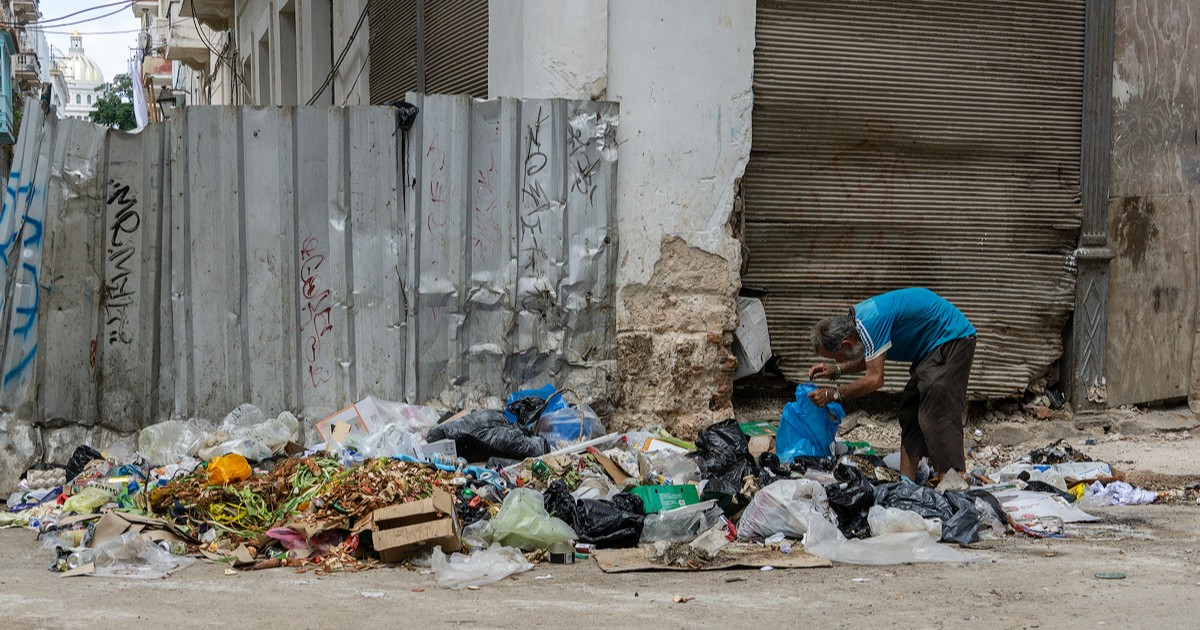
Díaz-Canel spoke of a "humanitarian toll of alarming proportions" and presented an extensive array of figures regarding the deterioration of health services, electrical generation, and other basic sectors, clearly without assuming any responsibility.
According to the data provided by the leader —which he attributed to the effects of U.S. sanctions—, 98,500 patients are on the surgical waiting list, including 12,000 children.
It was also stated that 34,000 pregnant women cannot receive enough prenatal ultrasounds, that 67,000 children under one year old do not have their immunization schedule updated, and that 117,000 adults and 1,200 children with cancer lack adequate treatments and must resort to secondary or tertiary alternatives.
All of them are nothing more than evidence of the collapse and failure of the Cuban socialist model.
In the energy sector, Díaz-Canel assured that more than 1,400 megawatts of power that had been recovered for distributed generation are not producing electricity due to a lack of diesel and fuel oil.
According to their calculations, if that capacity were available every day, power outages would be reduced to about three hours, instead of the "twenty or more hours" that part of the population is currently experiencing.
The National Electroenergetic System had suffered its seventh total collapse of 2026, just a few days before the conclusion of the meeting.
The leader also acknowledged the significant deterioration of various health indicators. He stated that the child mortality rate, which for years was between four and five deaths per thousand live births, has doubled and currently exceeds 9.8 per thousand.
He added that only 30% of the basic drug list is available and that the technical availability coefficient of ambulances is only 22%. "The ambulance service is overwhelmed," he admitted.
The figures represent an official acknowledgment of the extent of the deterioration of essential services, although Díaz-Canel once again attributed it mainly to Washington's policy.
However, the ruler himself had acknowledged in June that there are problems not stemming from outside or from the embargo: "There are obstacles that do not come from outside or from blockades. There is slowness, bureaucracy, regulations that hinder those who want to produce, and decisions that we have postponed."
In the political arena, Díaz-Canel referred to recent statements made by U.S. Secretary of State, Marco Rubio, who told Axios that Washington aims to show the Cuban regime that "there are no escape valves" against its pressure strategy.
The ruler also mentioned information from U.S. media about an increase in intelligence activities around Cuba.
Recent revelations point to the establishment of a CIA group specifically dedicated to Cuba and an increase in U.S. resources for intelligence gathering on the island.
Díaz-Canel also presented an international vote held on July 7 in the United Nations General Assembly as support for Cuba.
In particular, 136 countries voted in favor of the Cuban proposal to hold an additional debate on the embargo, while nine voted against and 30 abstained.
The vote was not about a new resolution to demand the lifting of the embargo, but rather about holding that extraordinary debate.
The economic transformations mentioned by Díaz-Canel are part of an emergency agenda presented in June.
Among the announced measures are the removal of general price caps, the opening to foreign direct investment in the private sector—including small and medium-sized enterprises (mipymes)—the elimination of mandatory intermediaries in foreign trade, and the opening to private and foreign financial institutions.
The regime has insisted on presenting that package as a transformation within socialism and not as a transition to a capitalist economy.
During the extraordinary session of the National Assembly held in June, Díaz-Canel also acknowledged that for decades, Cuban economic and social policies were sustained thanks to resources from the former socialist bloc and later from "friendly countries."
"The life showed us, and we learned, that that was not sustainable," he acknowledged then, before pointing out that the challenge was to continue building socialism without that external dependency.
The new call to build a "prosperous and sustainable socialism" comes amid a backdrop of significant economic contraction.
The ECLAC projects a 6.5% decline in Cuba's GDP in 2026, after estimating a contraction of 3.8% in 2025, according to its economic outlook update published in April.
Related videos:
Filed under: