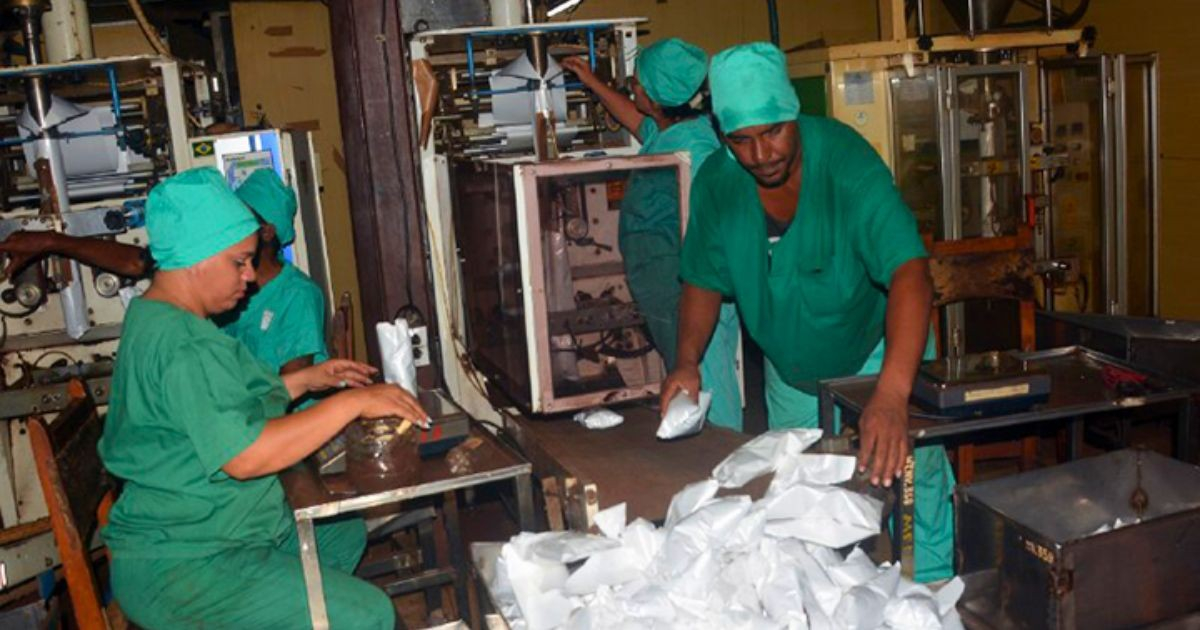
The Torrefactora Manuel Ascunce Domenech in Villa Clara, which was originally intended to process and market coffee, has had to reinvent itself to survive: it now roasts, grinds, and packages corn, sorghum, and rice because coffee simply stopped arriving in sufficient quantities to keep the plant operational.
The news was spread this Sunday by the Cuban News Agency (ACN), which presented it as an example of "business resilience" and "innovation." What the official text elegantly omits is the most obvious question: why doesn't a coffee roaster have coffee?
Yenis Leidy Cabrera Hayes, head of the Human Capital Management Group at the plant, provided the official response to the ACN: "The plant has had to reinvent itself due to the abrupt decline of its main aromatic grain as a result of the negative impact of the United States' oil blockade."
The explanation is as comprehensive as it is convenient. What it does not mention is that Cuba reached a historical peak of about 60,326 tons of coffee in 1961, according to an academic reconstruction of the national production series, and since then, coffee cultivation has shown a distinctly downward long-term trend, which began decades before the current energy supply restrictions.
In July 2025, the Minister of Food Industry, Alberto López Díaz, reported that during the first half of the year, only 2,887 tons had been produced, which corresponds to only 23.7% of the planned amount. The extent of the shortfall becomes even more evident when compared to a national demand that official Cuban sources have estimated at around 24,000 tons annually.
The Villa Clara roasting company is not unfamiliar with this story of chronic shortages. In June 2023, it had been inactive for months due to a lack of coffee, and by February 2024, it had coffee but lacked the peas for the standardized product blend. Because the coffee that reaches Cuban stores is not pure coffee: it has historically been distributed as a blend of 50% coffee and 50% peas, in packages of 115 grams. By January 2025, consumers were already complaining that the product "tastes like gofio."
The irony is perfect: the coffee roaster now produces gofio because it has no coffee, and the coffee that arrived at the warehouses already tasted like gofio before the plant stopped processing it.
José Raúl Arias Díaz, the director of the entity, explained to ACN the new operational logic with a pragmatism that unintentionally summarizes decades of improvisation: "We roast, grind, and package; that is the basic systemic process, and we can do it with corn, sorghum, and almost any seed."
Currently, the plant produces corn and sorghum flour and gofio, and has begun the production of rice flour. The raw materials are obtained through contracts with companies such as Acopio and the Seed Company, as well as with small and medium-sized enterprises and cooperatives. According to the director, they make use of grains that "have lost value as seeds but can still be useful as food," which are assessed in the entity's laboratory.
The picture that emerges is not that of an innovative company, but rather of a facility that processes what it can find, because what it should process does not exist. Villa Clara is no exception: it reflects a province, and a country in a state of widespread food crisis. In February 2026, it was reported that rationed bread in the territory would only be distributed to those under 13 and over 65 years old due to the lack of fuel. The potato harvest for 2024-2025 was a failure, yielding 11 tons per hectare compared to the standard of 22.5. On top of all this, the province lost around 181,000 cattle in a decade.
The ACN concludes its statement with a phrase worth framing: "the entity has demonstrated that, with discipline and innovation, a socialist state enterprise can be profitable even when its traditional purpose is affected." Translated: when there's no coffee, you make gofio, and that's called success.
Related videos:
Filed under: