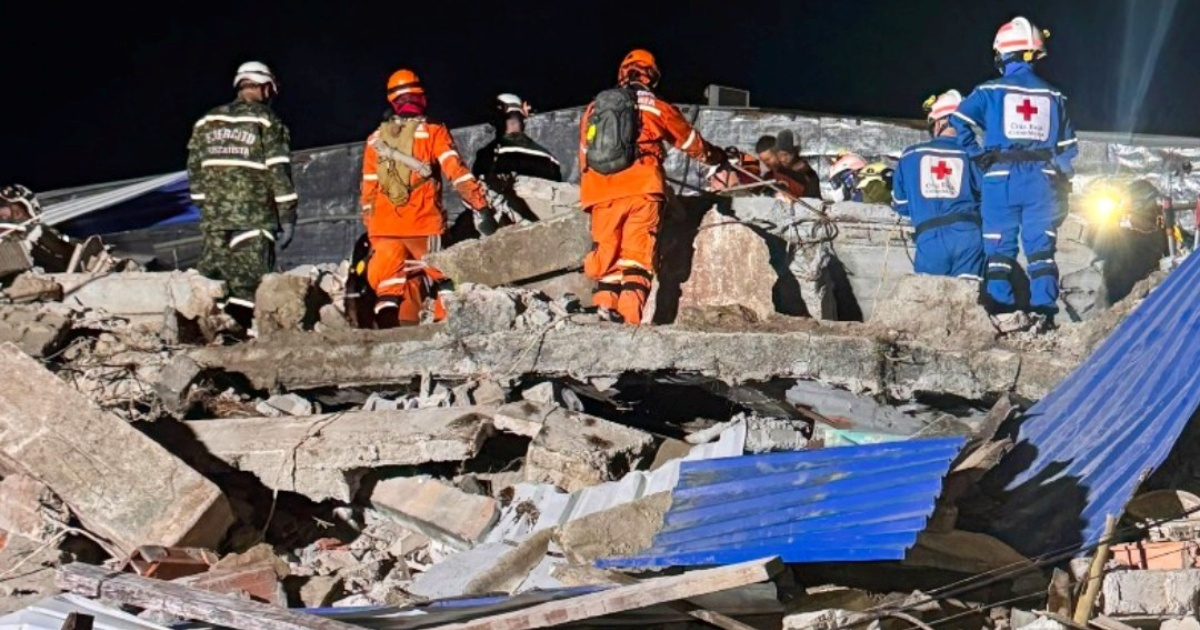
The toll from the earthquake that struck Colombia on Monday continues to rise: according to Asocapitales, the number of deceased has now reached 181, with 1,310 injured and 153 collapsed structures in the major cities of the country.
Asocapitales -the Colombian Association of Capital Cities- is a non-profit organization established in 2012 that brings together the 32 capital cities of Colombia, which account for approximately 47% of the population and around 55% of the country's gross domestic product.
Its function is to coordinate responses with the National Government during emergencies, consolidating data from municipalities, risk management organizations, and national entities.
Cali and Pereira, the most affected cities
According to the most recent preliminary report from Asocapitales - announced by the executive director of the entity - Cali leads the count with 95 fatalities, followed by Pereira with 66.
Quibdó has reported nine deaths and Manizales, five.
Asocapitales emphasized that Cali and Pereira “account for 151 of the 165 deaths recorded in the capitals, equivalent to more than 91% of the reported fatalities in these areas.”
In a statement, the association warned that the figures “remain preliminary and are subject to revision, as territorial authorities and response agencies are still deployed in the affected areas,” which means that the actual number of victims could be significantly higher.
In Cali, a four-story building collapsed and emergency teams worked to rescue potential survivors.
The association detailed that "from the initial reports, there were reports of collapses with people trapped, damage to hospital infrastructure, roads, and mass transit stations, as well as the need for support from specialized urban search and rescue teams."
In Pereira, according to Asocapitales, "the emergency has also compromised numerous buildings and strategic infrastructure," with "damage to health infrastructure, impacts at the Matecaña airport, and difficulties in communications and energy supply, factors that have hindered the establishment of the final assessment."
The mayor of Pereira, Mauricio Salazar, declared a curfew from six in the evening to five in the morning to prevent looting, with 1,000 Army personnel deployed at 40 strategic points.
The strongest earthquake in 47 years
The 7.4 magnitude earthquake -which occurred on August 10th at 7:34 AM (local time)- had its epicenter in San José del Palmar, in the Chocó department, at a depth of between 96 and 103 kilometers.
The Colombian Geological Service has classified it as the strongest earthquake recorded in the country in the 21st century and the most intense in 47 years, surpassing the devastating earthquake of the Coffee Triangle in 1999.
The United States Geological Survey issued an orange alert estimating that the most likely scenario places the final toll between 100 and 1,000 fatalities, with a 20% chance that the number will exceed 1,000 deaths.
Government response and business solidarity
The president Abelardo de la Espriella, who took office just three days before the earthquake, declared a national disaster and established a Unified Command Post.
In recent hours, the Colombian president reiterated his support for the affected families and announced that he would provide "rental subsidies" while the reconstruction efforts are underway.
The National Association of Industrialists has called for a business solidarity day this Tuesday with the aim of "gathering donations, mobilizing capabilities, and coordinating resources and solutions to address the most urgent needs."
Meanwhile, rescue teams are working against the clock in the most affected areas, with the certainty that the number of victims will continue to rise as authorities manage to access regions that have not yet been accounted for.
Related videos:
Filed under: