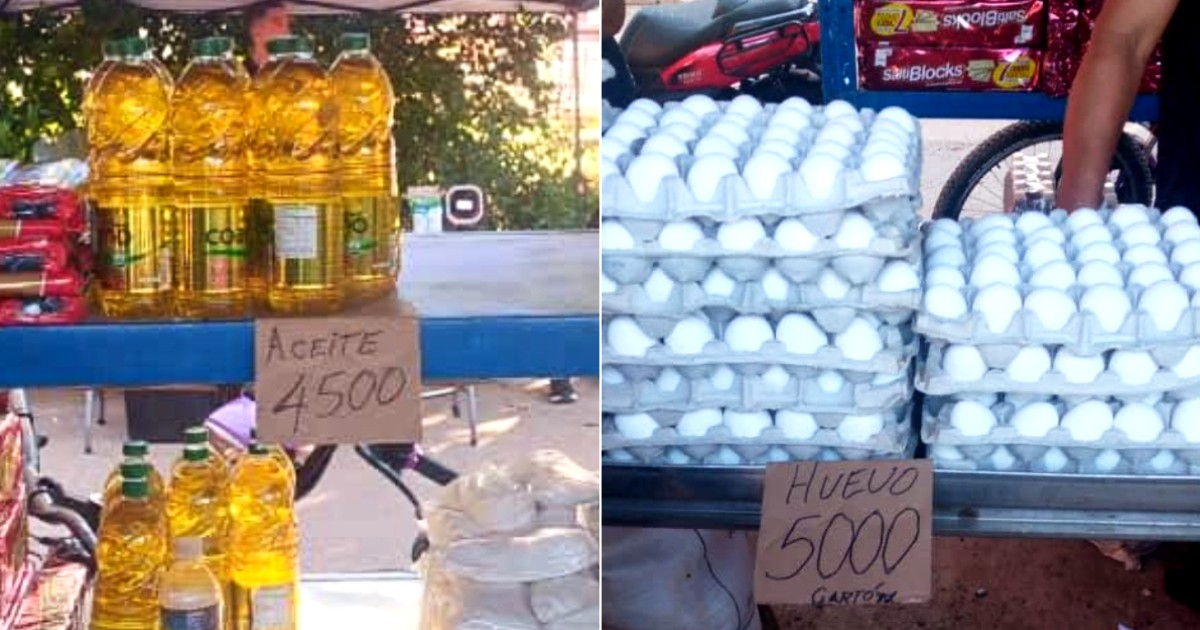
The authorities of the Municipal Administration Council of Songo-La Maya, in the province of Santiago de Cuba, set reference prices for oil and eggs this Monday, in response to the unchecked rise in food prices, although the measure excluded other essential products that are also experiencing significant increases.
Based on resolutions 345 and 350, the authorities established a limit of 2,500 Cuban pesos per liter bottle of oil and 110 pesos per unit of egg.
Municipal leaders rushed to clarify that this was not about strict price caps, but rather "values derived from an assessment of the costs and expenses associated with the marketing of these products."
The semantic distinction does not change the essence: any establishment that sells above those values is subject to severe penalties. Under Decree-Law 91, Article 12, Paragraph j), offenders may face fines of up to 60 installments of 1,000 pesos each, which amounts to a total of 60,000 Cuban pesos.
In addition to the fines, the authorities announced the seizure of goods, partial suspension of business operations, and the closure of the establishment for a period of up to three months.
To channel complaints, the municipal government has established three phone lines: Public Assistance (22378529), Municipal Finance and Prices Directorate (22378149), and the DIS (223788283).
The measure comes at a time when oil was being sold for between 4,000 and 7,000 pesos per liter in various regions of the country, and eggs were costing between 250 and 300 pesos each in Santiago de Cuba, with cartons of 30 units reaching up to 7,500 pesos.
Songo-La Maya thus joins a series of price regulations that have been implemented across the island since early August. Guantánamo, on August 5, set a reference price of 2,200 pesos per liter of oil; followed by Moa and Banes, in Holguín, with the same price; San Luis set the price of oil at 2,200 pesos and eggs at 120 pesos on August 8; Villa Clara established that same day caps of 2,500 pesos per liter of oil and 110 pesos per egg; and Matanzas joined in on Sunday with identical prices.
The catalyst for this spiral was Resolution 150/2026 from the Ministry of Finance and Prices, which on June 20 removed national price caps on oil, chopped chicken, powdered milk, pasta, and sausages; on July 16, the Council of Ministers also lifted the cap on rice.
The paradox is evident: the regime liberalized prices in June, and now the municipalities are regaining control over them due to popular pressure, in a reversal that even economists themselves are questioning.
Economists Pedro Monreal and Elías Amor criticized the reintroduction of price ceilings, describing it as "absurd" and warning that it historically leads to shortages and pushes products to the black market, without addressing the underlying inflation.
Related videos:
Filed under: