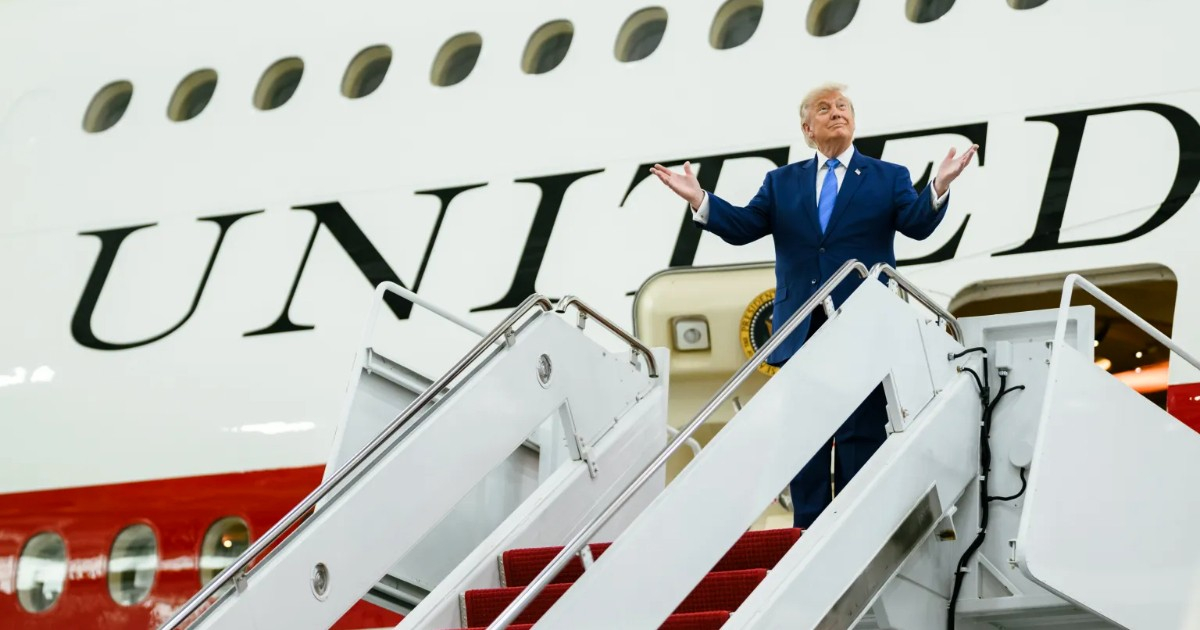
Donald Trump acknowledged this Wednesday that the Secret Service and the military ordered him to change aircraft when leaving the NATO summit in Ankara on July 8.
According to a report from the BBC, the operation was initiated after U.S. intelligence detected a credible Iranian threat to fire a missile at the presidential plane.
"I follow the Secret Service and the military. They wanted me to take a different flight, a different plane," Trump told reporters during a visit aboard Air Force One to an event in Ohio. "I just have to do what they tell me."
The confirmation came one day after the covert operation was publicly revealed, with details describing a high-risk maneuver carried out in front of cameras without anyone noticing.
According to the reconstruction by the Washington Post, Trump publicly boarded the classic Air Force One —a Boeing 747— at Ankara's Esenboğa Airport.
Minutes later, he was secretly transported via a hydraulically elevated airport catering truck to the opposite door of the plane, and from there he boarded a C-32A from the Air Force, a modified Boeing 757 typically used by the vice president, which flew under the discreet call sign "Reach 18."
The original Air Force One operated as a decoy under the call sign "AF1," carrying journalists and cabinet members onboard. According to the New York Times, Secretary of State Marco Rubio and Treasury Secretary Scott Bessent were on that plane. Secretary of Defense Pete Hegseth boarded the C-32A separately using external stairs to avoid raising suspicions.
The journalists on the decoy plane were ordered to lower the blinds on the windows. A photographer who briefly opened one was immediately urged to close it. The White House Correspondents' Association documented the episode in a report published on Tuesday.
U.S. intelligence had detected not only the general threat but also an identified individual near the summit carrying a shoulder-fired missile, according to reports from the New York Times. CBS News independently confirmed that the threat was deemed credible by intelligence services.
"I suppose there was a threat out there," Trump said. "I didn't ask too much about it. I receive a lot of threats. I have many threats that you don't know about."
The operation took place on the night when the U.S. resumed military attacks against Iran, following the collapse of negotiations between Washington and Tehran. On that same day, Trump had declared before NATO that the 60-day truce signed in June in Switzerland was "over," after Iran attacked commercial vessels in the Strait of Hormuz on July 6 and 7.
Two days after the plane change, Israel alerted the U.S. about an alleged Iranian plan to assassinate Trump, although there were discrepancies regarding whether it was a specific plot or general discussions within the Iranian leadership.
This is not the first time Trump has faced direct threats against his life. He survived two attempts in 2024 —the shooting in Butler, Pennsylvania, in July, and the incident in West Palm Beach in September— and in April 2026, a man was charged with attempting to carry out an attack on him during the Correspondents' Dinner. In July, eight people were charged with planning a drone and sniper attack against the president.
The episode also generated criticism regarding the treatment of journalists. Jose Zamora, regional director for the Americas at the Committee to Protect Journalists, stated that the Trump administration "has the responsibility to ensure that journalists covering the president are not unnecessarily exposed to danger" and that "reporters must be informed of credible threats in order to make informed decisions about their safety."
Related videos:
Filed under: