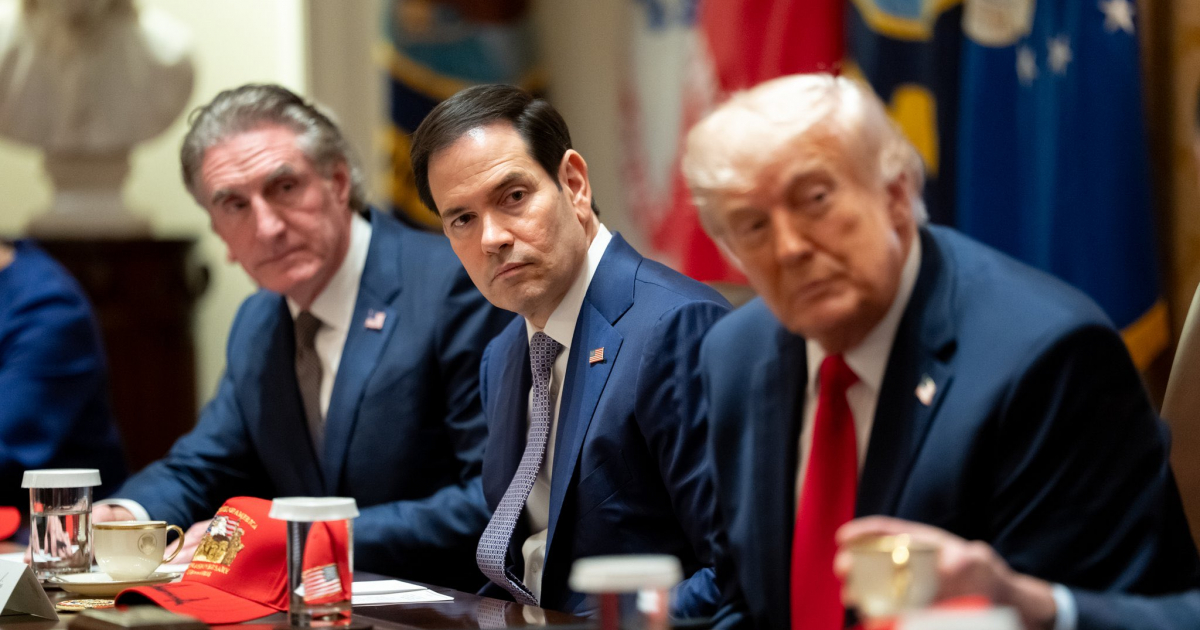
Donald Trump and Marco Rubio have heightened their rhetoric and, above all, implemented concrete measures against the Castro-communist regime to levels not seen in the last six decades. Trump has stated that the United States will not rest until the Cuban people regain their freedom, and Rubio has insisted that Washington will use all available tools to promote political and economic changes on the Island.
The words have been accompanied by actions. On January 29, Trump signed Executive Order 14380, which declared a national emergency regarding the Cuban regime and established a mechanism to impose additional tariffs on countries that supply oil, directly or indirectly, to the tyranny. On May 1, he signed another decree that significantly expanded the ability to sanction officials, entities, economic sectors, and third parties that collaborate with the repressive apparatus, corruption, or certain structures of the communist state.
On August 6, the State Department announced sanctions against five entities and eight individuals linked to the acquisition of military equipment and the cooperation of the FAR with Russia and China. Rubio stated then that the Trump Administration would continue to use all available tools to promote economic and political reforms in Cuba.
On May 20, the Secretary of State went even further by describing a future relationship between the United States and a "New Cuba," where citizens could own businesses, banks, newspapers, and media without depending on the Communist Party or GAESA. He also announced a U.S. offer of $100 million in food and medicine, conditioned on the aid reaching the people directly through reliable institutions. The aid is already arriving through the Catholic Church.
However, his statements from August 11th introduced an element that has captured the attention of many compatriots on the Island. Rubio expressed his conviction that, before the end of the Trump Administration in January 2029, Cuba will be on an “irreversible path toward a very different future.” He also explained that a transition does not happen overnight and recalled that the changes in Eastern Europe took years.
At this point, it is necessary to remember that Cubans have been fighting -bravely and sacrificially- for longer than all the successful pro-democracy movements in Eastern Europe. According to the significant report “Cuba: The Capital of Communism in the 21st Century,” published on July 20 by the Department of State, the Castro regime poses a threat to the security of the United States no less than the Chavista regime and the Iranian ayatollahs.
For those of us who expect immediate U.S. action to bring about the end of the regime, those words may be somewhat discouraging. They do not necessarily mean that Washington rules out new decisive measures; however, they do suggest that Rubio envisions a process of pressure, weakening, and transition, rather than publicly promising swift action to remove the Communist Party from power. This, I am sure, sounded very sweet to the ears of the Castro family, but I remind you that this is how Trump expressed himself days before the operation that led to the capture of Nicolás Maduro.
The regime in Havana needs time; its primary priority is survival. From that perspective, any event that demands resources, attention, and political will from Washington works in its favor. This is why a prolonged and exhausting war by the United States against Iran would be very convenient for Havana. It would force Washington to focus on a much larger and more dangerous scenario. Similarly, a significant defeat for the Republicans in the November legislative elections could complicate certain aspects of Trump’s agenda.
The Castro family can wait; they are very good at that. However, those who cannot wait indefinitely are the Cubans who are paying a steep price for the crisis created by the tyranny. Cuba is living under oppression and extreme misery, with power outages lasting for days, serious difficulties in obtaining food and medicine, and a profound deterioration of basic services. Millions of people are organizing their survival around small periods of electricity. The dictatorship and its allies blame the United States for the tragedy produced by their failed one-party system and centralized economy.
While the U.S. pressures the tyranny and the regime seeks to survive at any cost, there are human beings for whom every day, every hour, matters: elderly individuals dying from malnutrition and lack of medicine, children going to bed hungry, hundreds of political prisoners enduring hellish conditions. A whole enslaved people for whom 2029 may seem like a terribly distant date.
Trump and Rubio have generated enormous expectations, are applying real pressure, and have taken steps and spoken words that no U.S. government has expressed with such clarity in a long time, which is commendable. However, it would be disastrous for both the Cuban people and the United States if the Castro-Communist regime were to survive and emerge stronger from the worst crisis in its history. The enemies of this great nation are willing to make significant efforts to save Castroism.
Now, regardless of what happens, there is a reality that we cannot forget: the best way to ensure that tyranny ends and Cuba is reborn as the free, democratic, just, generous, and prosperous homeland that every good Cuban desires is to continue fighting with great love, courage, intelligence, and unity. Paraphrasing Pope John Paul II: we cannot wait for everything to be handed to us.
Related videos:
Filed under:
Opinion article: Las declaraciones y opiniones expresadas en este artículo son de exclusiva responsabilidad de su autor y no representan necesariamente el punto de vista de CiberCuba.