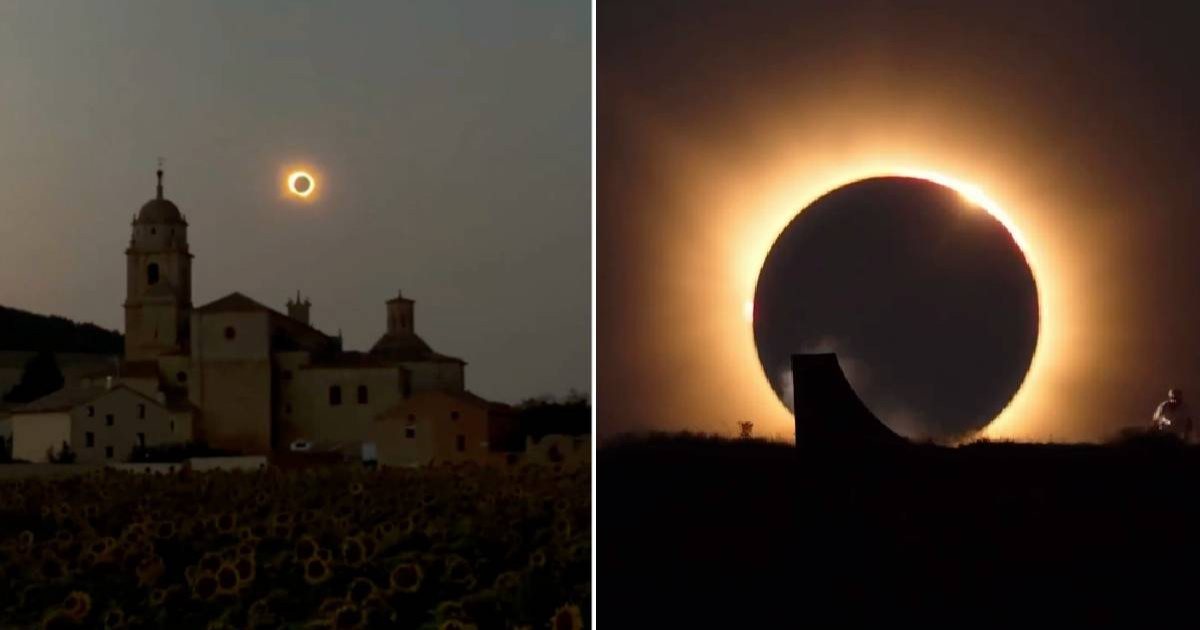
Spain experienced an astronomical phenomenon this Wednesday that had not occurred in over a century: a total solar eclipse over the Iberian Peninsula that turned day into night for just over a minute in several regions of the north and east of the country.
The last total eclipse in the Peninsula —, two days after the sinking of the Titanic— lasted just two seconds. To find a full and long-lasting total eclipse over the mainland, one must go back to August 30, 1905.
This Wednesday’s event was incomparably more generous: in Oviedo, it reached a total darkness of one minute and 48 seconds, while in Castellón de la Plana, the totality phase lasted exactly one minute and 34 seconds, the longest in the entire Valencian Community due to its proximity to the phenomenon's central line.
The path of totality crossed Spain from west to east, encompassing Galicia, Asturias, Cantabria, Castilla y León, Aragón, the Valencian Community, and the Balearic Islands. Madrid and Barcelona were outside the area of complete darkness.
The spectacle took place at sunset, with the Sun already low on the horizon, adding an extraordinary visual component: the sky was painted in shades of orange and pink typical of twilight, but caused by the Moon interposing itself between the Earth and the sun. During those moments, the solar corona was visible to the naked eye.
The images went viral immediately on social media. From Castrojeriz, Burgos, meteorologist Nahel Belgherze shared a photograph on X that garnered over 1.7 million views: the solar corona over a field of sunflowers in full bloom, with a Castilian church in the background and the sky painted with twilight colors. "Totality. Castrojeriz, Burgos, Spain, just a few minutes ago," he wrote.
From Tarragona, another video published by the user Dylan K surpassed one and a half million views. "Spain just went dark in the middle of the day. Total solar eclipse. Absolutely amazing," he described.
In the Spanish Mediterranean, the reaction of the viewers said it all: "It’s already covered! And what is that? Red? Yes! Yes! Yes! Yes!" could be heard among exclamations of astonishment.
Not everything was clear skies. According to reported by the agency EFE from Cantabria, clouds hindered visibility in places like Peña Cabarga, Suances, and Comillas, where many spectators had arrived hours early to secure a good spot.
The best visibility in that region was recorded at the La Lora moor. Around 1,400 personnel from the police and emergency services ensured safety in Cantabria during the event.
Before the eclipse, consumer authorities ordered the recall of at least seven models of glasses due to irregularities. The affected brands were Lionstar, ECP Eye Care Professional, Pelispan, Homanaje, Orro, Opticalia, and Mó, from Multiópticas.
The paradox, as FACUA warned, was that the defect was not that the lenses were too light, but rather the opposite: the filters were excessively dark, with a transmission rate below the minimum required, which could tempt users to remove their glasses to see the sun, precisely the moment of greatest risk for the eyes.
This eclipse was the first of three that the Iberian Peninsula will experience in consecutive years. The next one will occur on August 2, 2027, visible from the southern part of the peninsula —Ceuta, Melilla, Cádiz, Málaga, Granada, and Almería— with a totality of up to four minutes and 48 seconds in Ceuta and more than six minutes over the pyramids of Egypt.
Related videos:
Filed under: