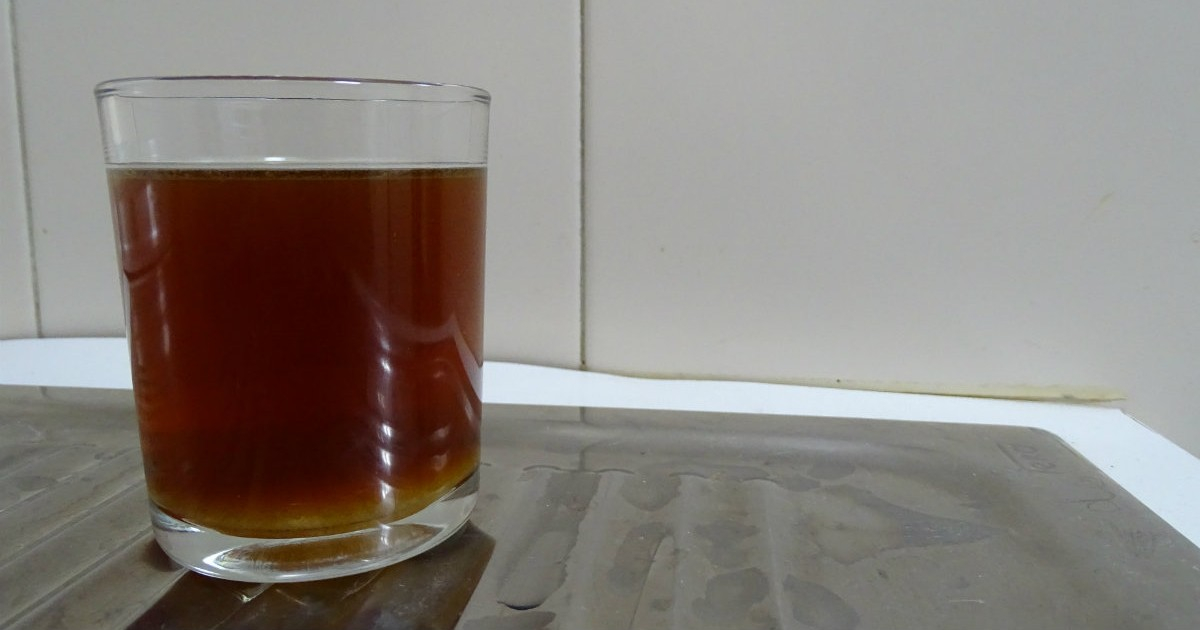
A Facebook post from the broadcaster and presenter Laritza Camacho sparked a wave of nostalgia and bittersweet humor among Cubans this week as she pointed out that milordo —that two-ingredient drink that mixes water with brown sugar— is now "in danger of extinction," not due to cultural forgetfulness but because of the simultaneous scarcity of its two components.
The phrase that captured the collective sentiment was striking: "I never imagined that the milordo would become a recipe on the verge of extinction. Extinct due to sugar and due to water."
The milordo —also known as munga, aguazúcar, or "gallo soup"— is the Cuban version of sugar syrup, which is simply called syrup in other parts of the world.
Its preparation did not require cooking or special ingredients: it was enough to dissolve sugar, preferably brown or dark, in water. For decades, it was the snack of those who had nothing.
The comments on the post ranged from irony to sadness. "And anyone who can afford it right now is a millionaire," one user sarcastically remarked regarding the difficulty of obtaining sugar on the island.
Others recalled the milordo as part of a childhood marked by scarcity. "Those of us who received scholarships in the 70s and 80s know it well, known as 'munga,'" shared a Cuban woman.
A woman recalled that she used to accompany him with flute bread and lamented that something so basic has become a privilege: "Poor thing, this generation that we can't even offer a small loaf."
In the comments, other humble dishes that have disappeared from the Cuban table also surfaced. "The guajiro’s sting also disappeared," wrote one user. "And what about bread with oil?" another asked.
The background of this viral nostalgia is a dual structural crisis. On one hand, Cuban sugar production has fallen to levels unseen since before 1899: the 2024-2025 harvest did not reach 150,000 metric tons, a figure lower than what Cuba produced when the country was emerging from three years of independence war.
Only six of the 14 planned sugar mills operated effectively during that harvest season. Economist Mauricio de Miranda directly pointed to the culprit: "Economic sanctions are not responsible for the destruction of the sugar industry. Those who are responsible are, first and foremost, Fidel Castro."
In 2002, Castro initiated the so-called "Álvaro Reynoso Task," which closed 71 of the existing 156 sugar mills and ended up dismantling nearly 98 in total, eliminating 100,000 jobs and leaving the sugarcane fields overrun by marabou weed.
Cuba, which in 1970 produced 8.5 million tons —25% of the world's production— today does not meet its internal consumption, estimated between 600,000 and 700,000 tons annually, and has to import sugar.
In provinces like Las Tunas, only one pound is distributed per person.
On the other hand, the water crisis affects over 3.1 million Cubans—nearly 30% of the population—with water services completely or partially interrupted, as acknowledged by state television in September 2025.
Drought, deteriorating infrastructure, blackouts, and lack of fuel for pumping are the causes of a problem that the regime itself acknowledges without resolution.
The convergence of both crises has turned the milord into an involuntary symbol: what was once the resource for those who had absolutely nothing has, by 2026, transformed into an unattainable luxury for millions of Cubans.
Related videos:
Filed under: