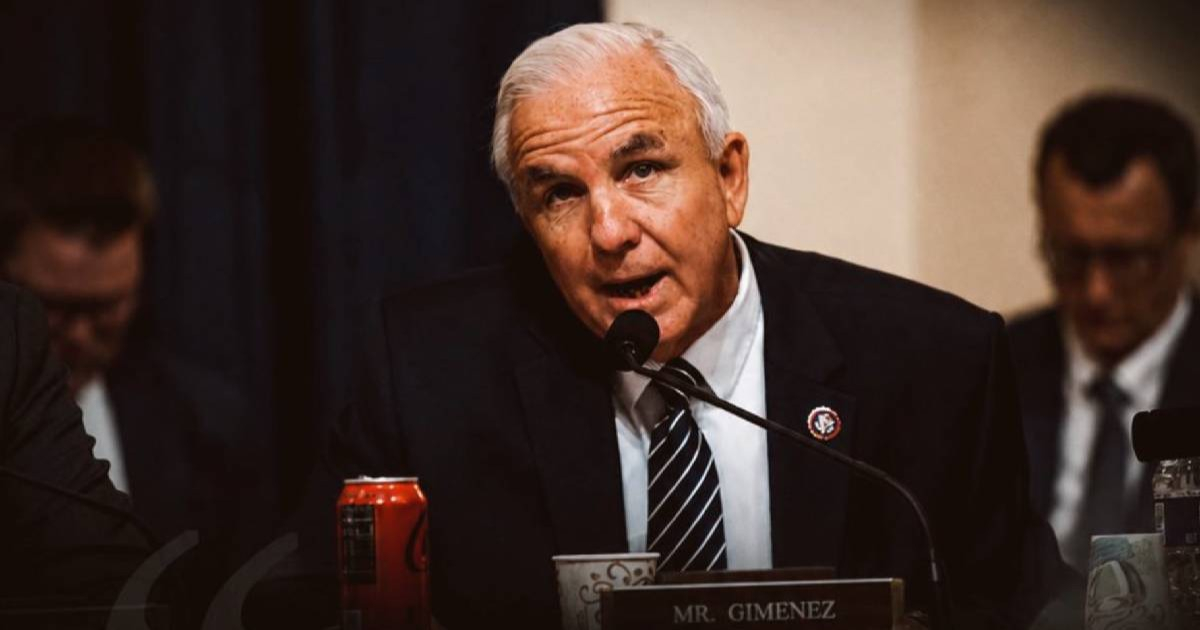
The Cuban-American congressman Carlos A. Giménez celebrated this Thursday the decision of Dominican Republic to expel nine diplomats from the Cuban regime in Santo Domingo, describing it as a historic gesture of democratic firmness.
In a message posted on his X account, the representative for Florida's 28th District thanked the Dominican government for "staying firmly on the right side of history."
"By expelling the diplomats of the Havana regime, they firmly demonstrate which side of history they stand on. This is a clear message to the world: Cuba's freedom is non-negotiable," wrote Giménez, who added that he was grateful to Santo Domingo for "supporting the Cuban people and not being complicit with the dictatorship."
The measure was ordered on that same Thursday by the government of President Luis Abinader.
The Dominican Foreign Ministry notified the nine officials of the Cuban Embassy —along with their families, a total of 21 people— that they must leave the country before Sunday, August 16.
The Dominican government justified the expulsion under Article 9 of the Vienna Convention on Diplomatic Relations, which permits declaring a member of a mission persona non grata without publicly explaining the reasons, and stated that it would handle the case with "due discretion" through diplomatic channels.
The Cuban regime immediately rejected the decision. Foreign Minister Bruno Rodríguez Parrilla stated that "there is no reason whatsoever to justify the measure" and described it as an act of "submission" to the pressures from the United States.
The expulsion was not unexpected. The cooling relationship between Santo Domingo and Havana had been building up since October 2025, when the Dominican Republic excluded the Cuban regime from the X Summit of the Americas in Punta Cana, along with Nicaragua and Venezuela.
In May 2026, Abinader publicly declared that Cuba "is obviously not a democratic state", and in July, the Caribbean nation abstained from the UN vote on the U.S. embargo against Cuba.
The Dominican decision is part of a broader wave of diplomatic isolation that the Cuban regime has faced in the region during 2026.
In March, Ecuador expelled all Cuban diplomatic staff in Quito with a 48-hour deadline; that same month, Costa Rica closed its embassy in Havana; and in July, the new government of Colombia announced the severance of relations with Cuba and Nicaragua.
Giménez, born in Cuba in 1954 and residing in Miami since childhood, is one of the most active U.S. lawmakers in denouncing the Cuban dictatorship. In February 2026, hecalled the regime "pathetic" and stated that it must be "completely annihilated."
"Thank you for not supporting the dictatorship and for backing our people," the congressman concluded in his statement, marking the most serious diplomatic break between Santo Domingo and Havana in decades.
Related videos:
Filed under: