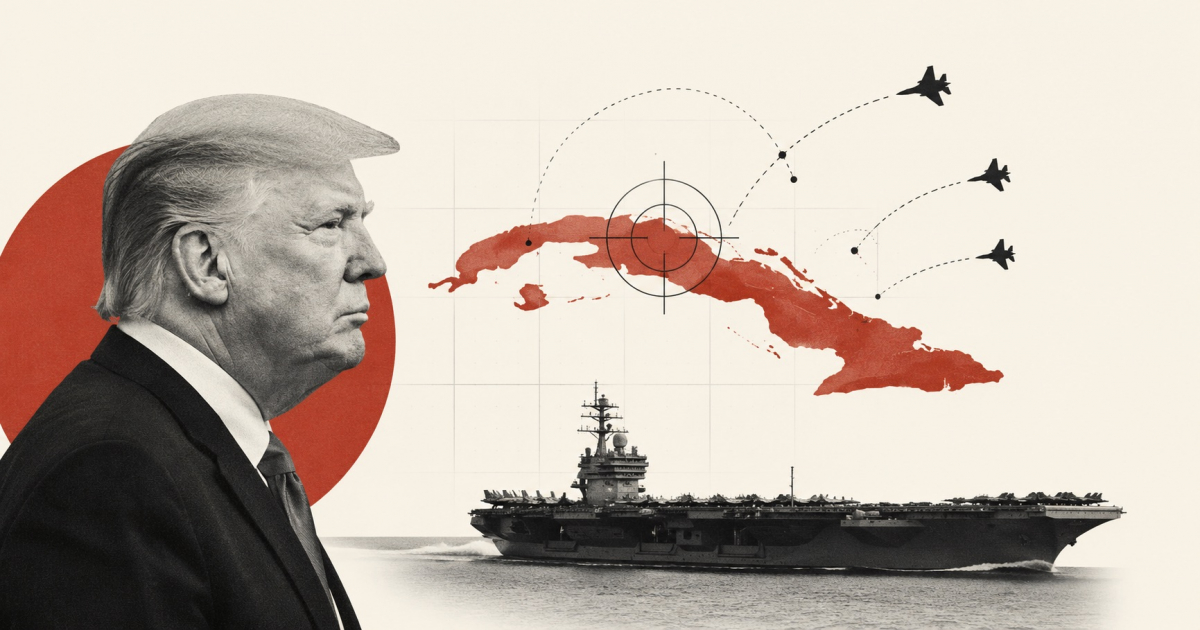
The Trump administration has decided to put aside the military option against Cuba and focus its strategy on unprecedented economic pressure, according to anonymous sources familiar with the administration's strategy cited by Bloomberg this Friday.
The central objective is to cut off all sources of income for the regime —not to execute a special forces operation similar to the capture of Nicolás Maduro in January— in order to create internal fractures and open space for negotiations that Havana has systematically rejected after nearly seven decades of a single-party rule.
According to the American media, Washington currently believes that deepening the financial isolation of the Cuban authorities is more effective than launching a military operation or special forces mission similar to the one used by the United States in Venezuela to capture Nicolás Maduro.
The sources consulted by Bloomberg, who spoke on condition of anonymity, assert that the focus of the White House is on
The war option is not explicitly ruled out—Trump values unpredictability as a political tool—but it has been relegated to the background of the agenda, partly because the war in Iran, now in its fifth month, is consuming political and military resources, and the president wants to avoid the deployment of ground troops.
According to Bloomberg, Washington believes that the Cuban system is made up of different factions, including the Castro family, the Armed Forces, the bureaucracy of the Communist Party, and the descendants of other historical figures from the revolution.
The Trump Administration also argues that a potential uncontrolled destabilization of Cuba could become a problem for the security of the United States.
A U.S. official quoted by Bloomberg stated that Washington is ready to begin "a new chapter" in bilateral relations, but considers that the current Cuban political direction represents the main obstacle.
The same source asserted that a failed state just a few miles from the U.S. coastline would pose a threat to national security.
The administration kept the door open to any scenario and stated that the president has various tools of foreign policy at his disposal.
He also stated that the United States will continue to use all available means to respond to what it considers threats from the Cuban government and to promote economic and political changes in the country.
More sanctions against sources of income
According to sources cited by Bloomberg, officials led by Secretary of State Marco Rubio are considering the possibility of further restricting resources that end up in the hands of structures linked to the Castro family and the high-ranking military officials in Cuba.
That offensive has already resulted in new sanctions. The State Department sanctioned GAESA, the military business conglomerate that dominates tourism.
In June, sanctions were imposed against CUPET and other energy entities; in July, against the Ministry of Tourism; and on August 6, against five entities and eight individuals linked to the procurement of weapons for the Cuban Armed Forces.
In total, since January, the administration has accumulated more than 240 sanctions and intercepted at least seven tankers, with an estimated drop of 80-90% in the island's energy imports.
The naval oil blockade —made possible by U.S. control over Venezuela, Cuba's former energy sponsor— has worsened the humanitarian crisis: repeated power outages, fuel shortages, 73% of hotels closed, and around 25,000 tourism workers without active employment.
UN agencies warn of shortages of food and medicine, and power outages in hospitals and oncology treatment centers.
The Cuban landscape is, moreover, more complex than the Venezuelan one. U.S. officials believe that Miguel Díaz-Canel is controlled by the Castro family, with power dispersed among its members and military leaders.
There is no credible political opposition or agreed-upon alternative leader to lead a transition, unlike what happened in Venezuela, where Washington installed Delcy Rodríguez after capturing Maduro.
In May, the CIA director, John Ratcliffe, visited Havana and met with the Minister of the Interior Lázaro Álvarez Casas and Raúl Guillermo Rodríguez Castro, the grandson of Raúl Castro.
An agency official said that Ratcliffe wanted to make it clear that Trump should be taken seriously, citing what happened in Venezuela.
Related videos:
Filed under: