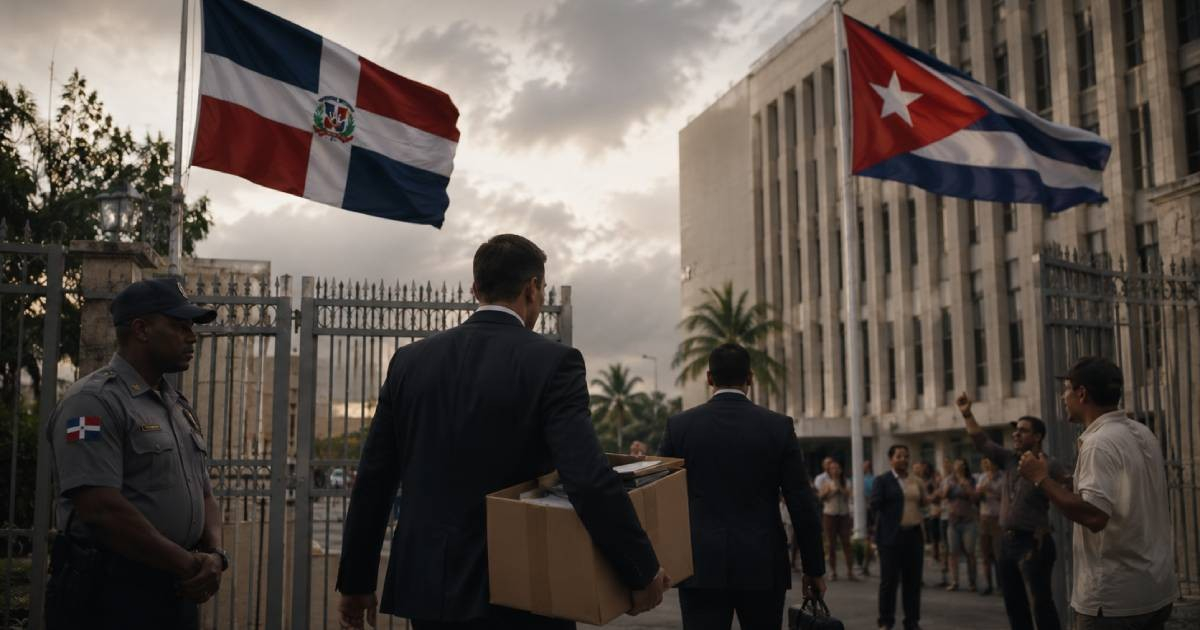
The decision by the Dominican Republic to order the expulsion of nine officials from the Cuban Embassy in Santo Domingo prompted a wave of reactions on social media this Thursday, where many Cubans celebrated the move and interpreted it as a new sign of the regime in Havana's increasing diplomatic isolation in the region.
"That's great, little by little they are tightening the noose," wrote a user in one of the comments that summed up the feelings of those who received the news with satisfaction.
The Dominican Foreign Ministry confirmed on Thursday the departure of the Cuban officials, citing Article 9 of the Vienna Convention on Diplomatic Relations, which empowers the receiving State to declare persona non grata to members of a diplomatic mission without being obliged to publicly explain the reasons.
The nine officials and their families—around 21 people in total—must leave Dominican territory before Sunday, August 16.
Santo Domingo has kept the specific reasons for the decision confidential, but the Ministry of Foreign Affairs of Cuba (MINREX) issued a strong statement in which it rejected the measure "in the strongest possible terms" and directly blamed the United States.
"There is no other explanation for this action than the subjugation of the government of the Dominican Republic to the pressures of the U.S. government," stated the Cuban Foreign Ministry, which also denied that its officials had committed any irregularities.
The explanation from Havana provoked new criticism on social media.
"I start to read 'Cuba rejects...' and that's where I stop. You reject it, don't generalize; what the people of Cuba reject a lot does not end," commented an internet user, questioning the government for speaking on behalf of all Cubans.
Another person directly responded to the argument about the supposed pressures from Washington: "Why not just explain the reasons they were given? They have an absolute fixation with the United States, and they are convinced that the Cuban people are cretins."
"Nobody should have diplomatic relations with a dictatorship."
Among the comments, there was a particularly critical tone towards the Cuban regime and its diplomatic representations.
"That's called getting rid of the trash; no one should have diplomatic relations with a dictatorship," wrote a user.
Another made a common accusation among certain exile groups regarding the roles of some Cuban representations abroad: "They were not diplomats; they were spies."
These statements reflect users' opinions on social media and have not been substantiated with evidence by the Dominican authorities, who have yet to disclose the specific reasons for the measure.
A minority of commentators, on the other hand, defended the position of the Cuban government and viewed the decision from Santo Domingo as a sign of subordination to U.S. foreign policy, in line with the argument used by MINREX.
The Cuban Foreign Ministry cited as background for this alleged alignment the exclusion of Cuba from the X Summit of the Americas and the Dominican Republic's change of position in the United Nations regarding the resolution against the U.S. embargo.
The distance between Santo Domingo and Havana is growing
The diplomatic crisis comes after months of signs of estrangement between both governments under the presidency of Luis Abinader.
In May, the Dominican leader publicly stated that Cuba "is not a democratic state", a statement that is unusual in the bilateral relationship and highlighted the growing political differences with Havana.
The episode also occurs in an unfavorable regional context for Cuban diplomacy.
In March, Ecuador ordered the departure of the entire Cuban diplomatic mission in Quito, giving its members only 48 hours to leave the country.
That same month, Costa Rica closed its embassy in Havana and requested the regime to withdraw its staff from San José.
In July, the then newly elected president of Colombia, Abelardo de la Espriella, announced the breaking of diplomatic relations with Cuba and Nicaragua as part of a reorganization of Colombia's foreign presence.
Havana promises "unwavering friendship" to the Dominican people
Despite holding the Abinader government responsible for aligning with Washington, the MINREX attempted to separate the crisis between both governments from the historical ties between Cubans and Dominicans.
In its statement, Havana acknowledged that the decision "sensibly harms the ties between the two governments," but assured that it will maintain its "unchanging friendship" towards the Dominican people.
On social media, however, many Cubans reacted from a perspective very different from that expressed by the Foreign Ministry.
For them, the departure of the diplomats does not represent an affront to Cuba, but rather a new setback for a regime they hold accountable for decades of repression, economic crisis, and massive exodus.
Related videos:
Filed under: