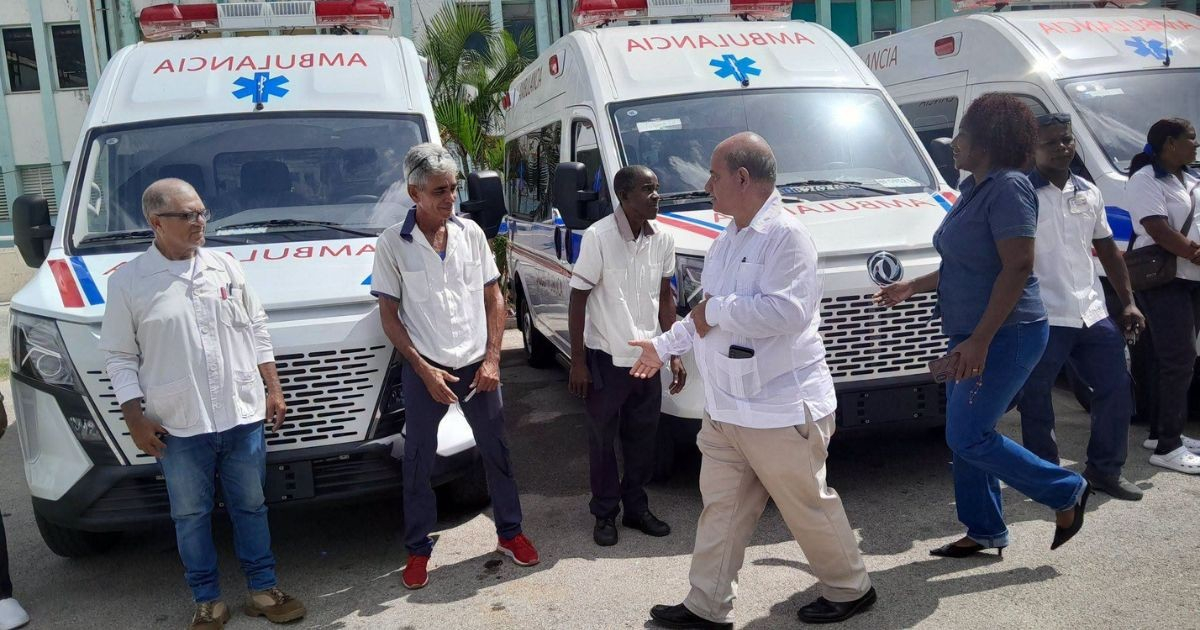
The “Saturnino Lora Torres” Provincial Clinical Surgical Teaching Hospital, the main hospital center in Santiago de Cuba, received five new ambulances for the emergency service of the province this Friday, in an official event that the hospital itself shared on its Facebook page.
The ceremony was led by the provincial director of Public Health, accompanied by leaders from various organizations and the hospital's management team. According to the official announcement from the center, the official " reaffirmed the unwavering commitment of healthcare workers to the Revolution and to our Commander in Chief, in the year of his centenary," and "emphasized the importance of these resources for continuing to save lives and improving the quality of care for the people, in line with the legacy of humanism that Fidel left us."
The keys to the five vehicles were handed over to the assigned drivers during the event. The hospital's statement described the acquisition as "a step forward in strengthening emergency services" that "reflects the Cuban state's effort to ensure the health of the population, even in the current difficult conditions." However, the triumphalist language contrasts with the extent of the deficit acknowledged by the system itself.
The addition of these five units coincides almost exactly with Cuba receiving three ambulances donated by the Russian city of Saint Petersburg, designated for Havana, Matanzas, and Santiago de Cuba. Earlier, in May, Pinar del Río had received five units and Holguín, six; in February, 25 100% electric ambulances manufactured in China were added; and in January, the government purchased 50 Foton brand ambulances from China. All these partial additions have not succeeded in bridging a structural gap that official data clearly reveals.
The Ministry of Public Health (MINSAP) acknowledged in 2023 that Cuba was operating with only 39.6% of the technical availability of ambulances nationwide, a deficit exceeding 60% that has only worsened since then. The provincial figures are equally alarming. Minister José Ángel Portal Miranda stated in February that the Cuban healthcare system was "on the brink of collapse" due to the energy crisis and lack of fuel.
The shortage of ambulances has direct and documented consequences for Cuban patients. This month, a woman who fell into an open well in Bayamo, Granma, had to be transported to the hospital on an electric scooter due to the unavailability of an ambulance. In July, the Pediatric Hospital of Guanajay, in Artemisa, confirmed that there was no ambulance to transport a child injured by gunfire because the only vehicle was engaged in another service. The center itself acknowledged in its statement: "We recognize that there are multiple causal deficiencies affecting our healthcare system, but we never delay the attention of a child."
Saturnino Lora is acutely aware of these shortcomings. In April 2026, a blackout in its intensive and intermediate care areas forced the evacuation of 12 patients. Santiago de Cuba also suffers from a deteriorating healthcare system recognized by the authorities themselves, with serious difficulties in water chlorination and reports of Hepatitis A outbreaks.
Cuban authorities have acknowledged that tens of thousands of people are awaiting surgery on the Island, including over 10,000 children. In this context, the five ambulances delivered this Friday to Saturnino Lora represent a temporary relief that does not address the needs of a province that handles a high volume of emergencies. They are palliatives that, beyond official propaganda, do not significantly alter the dynamics of a system that, according to its own data, continues to operate agonizingly.
Related videos:
Filed under: