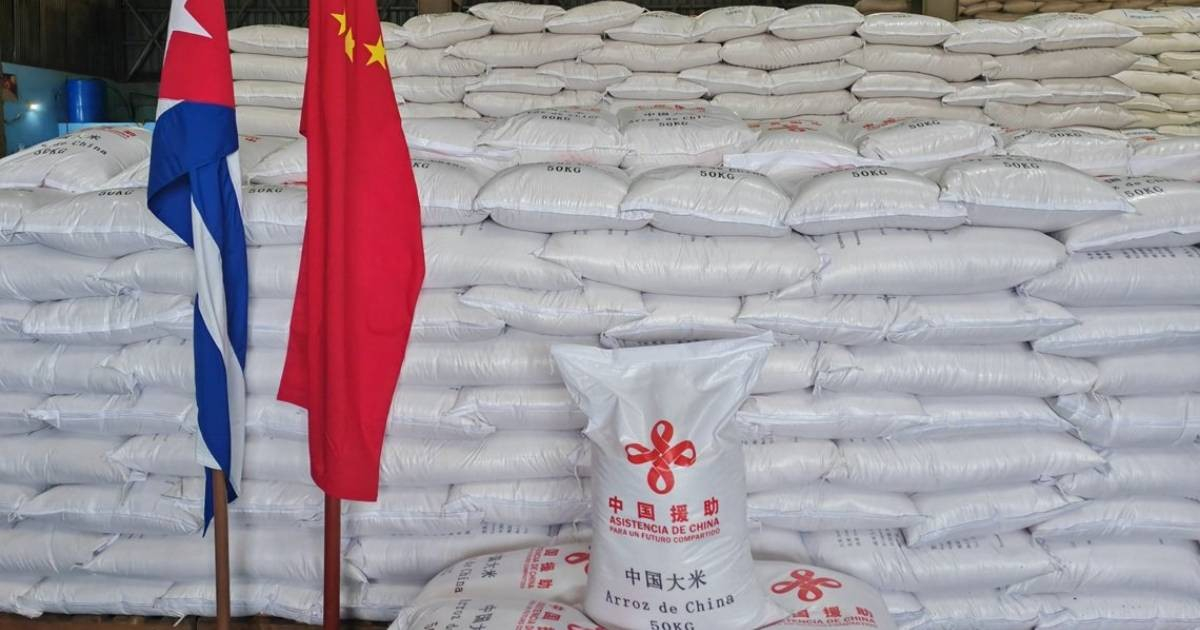
The Cuban Foreign Minister Bruno Rodríguez Parrilla thanked China this Saturday for the delivery of the third batch of 15,000 tons of rice, part of a total donation of 60,000 tons that Beijing committed to Havana amid an unprecedented food crisis on the Island.
In a message posted on his X account, Rodríguez Parrilla described the shipment as a demonstration of "the unwavering solidarity and brotherhood between both nations, evident in the most challenging times," and expressed gratitude to the Party, the Government, and the Chinese people.
The shipment, consisting of 50-kilogram bags labeled "Assistance from China," "Rice from China," and "For a Shared Future" in Chinese and Spanish, arrived on Friday at the Haiphong terminal of the Port of Havana during an event presided over by the Vice President of the Council of Ministers Óscar Pérez-Oliva Fraga.
The donation of 60,000 tons is divided into four equal batches. The first arrived in Cuba in the spring of this year, the second landed in Santiago de Cuba at the end of June, and the fourth and final one is scheduled for September, according to the Ministry of Foreign Trade and Foreign Investment.
This package was authorized by Chinese President Xi Jinping in January 2026, along with financial aid of 80 million dollars confirmed by the Chinese ambassador in Havana, Hua Xin. In addition to a previous shipment of 30,000 tons, the total amount of Chinese rice committed to Cuba in 2026 amounts to 90,000 tons.
The magnitude of the aid reflects the depth of the food crisis facing Cuba. According to the Food Monitor Program, 96.91% of the population lacks adequate access to food, and 33.9% of households have at least one member who went to bed hungry in the past month.
Rice, a cornerstone of the Cuban diet, is sold in the informal market for between 250 and over 400 pesos per pound, compared to an average state salary of about 7,000 pesos per month. In July, the Council of Ministers removed the price cap on the grain with Decree 156, further worsening access for families with lower incomes.
The relationship between Havana and Beijing has intensified throughout 2026. Rodríguez Parrilla traveled to China in February as a special envoy of the regime, and in May, both foreign ministries agreed to formally elevate bilateral ties. On that occasion, Chinese Foreign Minister Wang Yi stated that "China will continue to provide support and assistance to Cuba within its capabilities."
Cuba has also turned to donations from South Korea, Vietnam, Mexico, and the Government of the Canary Islands to sustain the basic food basket, highlighting a structural food dependency that the authorities on the Island have been unable to reverse after decades of centralized economic management.
Related videos:
Filed under: