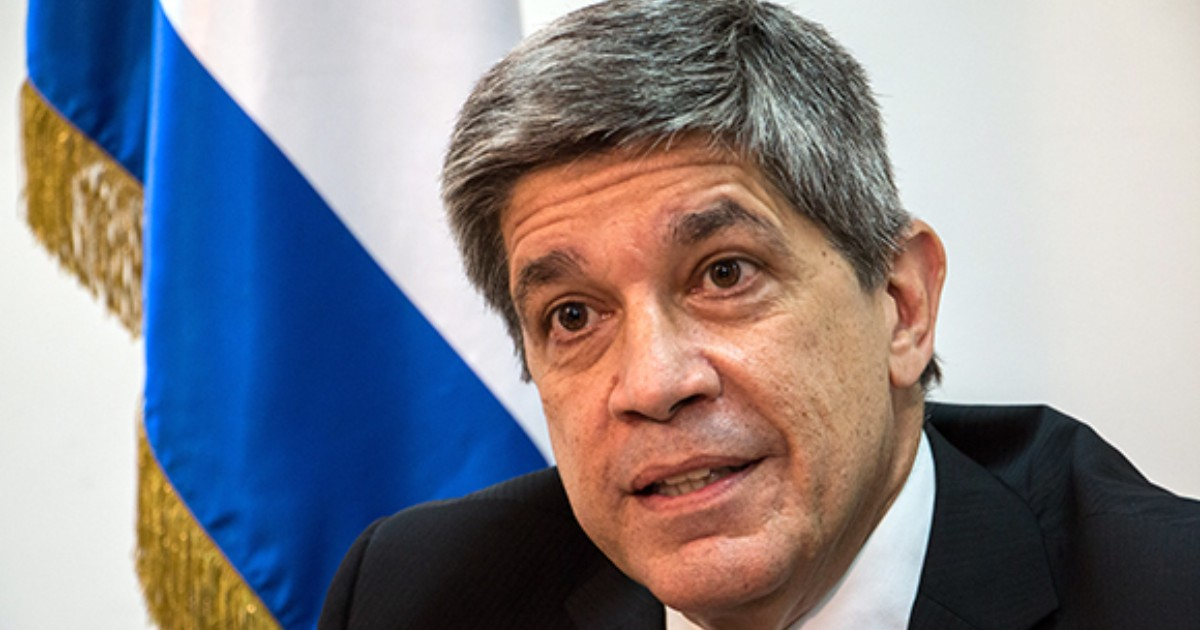
The Deputy Minister of Foreign Affairs of Cuba Carlos Fernández de Cossío accused the United States on Thursday of having tolerated for years networks dedicated to the irregular trafficking of Cuban migrants and stated that Washington's failure to act could be due to "negligence, complicity, political design, or a combination of those factors".
Fernández de Cossío assured that Cuban delegations repeatedly alerted U.S. authorities between 2022 and 2024 about human trafficking operations whose organization, management, and funding were based in South Florida.
The diplomat stated that Cuba and the United States maintain a series of bilateral migration agreements signed since 1984, the implementation of which requires cooperation between both governments.
Washington officially recognizes that the migration agreements between the United States and Cuba include understandings reached in 1984, 1994, 1995, and 2017, and that the bilateral talks serve to periodically review their implementation.
According to Fernández de Cossío, between 2022 and 2024, at the height of the Cuban exodus to the United States, six bilateral migration meetings were held: three in Washington and three in Havana.
The deputy minister stated that in several of those meetings, including one held in Havana in December 2024, the Cuban delegation warned about the "large volume of Cubans traveling irregularly to the U.S. through countries in the region."
According to the statement, the cost per person for those operations could range between 7,000 and 15,000 dollars.
Cossío also used as a reference the annual entry of over 100,000 Cubans through the southern border of the United States to gauge the scale of the operation. He stated that with those figures, "it was not difficult to estimate" how much money the trafficking networks could generate.
The official stated that the warnings were not limited to formal migration meetings, but were reiterated during other "technical and operational" exchanges between representatives of both countries.
According to their version, the networks had their epicenter in south Florida, from where the trips were organized and financed, and to where the profits ended up being directed.
Additionally, he described a business capable of providing migrants with various services during their journey, including transportation, accommodation, communications, financial support, and legal assistance.
The deputy minister went beyond denouncing the existence of those organizations and directly questioned the actions of the U.S. government.
It is absurd to assume that the US government was unaware of the phenomenon, he stated, before pointing out that Cuba had made warnings "officially and repeatedly."
"If U.S. authorities did not act and allowed the large and uncontrolled influx of Cubans through their southern border for several consecutive years, and tolerated the establishment of smuggling networks, it was due to negligence, complicity, political design, or a combination of these factors," he accused.
Despite his claim about a possible "complicity" or a supposed "political design," Fernández de Cossío did not provide evidence to demonstrate that Washington deliberately protected those networks, nor did he present documents that confirm a decision by the U.S. government to allow their operation.
However, his accusations emerge amid the controversy sparked by revelations about the connections of Raúl Guillermo Rodríguez Castro, known as "El Cangrejo" and grandson of Raúl Castro, with a transnational criminal network investigated by U.S. authorities.
Furthermore, following those revelations, Chancellor Bruno Rodríguez denied any involvement of the Cuban Government in human trafficking operations and described the allegations as a "malicious fabrication."
Rodríguez then used an argument very similar to the one now put forward by Fernández de Cossío: he asserted that between 2022 and 2024, the Cuban delegation had repeatedly warned Washington about one or more operations involving the trafficking of Cubans to the United States, with a coordinating center located in southern Florida.
Related videos:
Filed under: