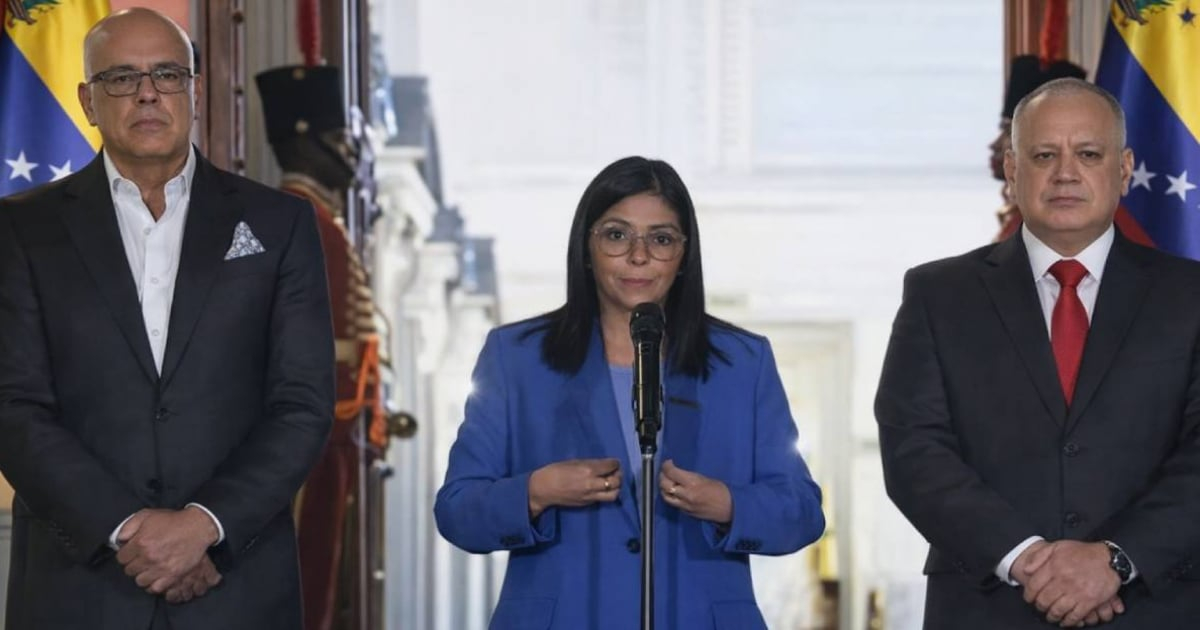
The Chavista regime announced on Friday the release of 131 political prisoners in Venezuela, a decision that comes immediately after the conclusion of the first formal round of dialogue between the government and the opposition, held at the La Carlota airbase in Caracas.
The announcement was formalized through a statement from the Program for Peace and Democratic Coexistence, created by the acting president Delcy Rodríguez.
The official text states that the courts of the Republic agreed to "alternative measures to deprivation of liberty" at the request of the Public Ministry, after reviewing cases of individuals prosecuted or convicted for crimes related to "attacks on democratic institutions."
The U.S. Secretary of State, Marco Rubio, celebrated the measure and described it as "a crucial step for the nation's reconciliation process."
On his account on the social network X, Rubio specified that since January 3, 1,046 Venezuelans have been released and emphasized that Washington continues to closely monitor the in-person dialogue process between the Venezuelan government and the interim authorities, within the framework of the three-phase plan promoted by the Trump administration.
However, the official figures have not been fully verified. The NGO Foro Penal, which independently monitors the releases, confirmed by the end of Friday only 64 of the 131 announced releases, warning that the verification was still ongoing. As of August 10, the organization recorded 391 active political prisoners in Venezuela.
Among those released is Christian Quintero, freed from the El Rodeo I prison, who publicly thanked the opposition leader María Corina Machado.
"I am grateful to the Nobel Peace Prize laureate, María Corina Machado, for always supporting us. Daily, we heard her asking for and demanding our immediate freedom," declared Quintero, as cited by the Venezuelan channel VPItv.
Machado, who was excluded from the formal negotiations for not being part of the National Assembly elected in 2015, responded with a message directed at the recently released individual in which she attributed the releases to the pressure from Donald Trump and the U.S. government.
"Your freedom and that of the recently released citizens has been made possible thanks to [...] President Donald Trump and the government of the United States, which by bringing Maduro to justice opened the way for the release of all political prisoners," wrote Machado on X.
The releases occur at a politically sensitive moment. The first round of dialogue between the chavismo—represented by Jorge Rodríguez—and the opposition delegation led by Dinorah Figuera was installed on August 6 and convened until August 12, with the releases being interpreted as a political gesture in this context.
Critical voices, however, questioned the extent of the measure. Analyst Pedro Mario Burelli directly asked, "Why not more? Why not everyone?" pointing out that the U.S. has not applied enough pressure to secure the release of all those detained. Activist Bárbara A. De Jesús also noted that more than 200 people remain behind bars.
Machado promised not to relent until complete liberation is achieved: "We will not rest until EVERYONE is reunited with their families and our country is fully FREE."
Related videos:
Filed under: