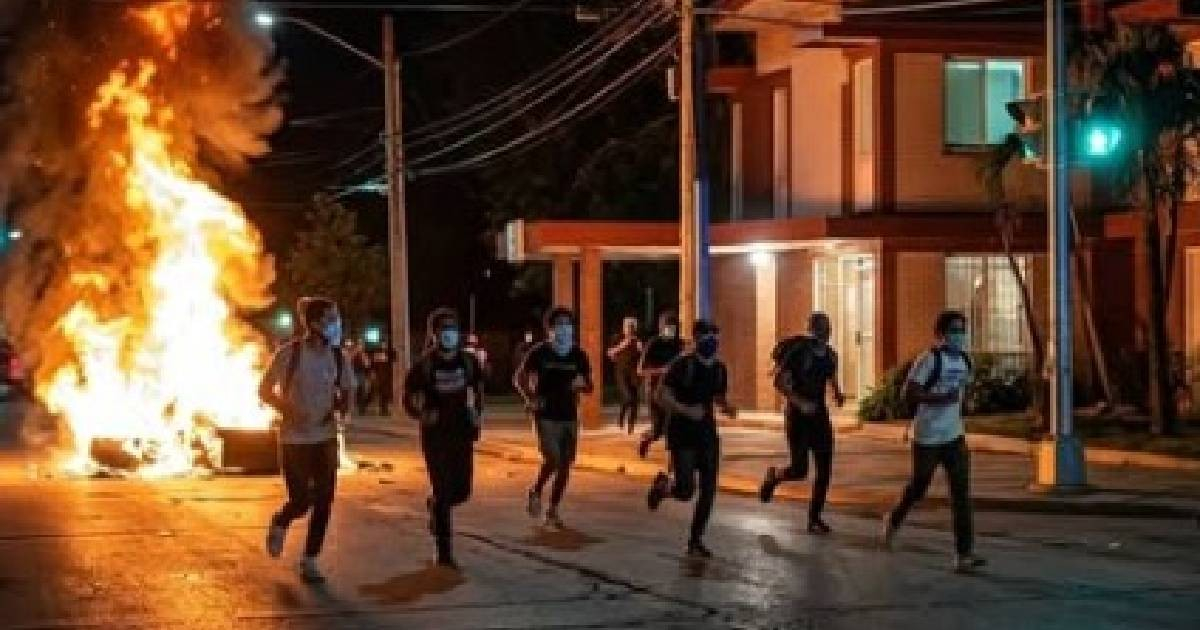
The Cuban historian and academic Ivette García González published an analysis on Facebook this week, in which she counters the pessimistic view regarding the resilience of the Cuban people and maintains that protests on the island have not ceased since July 2021.
The text, titled "Social Protests: Another Shadow with Lights," is a continuation of a previous reflection from August 8, in which García González rhetorically asked whether those protesting in Cuba are "Swiss in Switzerland or Cubans in Cuba," to emphasize that these are ordinary citizens acting under conditions of repression and survival.
"There is a tendency to present only the negative aspects of the diagnosis: the Cuban as a victim, obedient or incapable of doing anything for a future for their family and the country,” writes the academic, a doctor in Historical Sciences and former professor at the University of Havana.
García González acknowledges five limitations pointed out by his interlocutors: that a minority protests and the next day normalcy returns; that the demands are mainly for water, electricity, and shortages, not for rights and freedoms; that there are no organized mobilizations; that they are spontaneous rallies without coordination or leadership; and that any potential outbreak without organization would lead to chaos.
On that last point, he warns: "Tomorrow, due to emotions and the crisis, Cubans could experience a social explosion greater than 11J. The conditions are in place, but without being organized and without various leaders, it would be chaos and anarchy, with each person going their own way without knowing what to do and what is wanted."
However, he frames those limitations as part of a natural escalation process: "The evolution of protests in Cuba over the past few years is common in all struggles. It starts with water (which is also legitimate) and continues with freedom."
Regarding the argument that the protest fades away the next day, he responds: "It is logical that there is a return to normalcy the day after the protest, especially at this stage. The insight here is that this 'normalcy' is actually abnormal (survival), and yet people still protest."
The academic places the responsibility of turning that discontent into a political strategy directly on the Cuban opposition, and she is explicit about repeating the events of July 11, 2021: «We should not aspire to another 11J as it happened in 2021. That one fulfilled its purpose and was heroic; it showed everyone the popular cry for freedom. […] The opposition is once again the key».
The analysis comes at a time of sustained escalation. According to the Cuban Observatory of Conflicts (OCC), July 2026 closed with a historic record of 1,415 protests, complaints, and critical expressions, including 72 in-person protests, the highest monthly figure since the organization began tracking. In June, Cubalex recorded 319 repressive events and 253 demonstrations.
This record occurs in the context of a deep crisis: the Cuban economy has experienced a contraction exceeding 15% since 2020, with a projected decline of 7.2% for 2026. Prisoners Defenders documented 1,306 political prisoners as of July 9, a historic record that includes 40 minors. And according to the National Bureau of Statistics and Information, 245,264 Cubans emigrated in 2025 alone.
García González had already addressed the political situation in previous analyses: on July 26, heargued that there is a profound contradiction between the Cuban government and the Revolution it claims to represent, and in May he proposed aNational Civic Movement based on non-violent struggle with demands for amnesty for political prisoners and free access to the internet.
“Social protests in Cuba will still have some shadows, but their lights are also there for those who want to see them,” concludes García González.
Related videos:
Filed under: