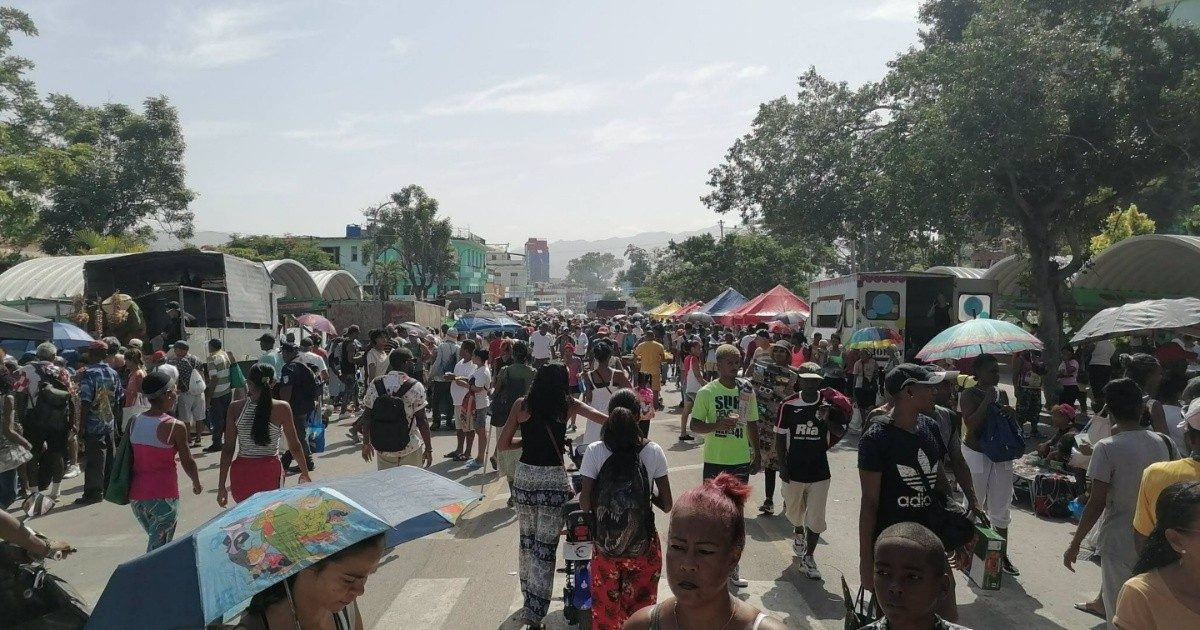
The state television TV Santiago published a promotional note on Facebook about an Agricultural and Commercial Fair held on Victoriano Garzón Avenue in Santiago de Cuba, stating that "the community enjoys various gastronomic, commercial, recreational, and cultural offerings, with options designed for all ages."
The event was officially framed within the summer program "Summer With My People" and the commemorative activities for the Centenary of Fidel Castro's Birth.
But the official version immediately clashed with the reality experienced by those who attended: citizens' comments on the same publication dismantle the triumphalist narrative point by point.
The citizen identified as Leosdel Massó reported that he walked through the fair from nine in the morning without finding a single stall that accepted payment by bank transfer: "Well, where were the inspectors to oversee the transfer issue? I was personally walking around since nine in the morning and none accepted it for reasons..."
Kenia Santray was more direct in questioning the language of the state media: "What enjoyment are they referring to... when payments couldn't be made by transfer as usual... don't make publications stating that the people are happy when that is not the reality."
Santray also called out the officials responsible for ensuring compliance with regulations: "Do your job well and criticize all those who do not safeguard the rights of consumers... It makes me laugh and feel pity for us ordinary people who are the ones suffering from the incompetence of those appointed to ensure the well-being of the sacrificed people, who do nothing but RESIST WITH CREATIVITY."
Another commentator, identified as Cigarros Cigarros, summarized the three issues in a single sentence: "In the end, high prices don't get transferred, and the inspectors are filling their pockets. Publish that too."
Matos Matos was even more emphatic, describing the publication as "disrespecting human intelligence" and criticizing the large gatherings associated with alcoholic beverages and social misconduct: "It's a shame that image matters more than respect."
The refusal to accept bank transfers at fairs and markets is a chronic problem throughout Cuba: the official press acknowledged in July 2026 that only 3.77% of transactions in the country are digital, and in provinces like Sancti Spíritus, less than 10% of private businesses regularly accept electronic payments.
The regime has attempted to enforce compliance through fines of up to 16,000 pesos and closures of establishments. In Bayamo, five businesses were closed for refusing transfers just days ago, but the measure has not succeeded in changing the widespread practice.
Payment issues are compounded by prices. At a fair held in Camagüey on August 14, meat was offered at 600 pesos per pound, a figure that official media described as "affordable" despite representing nearly 20% of the monthly minimum wage. In Las Tunas, a fair in July showcased eggs at 2,600 pesos per dozen, and in June, a basic grocery purchase exceeded 21,000 pesos at a community fair, more than three times the average monthly salary.
The removal of price caps on various basic goods through Resolution 150/2026, approved last June, further increased the pressure on people's finances.
This is not the first time that the regime has used fair events on Avenida Garzón as a showcase. In March 2026, the authorities announced a mega food sale in Santiago specifically to "calm the discontent," a formula that is repeated without addressing the underlying issues.
"The only thing we do is RESIST WITH CREATIVITY," wrote Kenia Santray, summarizing in uppercase what official propaganda prefers to ignore.
Related videos:
Filed under: