Something seems to be moving in Spanish politics regarding Cuba. In just a few days, two messages from different segments of the right have pointed in the same direction: Spain should abandon its current policy towards Havana and play a more active role in favor of democratic change on the island.
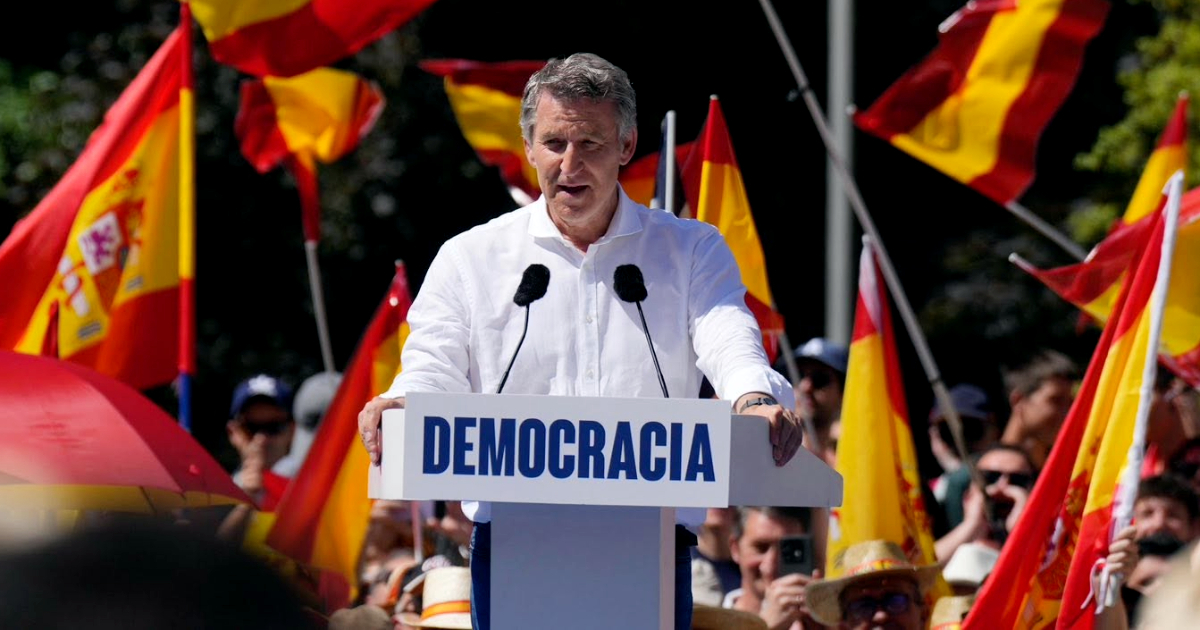
The first came from Alberto Núñez Feijóo. The leader of the Popular Party (PP) stated that if he becomes president of the Government, Spain will work alongside the United States to ensure that "prosperity and freedom reach Cuba".
It was not an isolated statement about international politics. Feijóo accused the government of Pedro Sánchez of maintaining, over the past few years, a foreign policy that supports the dictatorships of Venezuela and advocated for a different relationship with Cuba, a country with which, he recalled, Spain has special historical ties.
Almost simultaneously, Foro Madrid presented a much more detailed set of proposals to change Spain and the European Union's policy towards the Cuban regime.
The international platform, driven by the Disenso Foundation —linked to VOX and chaired by Santiago Abascal— demands that relations with Havana be conditioned on progress toward a democratic transition, a review of European cooperation, withdraw public support for businesses related to the military conglomerate GAESA, and increased monitoring of potential financial movements by members of the Cuban leadership.
They are positions coming from different political actors and do not constitute a joint government program. However, their agreement allows us to pose a question that could gain increasing relevance ahead of the upcoming general elections, scheduled for 2027 if there is no early election: What would happen to Spanish policy towards Cuba if the right comes to power in La Moncloa?
From dialogue to political pressure
During Pedro Sánchez's administrations, Spain has maintained a dialogue policy with Havana, economic cooperation, and support for European engagement with the Cuban authorities.
In October 2025, the Spanish Government approved a new restructuring of Cuban debt amounting to 193.4 million euros and revived a debt conversion program for up to 375 million. Spain also maintains significant trade and business relations with the island.
The PP is sending signals that this policy could change.
In addition to the latest statements from Núñez Feijóo, since 2020 the Popular Party has called for Spain to urge the European Union to suspend the Political Dialogue and Cooperation Agreement with Cuba (ADPC), the main framework for relations between Brussels and Havana.
The evolution is particularly significant in the case of Feijóo himself.
During his tenure as president of the Xunta de Galicia, he maintained a pragmatic relationship with the Cuban authorities. In 2016, he visited Havana, met with Chancellor Bruno Rodríguez Parrilla, and emphasized the historical ties between Galicia and Cuba.
The current discourse is considerably different: it speaks of freedom for Cuba, challenges Sánchez's policy, and explicitly suggests working alongside the United States.
VOX aims to go much further
The proposals gathered by Foro Madrid allow us to see how far this policy could still shift within the political space related to VOX.
In its report Cuba: a criminal regime sustained from abroad, Foro Madrid argues that Spain and the EU must stop providing resources that could contribute to the survival of the regime.
Among its proposals is to prevent cooperation funds from being controlled by Cuban state institutions, to avoid public support for investments linked to GAESA, to increase pressure for the release of political prisoners, and to condition relations with Havana on progress toward a democratic transition.
It also suggests that Spain use its tools against money laundering when appropriate and strengthen the coordination among police, judges, prosecutors, and intelligence services in the face of potential financial or criminal networks linked to members of the regime.
The organization also proposes to prepare Spain to play a significant economic and political role in a potential democratic Cuba.
Foro Madrid is not VOX, nor can its proposals be automatically transferred to a future government program. However, the platform was promoted by the Disenso Foundation, linked to Santiago Abascal's party, which makes its approaches a significant reference for observing the debate on Cuba within that political space.
The scenario of a PP-VOX government
The upcoming general elections in 2027 —unless they are moved forward— will determine whether this shift in discourse remains with the opposition or can be transferred to Spanish foreign policy.
An eventual government led by the PP, whether alone or through an agreement with VOX, would open a potentially very different scenario for relations between Madrid and Havana.
There is currently no common PP-VOX program regarding Cuba that would allow us to anticipate all the decisions that such a hypothetical administration would make. Additionally, not all the proposals from Foro Madrid would necessarily be adopted by a government in which Abascal's party participated.
However, there are already important points of convergence: a more critical stance toward the Cuban regime, greater emphasis on political prisoners and democratic transition, questioning the current European policy toward Havana, and a greater willingness to coordinate with the United States.
The actual scope of the change would also depend on the balance of power within a potential government. A solo Executive from the PP could adopt a different policy than what would result from a coalition or parliamentary agreement with VOX.
Washington comes into the equation
Probably one of the most significant indications in Feijóo's statements is his explicit reference to the United States.
The president of the PP did not only talk about changing Spanish politics. He said that Spain should act "together with the U.S." to achieve freedom and prosperity for Cuba.
Feijóo already spoke in February with U.S. Secretary of State, Marco Rubio, and at that time assured that Spain would once again be a "reliable partner" for its allies.
To this scenario is added an element with special symbolism for Cuba: the current ambassador of the United States in Spain, Benjamín León Jr., is Cuban-American, having emigrated from the island in 1961, and was chosen by Donald Trump to represent Washington in Madrid.
León was confirmed by the U.S. Senate in December 2025, sworn in February before Secretary of State Marco Rubio and, in his first message from Spain, highlighted Trump's foreign policy and his intention to reinforce cooperation between the two countries.
His activities since assuming the position have also directly impacted the Cuban file. Before settling in Madrid, he met in Miami with Mike Hammer, head of the U.S. diplomatic mission in Cuba, and in May he welcomed the Cuban opposition leader José Daniel Ferrer, along with Javier Larrondo, president of Prisoners Defenders, and Guillermo Ponce, president of the Association of Cuban Doctors in Spain, in a meeting that the U.S. Embassy linked to the situation of freedom in Cuba.
The presence of León in Madrid thus adds another piece to the new scenario: if Spain were to experience a political shift after the upcoming elections, Washington already has a Cuban-American ambassador in the Spanish capital who has publicly incorporated the Cuban issue into his diplomatic agenda.
A possible arrival of the PP to power could, therefore, bring Spain's position toward Cuba closer to Washington's strategy, although the intensity of that coordination would depend on the specific decisions made by the new government.
For Havana, this change would hold special significance. Spain is not only one of its key European partners: it has deep economic, business, diplomatic, and human ties with Cuba and has traditionally exerted considerable influence in shaping European policy towards the island.
The battle could shift to Brussels
The potential Spanish shift would have consequences that extend beyond bilateral relations.
Spain alone cannot suspend the Political Dialogue and Cooperation Agreement between Cuba and the EU, nor can it dictate the entire community policy towards Havana. However, a Spanish government willing to toughen that relationship could leverage its diplomatic weight to seek support from other member states.
The PP has already requested to use precisely that European stage to increase pressure on the Cuban authorities.
A change in position in Madrid could open discussions about the future of the ADPC, the conditions of European cooperation, the relationship with Cuban state institutions, and Brussels' response to human rights violations.
That would turn a political change in Spain into a potentially much greater problem for Havana.
Cooperation, debt, and GAESA
The consequences could also be felt in the economic sphere.
Spain has restructured and forgiven significant amounts of Cuban debt for decades, maintains cooperation programs, and has hundreds of companies with interests on the island.
A government that adopted some of the proposals currently defended by the right could reevaluate future debt restructurings, public guarantees for certain business operations, and projects involving entities associated with GAESA.
It could also modify the cooperation mechanisms to try to ensure that a larger portion of the resources reaches independent organizations or the population directly, without going through state structures.
This would not necessarily mean the end of Spanish cooperation with Cuba. The change could be in who receives the resources, under what conditions, and to what extent the Cuban state is involved.
A change that is still hypothetical, but with visible signs
Much is still to be determined. The upcoming elections have not yet taken place, and a PP-VOX government is just one of the possible scenarios, with no common policy towards Cuba negotiated between the two parties as of now.
But the political signals are starting to accumulate.
Feijóo promises to work with the United States to bring "prosperity and freedom" to Cuba. The PP calls for a review of the framework of relations between the EU and Havana. And Foro Madrid, from the political space associated with VOX, proposes an even deeper strategy of economic, diplomatic, and financial pressure on the regime.
Separately, each element has its own dimension. When observed together, they indicate a shift in the Spanish right's axis in relation to Cuba and anticipate a discussion that could gain particular significance if a political alternation occurs in Spain.
For the Cuban regime, what happens in the upcoming Spanish elections could have consequences that extend far beyond a mere change of interlocutor in La Moncloa.
In play are cooperation, financial and business relations, Spain's position within the European Union, and, above all, the possibility that Madrid may shift from prioritizing dialogue with Havana to coordinating a policy of greater pressure alongside Washington.
Related videos:
Filed under: